Only his hands are small 🙂 BIG on talent, humor and general awesomeness! Thank you Joan Hogol for the smiles!
Originally shared by Joan Hogol
Well… you can play piano this way too… 🙂
Only his hands are small 🙂 BIG on talent, humor and general awesomeness! Thank you Joan Hogol for the smiles!
Originally shared by Joan Hogol
Well… you can play piano this way too… 🙂
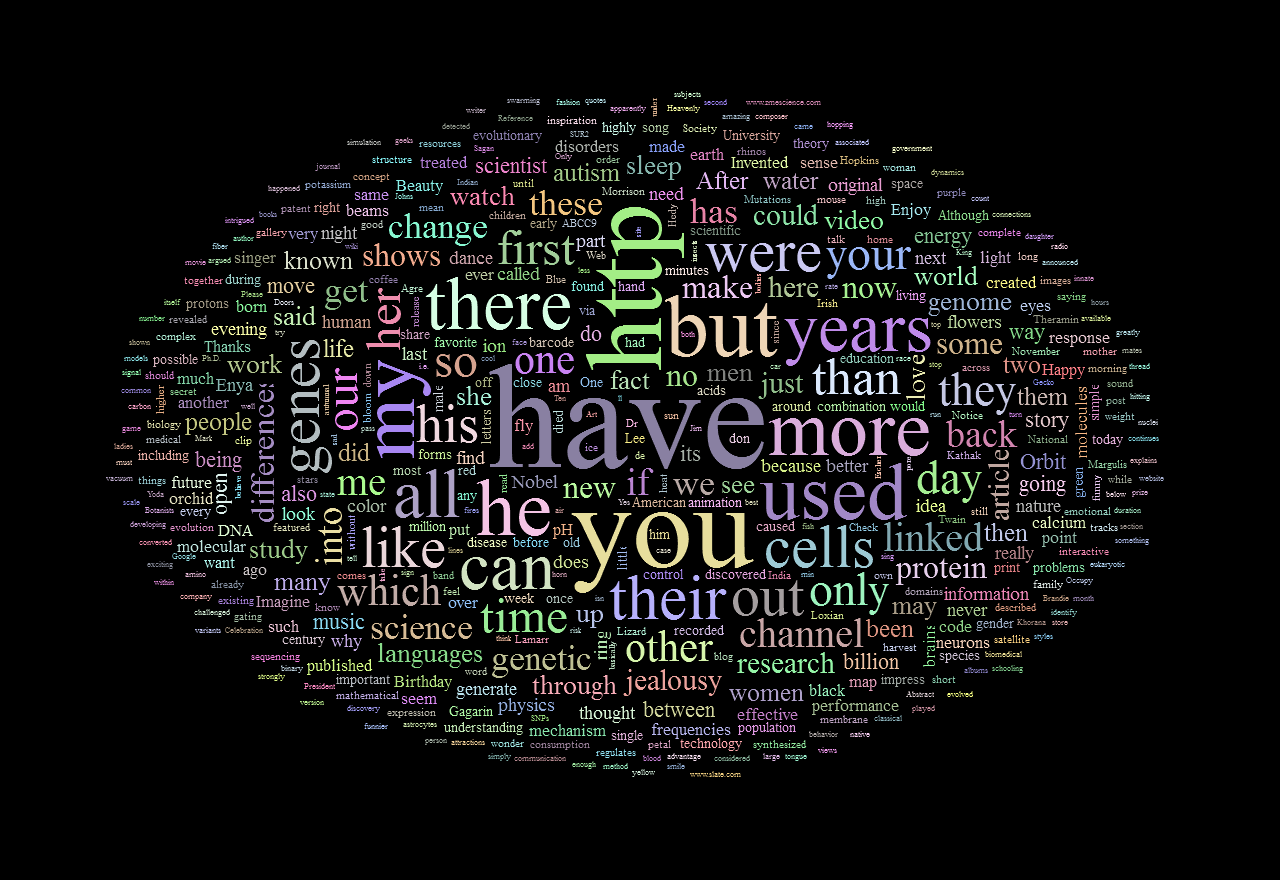
Word Cloud! Want to know what I yammer about on G+ before circling me? Here’s a sampling from my public posts: cells, genes, science, protein, channel, research, autism, neurons, calcium , oh yes…also, music although I have to work on getting Morrison and Mercury to greater prominence. So more Doors and Queen coming up 🙂
Thanks to Craig Smith for sharing this fun tool. See your Word Cloud from Facebook, Twitter or Google+ profiles at: http://timc.idv.tw/wordcloud/en/#

Newton’s First Law is best illustrated by cats.
Originally shared by DaFreak
It’s that day of the week again… #Caturday :p
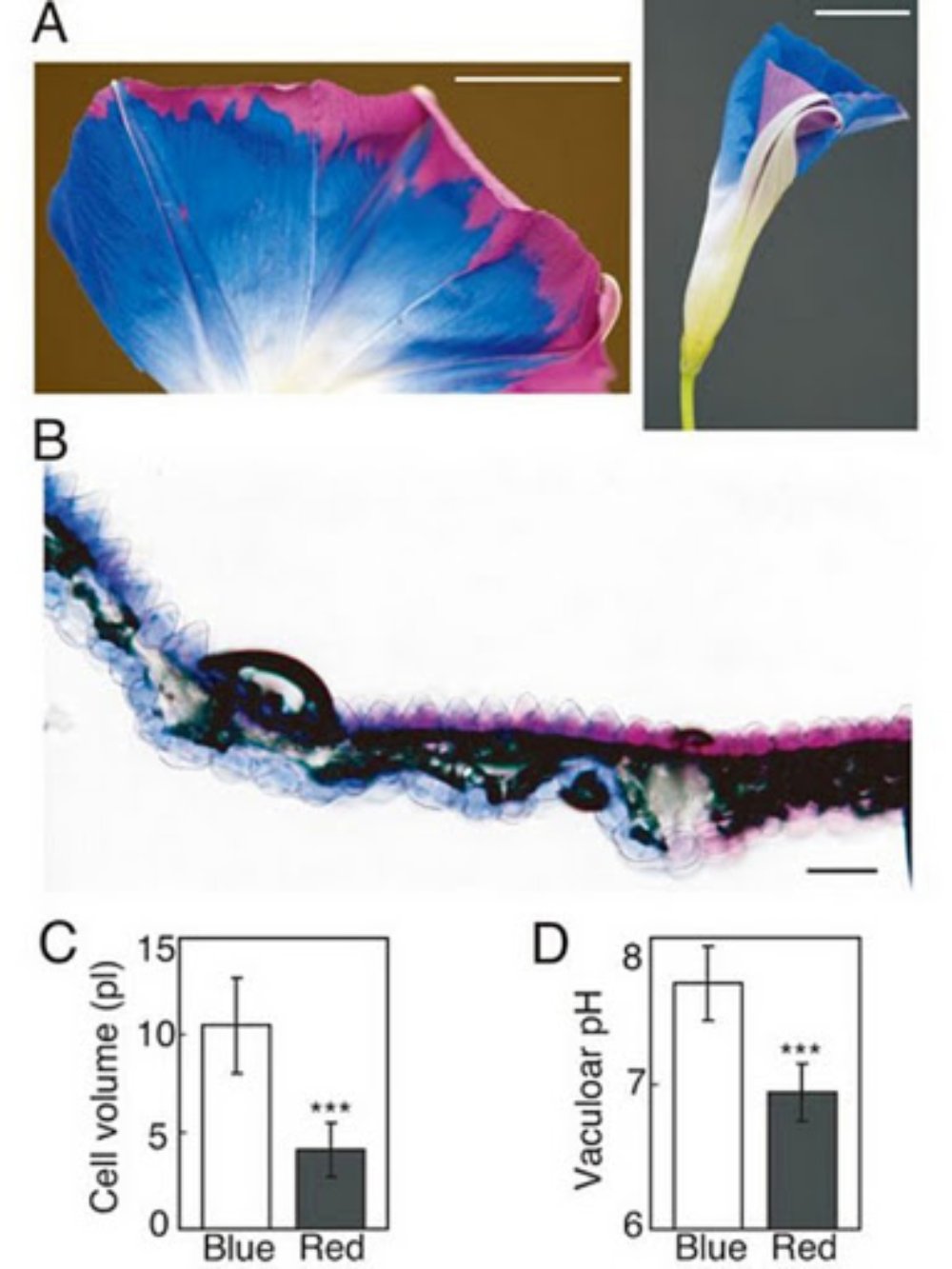
Heavenly Blue Ever wonder how flowers get their colors? Anthocyanin pigments, stored in the vacuoles of petal cells change color with pH (acidity). The Japanese Morning Glory, Ipomoea tricolor var. Heavenly Blue, changes color from purple to blue in the early hours of the morning (Figure A).
A section of the petal (B) shows the transition in color. Notice the change in cell volume (C) and pH (D) accompanying the color change. This is a caused by the induction of a gene, NHX1 that exchanges sodium or potassium ions for protons and regulates lumen pH. This gene was discovered serendipitously in my lab back in the ’90’s.
In humans, these same genes regulate pH inside synaptic vesicles and appear to be important for packaging neurotransmitters for release, and clearing them from the synaptic cleft. Mutations are linked to autism, addiction, ADHD and XLMR.
From flowers to neurons. Isn’t science wonderful?
Ref: http://www.jstage.jst.go.jp/article/pjab/85/6/85_187/_article
Occupy The Cell! 99% of the molecules in our cells are water, about 70% by weight .
“Water is life’s mater and matrix, mother and medium. There is no life without water”, so said Hungarian biochemist and Nobel laureate Albert Szent-Gyorgyi (1893-1986)
Water enters and exits the cell through water channels known as Aquaporins, embedded in the hydrophobic lipid membrane.
Aquaporins move water at the rate of 1/ns or 1 billion water molecules per second!
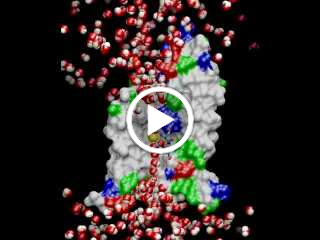
The animation shows water molecules squeezing through a narrow pore in a single file. One of them is labeled in yellow so you can watch its progress through the 10 ns simulation. Notice that the oxygen atoms (red) face the channel center, flipping in orientation in the middle of the pore. This is thought to break the chain of hydrogen bonds and prevent protons from tunneling through, which would destroy proton gradients and mess up cellular pH. (See Grotthuss mechanism: http://en.wikipedia.org/wiki/Grotthuss_mechanism)
Discovered by Hopkins scientist Peter Agre by accident (he was searching for the Rh antigen on blood cells); my colleague Bill Guggino tells the story of putting the unknown protein into frog eggs ( Xenopus oocytes, used because of their large size) to measure their function..but water rushing into the eggs made them explode, spattering yolk all over the microscope lens! Agre was awarded the Chemistry Nobel in 2003.
This molecular dynamics simulation is by Emad Tajkhorshid (http://csbmb.beckman.illinois.edu/) and is featured on the Nobel web site.

Happy Birthday, Jim Morrison The Door’s singer, aka The Lizard King , was born on this day, 1943, although as he said, “Actually I don’t remember being born, it must have happened during one of my black outs.”
A special birthday shout out to Marian Wirth who was born on Morrison’s last birthday (I guess this makes him an incarnate?). Happy Birthday, Marian!
Here are my favorite lines from Celebration of the Lizard King :
Once I had, a little game
I liked to crawl, back in my brain
I think you know, the game I mean
I mean the game, called ‘go insane’
You should try, this little game
Just close your eyes, forget your name
Forget the world, forget the people
And we’ll erect, a different steeple
This little game, is fun to do
Just close your eyes, no way to lose
And I’m right there, I’m going too
Release control, we’re breaking thru
Way back deep into the brain
Back where there’s never any pain…
I can’t find the complete 17 min epic version on YouTube (also you need to get back to work!) but here is part 1: The Doors: Celebration of the Lizard Part 1
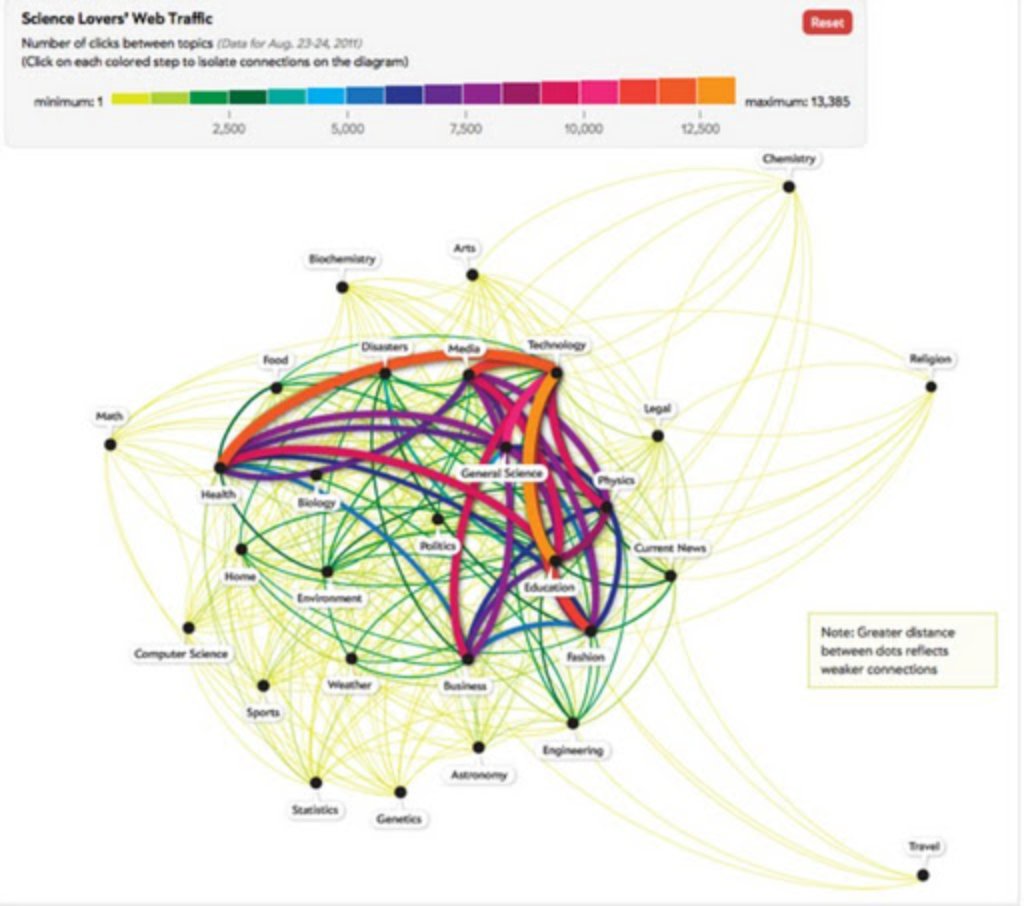
Science Lovers Web Traffic People who are intrigued with physics are somewhat intrigued with computer science, too, but they are crazy about fashion. Who knew?
Hilary Mason did. At Scientific American’s request, the chief scientist at bitly (www.bitly.com), which shortens URLs for Web users, examined 600 science Web page addresses sent to the company’s servers on August 23 and 24. Then she tracked 6,000 pages people visited next and mapped the connections (below). The results revealed which subjects were strongly and weakly associated. Chemistry was linked to almost no other science. Biology was linked to almost all of them. Health was tied more to business than to food. But why did fashion connect strongly to physics? And why was astronomy linked to genetics? Check out the interactive graphic at www.ScientificAmerican.com .
From: http://www.scientificamerican.com/article.cfm?id=the-links-we-love
Thanks to Klaus Seiersen for the link!
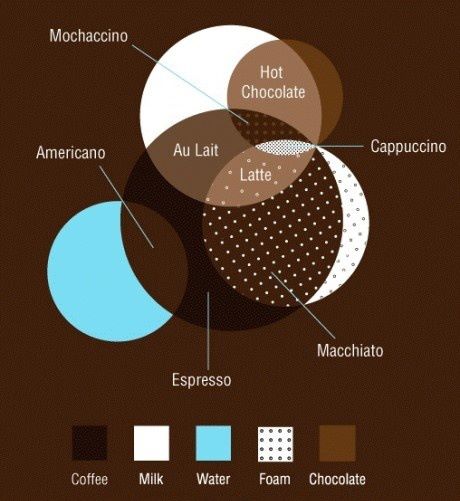
How do you like yours? 🙂
Originally shared by ****
A Simple Venn-Diagram To Understand Coffee ..
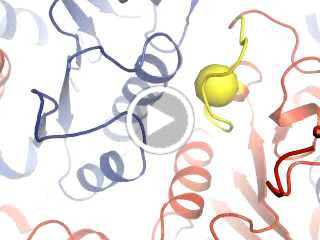
Like the petals of a flower. Ion channels open and shut on a millisecond time scale and send thousands of charged ions flowing in or out of the cell to trigger or modulate nerve cell electrical activity, muscle contraction or tuning of “hair cells” in our inner ear.
Ion channels made by microbes as part of their competitive arsenal can be stunningly simple and highly effective: valinomycin, secreted by Streptomyces , is a circular ring of only 12 amino acids. (see: http://en.wikipedia.org/wiki/Valinomycin).
But ion channels in our cells are enormously large and complex because they need to be regulated in sophisticated ways, in response to small molecules, voltage or pH. One such type of potassium channel opens when calcium binds and closes when calcium comes off. To understand how this works, researchers from Rod McKinnon’s group crystallized and solved for the structure of these membrane proteins in multiple forms and put the story together in this movie.
First, you will see a ring of 4 blue protein domains, sitting on top of 4 red protein domains, which form the circular gate that regulates the opening of the channel. Morphing between the calcium bound and unbound structures shows how the ring changes shape.
Next, we zoom in on the calcium (yellow sphere) site. Finally, we see the gating ring assembled with the ion channel itself (green helices) which forms the K+ conducting pore through the membrane. Watch how the gating ring opens “like the petals of a flower” to tweak the channel open or closed. Thus, the free energy from calcium binding is converted into mechanical energy of opening (gating) the ion channel. This is poetry in motion!
Reference: http://www.nature.com/nature/journal/vaop/ncurrent/full/nature10670.html
Ladies and Gentlemen, once again, The Doors! Some questions to ponder….
1) Hey, is that belt back in fashion?
2) Why does Robby Krieger have a black eye (1:40) ?
3) Who cares if Jim Morrison shakes that rattle?
For all classic rock fans, including Tom Lee, enjoy 🙂


 madame scientist's not-so-mad musings