Shame on me for thinking that the future of archaeology lay in ruins! 😉
Originally shared by Derya Unutmaz
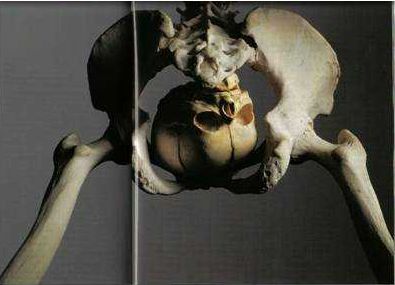
Latest Archaeological Discovery Believed To Be 10,000 Year Old Remains Of First Politician
An archaeological team, digging in Washington DC, has recently uncovered what is believed to be the fossil remains of the first politician to have ruled some 10,000 years ago.
Although at the time of this writing, the team is not 100% certain, based on the the few clues that have been uncovered thus far, combined with the physical positioning of the skeletal remains, all indications point to the fact that this assumption is valid.
Calvin and Hobbes: A Very (Un- Merry) Christmas! For all you fans of the beloved and classic cartoon strip, here is a beautifully crafted recreation of the dark (funny) side.
• Hobbes: Why is the snowman looking at a snowball?
Calvin: He’s contemplating snowman evolution. Obviously, if he evolved from a snowball, it raises tough theological questions for him.
Hobbes: Like the morality of throwing one’s precursors at someone?
Calvin: Sure, and what about shoveling one’s genetic material off the walk.
• Calvin: It snowed last night! Turn on the radio! Maybe they closed school. Maybe the school buses froze up! Maybe the principal can’t get out of his driveway!
Mum: Get dressed, Calvin. It only snowed an inch.
Calvin: Getting an inch of snow is like winning 10 cents in the lottery.
• Calvin: This sculpture is about transience. As this figure melts, it invites the viewer to contemplate the evanescence of life. This piece speaks to the horror of our own immortality.
(Kid off panel): Hey stupid! It’s too warm to build a snowman! What a dope! Ha ha ha!
Calvin: Genius is never understood in its own time.
Sweeter than a woman’s kiss 🙂 Glucose is the most important sugar in biology! The name comes from the Greek glukus (γλυκύς), meaning “sweet”. The suffix “-ose” denotes a sugar.
Biochemistry: Carbs are polymers of glucose, either exclusively (starch, glycogen) or in combination with other simple sugars like fructose and galactose (found in table sugar and milk sugar). These polymers are broken down during digestion before being absorbed in the intestine. Insulin is the signal for clearing glucose from blood into the liver, fat or muscle, where it is converted back into a polymer (glycogen).
Energetics: Glucose is completely broken down to carbon dioxide and water by cellular respiration: C6H12O6 +6O2 → 6CO2 and 6H2O. This process makes ATP, which is then used to power all energy requiring processes in the body. One gram of glucose yields about 3.75 kilocalories of energy.
When your muscles can’t get hold of oxygen fast enough, as in strenuous exercise, glucose is broken down only partially to lactate (“-ate” denotes acid). The old view of lactate as “bad” has been revised drastically. We now know that lactate can fuel neurons to establish memory and that muscles actively burn lactate in the mitochondria to make ATP.
History: Emil Fischer, a German chemist, received the 1902 Nobel Prize in Chemistry for describing the structure of glucose.
Cool Science: Professor Jin Zhang, a Chemical and Biochemical Engineering professor from the University of Western Ontario, has engineered nanoparticles into contact lenses that react with the glucose molecules contained in tears.When sugar levels rise or fall in a diabetic, a chemical reaction causes the lens to change color, allowing the wearer to adjust their glucose accordingly. (Minor problem: wearer has to check mirror frequently and risk being considered vain!)
Geeky Confessions: I play this song to my first year PhD and medical student class before I talk about glucose transporters. Not all of them get the connection to the old Archies song (sigh). It was the 1969 hit single of the year. Here it is, tambourine and all: http://youtu.be/VwMH0Xzs0IU
This song is for Martha E Fay, who ate birthday cake for breakfast today.
For #ScienceSunday curated by Allison Sekuler and Robby Bowles .
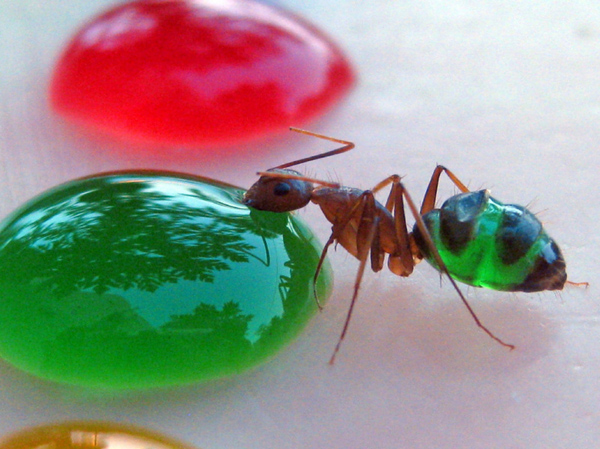
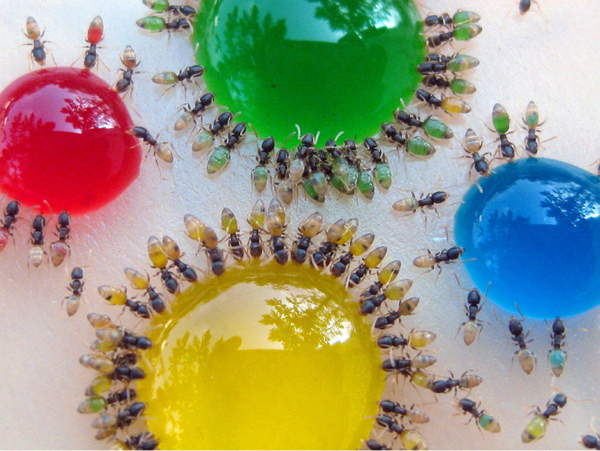
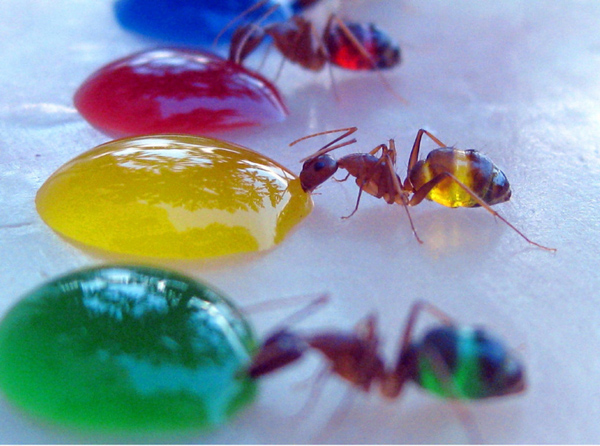
Apparently, ants have a clear coloured abdomen – something that photographer Mohamed Babu and his wife discovered one day when they noticed a “white ant” that was crawling along their counter. It turns out, the ant had just consumed a drop of milk that was left on the counter, turning his lower half white. The photographer set up a variety of coloured water pools and patiently waited until the ants consumed the liquid to show their coloured abdomens.
Seraphim and Sugar Plum Fairies, a match made in heaven!
* The Seraphim (Glass Harp, Glass Harmonica) is a musical instrument made of a series of goblets. Each is tuned to a specific pitch (frequency), either permanently by grinding the glass or by filling it with different levels of water. The musician runs a moist or chalk covered finger along the glass rim to get the desired tone.
* Benjamin Franklin invented a mechanical version in 1761. He mounted 37 goblets (differently colored according to pitch) horizontally on a spindle turned by a foot pedal.
* Pink Floyd used the glass harp in Shine On You Crazy Diamond on their album Wish You Were Here .
* In the 18th century, a strange rumor circulated that this music could drive the listener mad! Enjoy at your own peril 🙂
Eye of newt, and toe of frog: Organogenesis Imagine if complex structures like the eye could be regenerated to correct injury or birth defects.
Developmental biologists studying eye generation previously found a “cocktail of proteins” known as Eye Field Transcription Factors (EFTFs) that determine eye fate in the embryo by turning on precise patterns of gene expression. But is there an even more minimal set of instructions to induce an eye? Can an eye be formed anywhere on the body?
A new study finds that simple bioelectric signals, in the form of voltage gradients across the cell membrane, trigger eye development in the frog, Xenopus laevis . Early on, cells in the eye primordia become hyperpolarized, i.e., the charge difference, Vm, across the membrane is higher than that of neighboring cells. Locally depolarizing these cells blocked only eye development and disrupted the pattern of EFTFs without harming other organ development.
Next, researchers injected into the frog embryo various ion channels with predictable effects on the membrane voltage. Remember that ion channels move charged particles such as Na+ and K+ across the membrane to generate potential differences in the order of ~100 millivolts. Amazingly, they were able to induce eyes ectopically, all over the surface of the embryo. These artificially generated eyes had similar retinal cell arrangement as normal eyes.
Understanding eye development is the first step towards regenerative medicine. That would be good magic, better than the three witches of Macbeth could conjure:
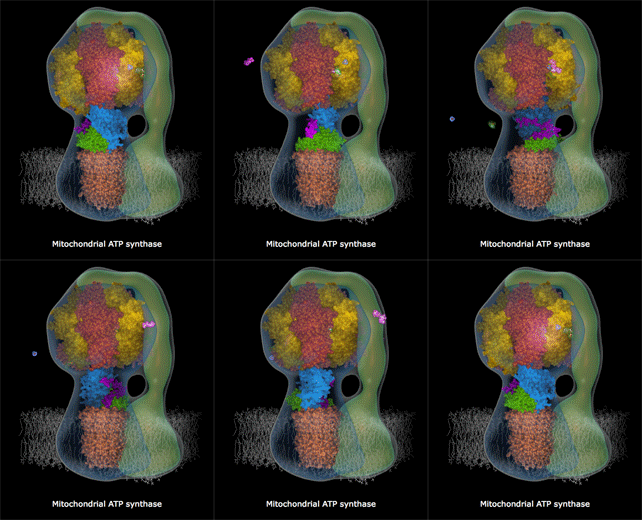
Smallest rotary motor in biology, the ATP synthase. All the work done in your body is fueled by breaking a chemical bond in ATP, the “currency of energy”. Did you know that you convert your body weight (or an estimated 50 kg) of ATP per day?!
Where does this ATP come from? It is synthesized by an incredibly sophisticated molecular machine, the ATP synthase, embedded in the inner membrane of our mitochondria. Energy from the oxidation of food results in protons being pumped across the membrane to create a proton gradient. The protons drive the rotation of a circular ring of proteins in the membrane that in turn move a central shaft. The shaft interacts sequentially with one of 3 catalytic sites within a hexamer, making ATP (little butterflies in the movie!). The ATP synthase rotates about 150 times/second
To visualize the rotation under a microscope, a very long fluorescent rod (actin filament) was chemically attached to the central shaft. Watch real movies (not animations!) of the enzyme spinning here: http://www.k2.phys.waseda.ac.jp/F1movies/F1long.htm
Notice the rotation is slower with longer rods. The rotor produces a torque of 40 pN nm (40 pico Newtons x nanometer), irrespective of the load. This would be the force you would need to rotate a 500 m long rod while standing at the bottom of a large swimming pool at the rate shown in the movie.
How did this amazing rotor evolve? The hexameric structure is related to DNA helicases that rotate along the DNA double helix, using ATP to unzip the two strands apart. The H+ motor has precedence in flagella motors that use proton gradients to drive rotation of long filaments, allowing bacteria to tumble through their surroundings. At some point, a H+ driven motor came together with a helicase like hexamer to create a rotor driving the hexamer in reverse, to synthesize ATP.
The 1997 Nobel prize in Chemistry was awarded to John Walker and Paul Boyer for solving the structure and cyclical mechanism of the ATP synthase, respectively. This amazing enzyme was also the subject of my own Ph.D. thesis, and my first love!
For #ScienceSunday curated by Allison Sekuler and Robby Bowles .



 madame scientist's not-so-mad musings