


Recent Comments

Do you ♡ Google+ ?
Originally shared by Chad Haney
There’s something weird, in the neighborhood.
Who you gonna call? G+ost plussers.
In collaboration with Rajini Rao, this is a follow up of Ricardo Nuno Silva post here: http://goo.gl/Cj5iq
Fellow Googlers will get a chuckle from these creative and clever pokes at our Ghost Town criticism. Thanks for the smiles, Ricardo Nuno Silva!
Originally shared by Ricardo Nuno Silva
Welcome to Ghost Town! | Now in pictures!
Well, you know I’m not a designer (as you will find out in a minute 😉 but I really enjoyed playing with our collective “private joke” 🙂
Well, at least those journalists gave me a laugh 🙂 Enjoy!
(About the cute little fellow with the hood? It’s g+hosty, our new little friend 😉
— Update about plagiarism, originality and a simple coincidence —
Thanks to Thomas Rauscher for pointing out the similarity between the “I heart+ ghost+town” poster and these (fine) Swiss t-shirts: http://swiss.spreadshirt.de/i-love-switzerland-t-shirt-weiss-A1012762
Well, short version is:
It was just a design coincidence. Pure and simple. Never seen that Swiss logo.
Long-making-of-version is:
We’re talking about two simple design shapes: a heart and a “+” and a limited number of good design combinations.
I tried two or three of them. Apparently I chose a simple one (I’m not a designer, haven’t you heard?) that’s already being used somewhere else in the world.
I tried to find a nice way to fit the G+ “plus” sign inside the shape of the heart. My idea was to make just a customized version of the world-famous meme “I heart “.
Truth be told, I tried to put a big centered “plus” inside the heart, but it didn’t looked nice.
So I resized and pushed the “plus” to the upper right “corner” of the heart. This rather obvious choice looked “good enough” for me.
The fact that this poster appears as the first in the collection is another coincidence.
I chose it to lead the 17 posters sequence because it’s the simplest (and cutest) one, that really makes the “little ghost” shine 🙂
So, In someone in this monetizing-copyright-obsessed-world comes after me, I won’t mind deleting this single design.
We’ve got 16 more in the collection 🙂 So keep calm and carry on 😉
(oh, I just remembered: someone already said, and sold, that 🙂 LOL
#welcometoghosttown #ghosttown #googleplus #meme #funny #facebook #twitter #foursquare








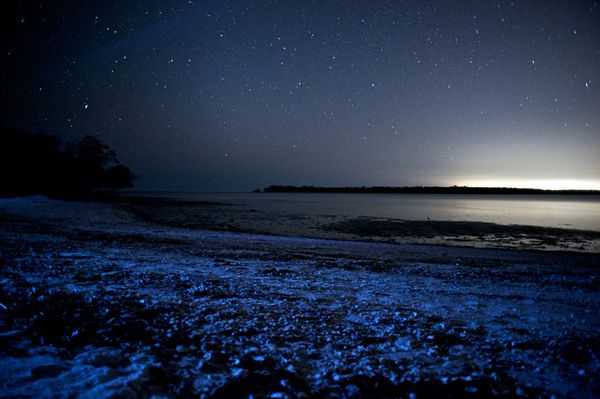
Beautiful Bioluminescence: Cool Chemistry (and Amusing Alliteration?). You’ve all seen the What’s Hot photos. Here comes the science.
• What is it? Bioluminescence is light produced by a chemical reaction within a living organism. It requires a chemical, generically called luciferin, and an enzyme catalyst, luciferase. It is different from fluorescence or phosphorescence, which involve the re-emission of absorbed light.
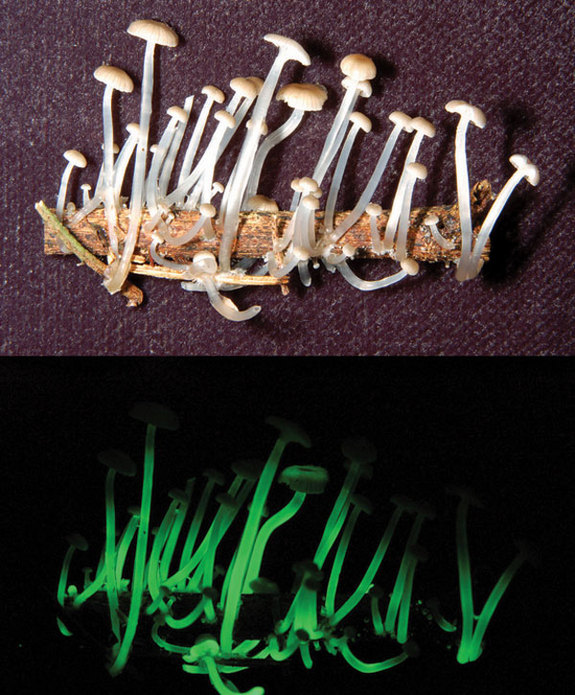
• Where is it? Over 80% of bioluminescence comes from the ocean. There is virtually none in fresh water,for unknown reasons. On land, most bioluminescence comes from fireflies and mushrooms (see images).
• How did it evolve? Based on the number of distinct light-producing chemical mechanisms, it is estimated that bioluminescence evolved independently at least 40 times! This convergent evolution suggests that it is important to organisms, and also it must be relatively easy to make. In fact, there are surprisingly few luciferins, most are acquired in the food chain (as vitamins or chlorophyll) or synthesized from common amino acids. For example, coelenterazine is the light emitter for nine phyla. However, luciferase enzymes are very different proteins across species. More on chemistry: http://www.lifesci.ucsb.edu/~biolum/chem/detail2.html
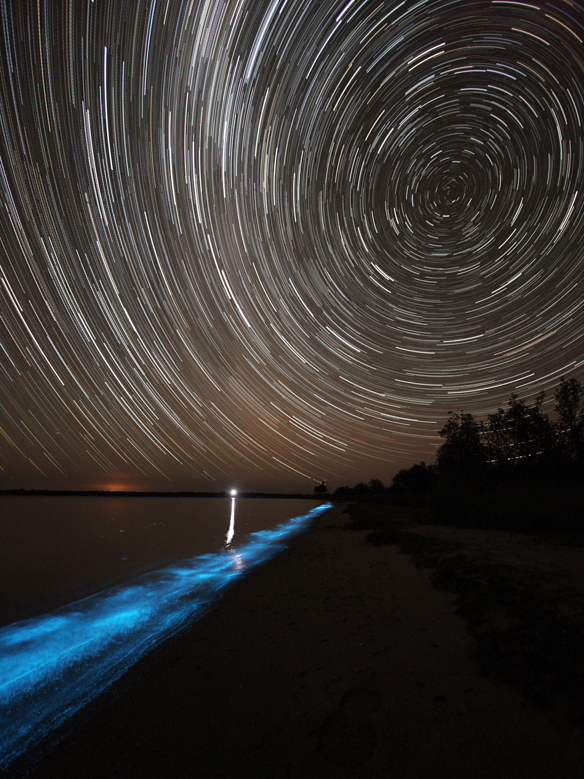
• Biophysics: Bioluminescence is typically blue light, which is best suited for the optical transparency of sea water. Sometimes, as in infra-red detecting Malacosteid fish, the initial blue light is absorbed and re-emitted as red, which is then used to find prey. Light intensity varies from 6e8 photons to 2e11photons, lasting from a fraction of second to many tens of seconds long.
• Neuroscience: In multicelled animals, luminescence is neurally controlled by neurotransmitters like glutamate or nor-adrenaline. In single celled dinoflagellates, a proton channel was just cloned that links mechanical perturbation to pH changes, as a trigger for bioluminescence.
• Milky Seas: Did you know that bioluminescence has been observed from satellites? Or that Jules Verne described milky seas in his novel Twenty Thousand Leagues Under the Sea? (I’ll let you intrepid plussers find out more).
• Biomedical Science: Bioluminescence is a favorite tool of researchers (including myself)! Firefly luciferin uses ATP to generate light, so it can be used as a highly sensitive and quantitative biosensor for ATP. If the luciferase gene is inserted into tumor cells, then tumor growth and metastasis can be followed in live mice using whole body imaging. Similarly, bioluminescence generated by jellyfish aqueorin requires calcium ions, so many researchers use it to follow calcium signaling in cells.
#bioluminescence , #sciencesunday for ScienceSunday . Thanks to Allison Sekuler and Robby Bowles for maintaining this Page and inviting me to guest-curate this morning. It was fun!






 madame scientist's not-so-mad musings