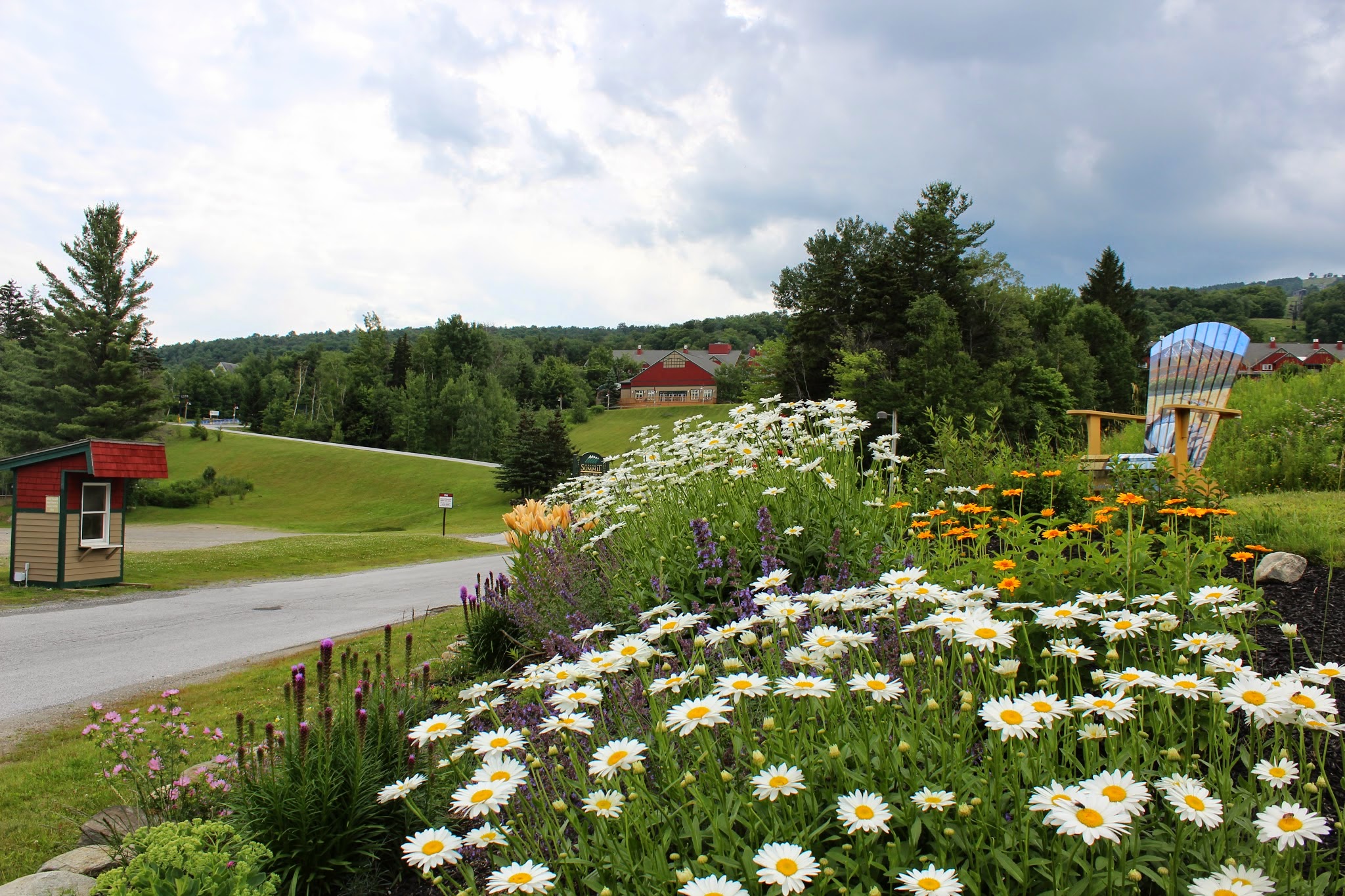
I spent the past week amidst the bucolic charms of Vermont debating the merits of mountains, molecules and membrane transport proteins (scientific program here: http://goo.gl/S6zHpC). The keynote talk was given by Ed Boyden (MIT; http://goo.gl/Lrgz9m) on the topic of optogenetics: light activated ion channels are cloned from corals, bacteria and fungi, delivered into neurons in a living animal, to precisely control and study behavior. We watched how activation of dopamine neurons by a blue light led pleasure seeking mice to return to the light spot again and again!
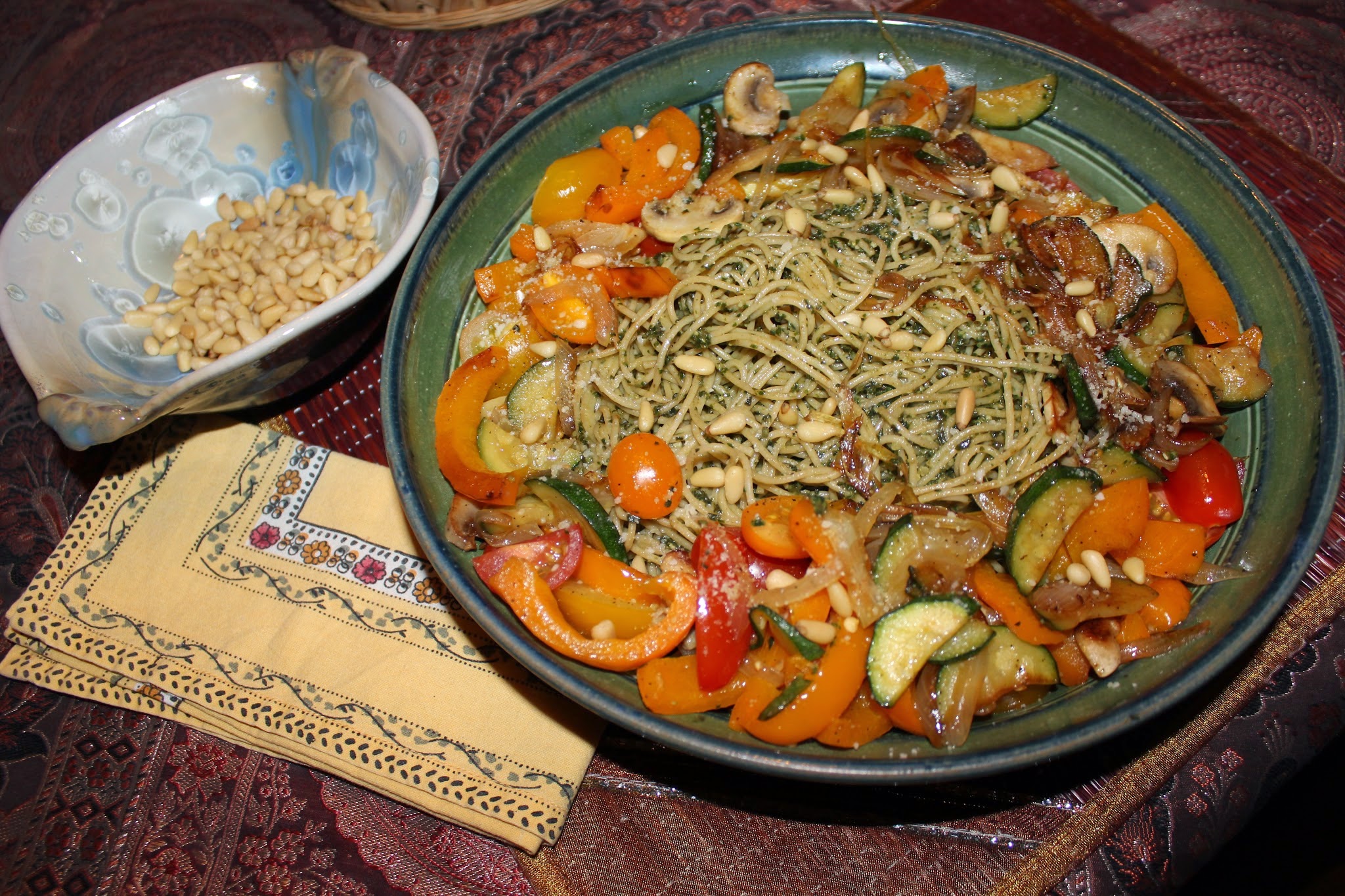
Each summer, for the past 80 years, scientists having been making the pilgrimage to the Gordon Research Conferences that cover hundreds of topics in physics, chemistry and biology. Discussions are intense, “off the record” and feature unpublished work. Isolated from the metropolitan hubbub, sites are typically in rural New England, Tuscany or the Swiss Alps (see my pix from Les Diablerets here: http://goo.gl/8qKpil). Afternoons are free, and we ventured into a charming old town where we explored a long-forgotten graveyard and discovered hand thrown pottery with colorful, crystalline glazes. They inspired me to make a pesto pasta with summer vegetables as soon as I returned home! I hope you enjoy these pictures in place of my usual #ScienceSunday post.
Cutie with Long Q-T: A baby girl is born with an irregular heartbeat. Out of synchrony, her heart stops beating several times. By Day 2 doctors perform emergency surgery to implant a cardiac defibrillator. They cut off the sympathetic nerves to prevent further stimulation of this condition. She is put on a slew of medications but it’s too soon to know if they are the right ones for her condition. Her diagnosis? Long Q-T syndrome.
Choreographing a Ballet: Every heart beat is powered by a wave of electrical activity caused by carefully choreographed opening and closing of ion channels that move sodium, potassium and calcium ions into and out of cardiac cells on a millisecond time scale. This electrical activity is picked up in an ECG which parses out the events as a repeating waveform labeled P, Q, R, S, and T (image). Each waveform triggers the cardiac muscles to contract rhythmically, pushing blood out of the chambers of the heart. In long Q-T syndrome, the lengthening of the Q-T interval reflects a delay in resetting the lower heart chambers (“repolarizing”) so that the arrival of a new heart beat occurs before the conclusion of the last one. This can set off a confusion of waveforms which appear to twist around a point, resembling the ballet movement torsades des pointes (see http://goo.gl/ctSg2d) to trigger fainting, seizures or sudden cardiac death.
Choosing a Channelopathy: Long Q-T syndrome occurs in 1 of every 2,000 persons. About 2/3 of the cases are due to mutations in two potassium channel genes which cause them to fail to open. Another 10% of mutations are found in sodium channels which make them fail to close. Either way, the Q-T interval is prolonged. But potassium and sodium channels have very different responses to drugs. Before treatment, it’s important to know where the defect lies. With our baby girl, her condition was too serious to play around with different drugs. So the scientists at Stanford University took the unprecedented step of sending her DNA for whole genome sequencing. It took 13 years for the first human genome to be fully sequenced. This baby girl’s DNA was sequenced before she was 10 days old. A mutation was found in the KCNH2 gene encoding a potassium channel known to be defective in long Q-T. She was taken off sodium channel blockers, put on more appropriate medication, and sent home. As one of the scientist’s remarked, “This is the future of genetic testing and we hope, the future of medicine.”
What’s normal anyway?: It is somewhat stunning to note that sequencing revealed 3,711,590 single nucleotide variants and 754,196 insertions and deletions that would cause more than 900 protein variants in our baby girl! Some of these could potentially cause other disorders, possibly in the future. We may all have our genomes fully sequenced in the not too distant future and we must ponder what we would do with this information?
◈ The Unseen War: In the intense, unseen competition for space and food, warring factions of bacteria produce antibiotics in a microscopic, internecine war. Actinomycetes, a filamentous type of bacteria found in soil, are arguably the deepest and richest natural source of drugs that we exploit as antibiotics, antifungals, chemotherapeutics and immunosuppressants. It was from an actinobacterium, Streptomyces that the first compound to be dubbed an antibiotic was isolated, in the lab of Ukrainian born microbiologist Selman Waksman. Streptomycin cured tuberculosis, winning Waksman a Nobel prize in 1952.
◈ Antibiotic Apocalypse: Since then, however, rampant antibiotic resistance has led the director of the Center for Disease Control (CDC) to issue a dire warning that we may be heading into a post-antibiotic era (for a scary read: http://goo.gl/LvFymj). A potential way to fight back is with phage therapy, a ploy that uses viruses to prey on their natural bacterial targets (see The Enemy of My Enemy: http://goo.gl/ks0qdv).
◈ Hold the Doom and Gloom: Scientists may yet have other tricks up their lab coat sleeves. Recently, they have discovered that the vast majority of compounds manufactured by bacteria are coded by sleeping gene clusters that can be woken up only in response to specific environmental challenges or bacterial interactions. Grown under typical laboratory conditions, bacteria produce only a handful of their complex repertoire of chemicals. But when placed in intimate contact with competing species, co-cultures of Streptomycescoelicolor produce many new and specialized compounds. Specific communities of microbes yield distinctive “chemical signatures”, revealing an untapped potential for the discovery of new antibiotics. This promising approach could be used not just with actinomycetes, but with all kinds of antibiotic-producing microbes. Forget Facebook, let’s mine those social networks..of bacteria!
REF: Imaging Mass Spectrometry Reveals Highly Specific Interactions between Actinomycetes To Activate Specialized Metabolic Gene Clusters (2013) David A. Hopwood http://mbio.asm.org/content/4/5/e00612-13.full
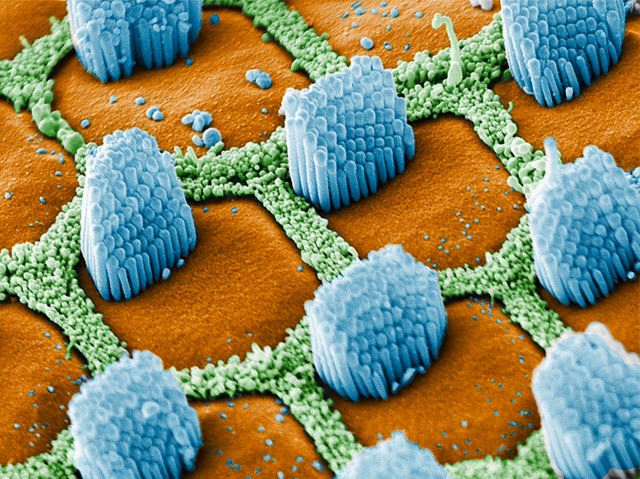
Can you guess the identity of the tiny blue skyscrapers in today’s Science Mystery Pix?
Hint: We have ~20,000 of these. The shorter “skyscrapers” are arranged in front and longer ones in back of a certain body part. Proteins with funny names like Noggin, Bmp and Bambi cause these gradients to develop.
If you google guess the answer, try not to give it away, but add some confusing helpful information in your comment!
✇ Nearly 125 years ago, a British bacteriologist observed that the holy waters of the Ganges and Yamuna had curious bactericidal properties, limiting the spread of cholera. It took another 20 years before two microbiologists independently proposed the existence of viruses. Observing small clearings on a lawn of dysentery-causing bacillus on an agar plate, d’Herelle coined the term bacteriophage for the virus that devours bacteria; now affectionately abbreviated to “phage”.
✇ A Voracious Appetite: Found everywhere bacteria exist- in the soil, deep inside the earth’s crust, within the bodies of animals and plants, and densely packed in the oceans, there are an estimated 1×10^8 different types of phages, each infecting only a specific type of bacteria. Almost comical in appearance, a phage has its genetic material tightly packed into the capsid head, that can be injected through the stalk-like tail into the bacterial cell. Once inside, it can stage a peaceful coup (lysogenic) or burst open the bacterium (lytic) when it multiplies. It is estimated that there are up to 10^32 phages in our biosphere, destroying half the bacterial population every 48 hours!
✇ Microbe Hunters: d’Herelle and his fellow scientists were quick to grasp the potential of phages as antibacterials. After consuming a preparation to confirm its safety, he administered the phage to a 12-year old boy with acute dysentery. The boy fully recovered. This set off a golden era in the commercial production and use of phages, centered largely in eastern Europe and Russia. In the 1940’s, companies like L’Oreal and Eli Lilly marketed products with catchy names like Bacté-coli-phage and Staphylo-gel! There were set backs (d’Herelle’s science partner in Tbilisi was executed by Stalin) and with the discovery of antibiotics in the 1940’s, Western scientists lost interest in this line of medical research. Unfortunately, most published studies (written in Russian or Georgian) are not accessible to the western world and clinical trials did not follow current protocols of controls, making them difficult to assess retrospectively.
✇ Evolutionary Arms Race: With growing resistance to antibiotics, a resurgence in phage therapy may be warranted. One advantage to phage therapy is that when bacteria develop resistance to a phage, we should be able to rapidly select (in a few days or weeks) for mutant phage versions in a tit-for-tat evolutionary arms race! Phage therapy is already around us in some form:the USDA has approved a phage spray (ListShield) that can be used on cheese, chicken, and processed meat to prevent infection with Listeria. Is this the start of a new phage in the way we treat bacterial infections? 🙂
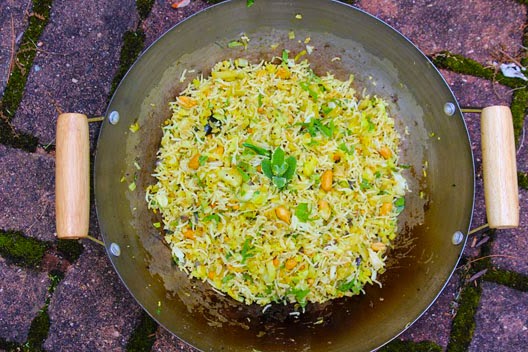
A lazy weekend dish that will wait until the boys come back from their wanderings (they’d better hurry, I’m hungry!).
Cook separately, 1.5 cups of basmati rice. Inhale the floral flagrance, ahhh!
Finely chop a head of cabbage and half an onion.
Add to hot oil: black mustard seeds, white split urad dal, yellow split channa dal, roasted peanuts, dash of asafoetida powder, curry leaves, a few grains of fenugreek. When the mustard seeds turn grey and pop, and the dals release a nutty aroma, add the chopped onions and cabbage in succession. I leave green chillies whole so the wimps boys can fish them out. Stir on high heat, season with salt, a pinch of turmeric and your favorite garam masala spice mix. I used one made my mom that I have stashed away in my refrigerator.
Cover briefly until the cabbage just about cooks. Add fresh, grated coconut and a tablespoon of coconut oil for flavor. Toss in the cooked rice very gently, garnish with chopped cilantro and mint (mine are from the garden..the only herbs that are out and about this early in our spring). The mint is a variegated variety, isn’t it pretty? 🙂
The boys are not home yet. So post pix on social media and hold off consuming until they return. Bon appetit foodies!
♥ Stanford graduate student Adam Cole was taking a class in behavioral human biology when he was inspired to pen these whimsical, biologically explicit verses. To his surprise, the song became a hit! He explains that mitochondrial DNA is inherited exclusively from mom, also X has over a thousand genes, Y has less than 92 so that:
Just like two strands of DNA are spirally entwined
Your nature and your nurture are inspiringly combined
Scientists remind me and I find that it is true
Slightly more than half of everything I am is thanks to you
Making a cameo appearance in the video, the bushy-bearded man is Stanford biology professor Robert Sapolsky, PhD.
Cole is quick to reassure dad: ““He knows that my love for him is not proportional to the biological effect he had on my genetics and development.”
Roses are Red, Blood Cells Blue: For last year’s Mother’s Day post, see http://goo.gl/ptEPLD
Of course I tweeted Hiring opportunities for #StemWomen when I saw the headlines. Jokes ensued. Could the gender of the researcher really have a noticeable effect on experimental outcomes with animals? This was a #journalclub worthy post, so here goes.
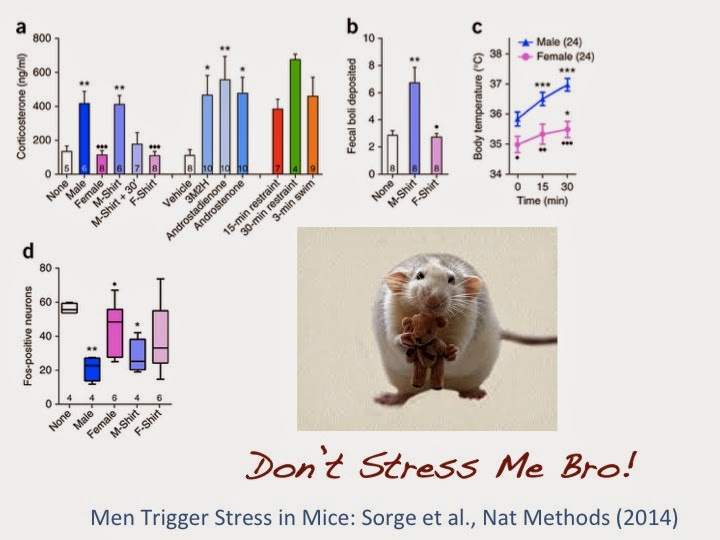
Don’t Stress Me Bro: Experimenters from a Montreal-based lab noticed anecdotally, that pain response in mice was less in human presence. Blunting of pain happens not when one has warm and fuzzy feelings, it turns out, but under stress. So an experiment was set up to measure pain response using a highly sensitive measure known as “mouse grimace scale”. Mice were anesthetized and injected in the leg with some yeast cell wall extract (zymosan) known to cause inflammatory pain. Their expressions were recorded by video and scored by a “blinded” observer, either in an empty room, or in the presence of a male or female lab person sitting quietly half a meter away. The grimace response was lower when a male was in the room. It didn’t matter if a female was present or not. Both male and female mice showed statistically significant response to guys, but the effect was larger in female mice!
Bros and BO: Rodents have a keen sense of smell, so the researchers tested if a T-shirt worn overnight by a male and place 0.5 m away would have the same effect. Yep, male BO was stressful, but female smells were ignored (oddly, the female shirt also cancelled out the effect of the male shirt. Why?). Males produce androgens and these are conserved in other animals. Pure samples of these chemicals had the same effect. Male cats and dogs had the same effect. So the researchers were on to something real.
Stress induced analgesia is an evolutionary adaptation thought to protect us in times of fight or flight. In the figure shown, panel a shows a rise in rodent stress hormone (corticosterone) levels by the mere presence of males, or their T-shirts. The stress response was similar to other unpleasant experiences such as being confined in a closed space or forced to swim! Actually, the animals were sh** scared (to be more scientific, they deposited more fecal boli; panel b). They became hot and bothered, as seen by the rise in body temperature (panel c).
What convinced me were the data in panel d. When triggered, pain-sensing neurons are known to produce a protein known as Fos. As you can see, Fos production after zymosan injection was significantly lowered by male presence. The rest of the paper showed that the effect could be blocked using drugs that reversed known opioid and non-opioid pain pathways. The study also examined other behavioral indicators of pain and stress and confirmed these findings.
Cause for Paws Pause: I can see that this gender-specific effect would add noise to data, but is it large enough to skew the overall conclusion? It is impressive that the effect could be mimicked by androgens, but they were used at very high, non-natural concentrations. Also, chemical effects ought to show a “dose response” and these were found to be weak. Still, I found the results in the attached figure to be convincing; how about you? Also, it gave me an excuse to post the cute mouse image.
REF: R.E. Sorge et al., “Olfactory exposure to males, including men, causes stress and related analgesia in rodents,” Nature Methods, doi:10.1038/nmeth.2935, 2014. http://goo.gl/9qpNh9
❖ Fungus-infested wood, or spalt was once dismissed as inferior, structurally unsound and consigned to the scrap heap. But since the 1950’s, the Lindquists, a father and son wood turning team from the New York Adirondacks, changed the way we look at spalted wood. Today, the intricate swirls of bold lines, unexpected splotches of color and random patterns are a sculptor’s dream. Spalting has developed a niche market by adding economic value to a previously wasted resource.
❖ Science of Spalting: Oregon State University’s Sara Robinson (“Dr. Spalting”) has taken this accidental art and transformed it into science. By systematically testing different combinations of fungi, moisture, temperature and pH, Dr. Robinson creates beautiful wood specimen in the laboratory.
❖ The thick black lines that appear to artistically meander through the wood actually mark out fungal war zones! Formed by heavy deposits of black melanin pigment and hardened combinations of fungal filaments and wood, zone lines are used by antagonistic fungi of different species or even genetically distinct fungi of the same species to protect their own territory and resources. Bleached patches of wood that form a canvas for other colors are formed by white rot fungi that eat away at dark colored lignin leaving behind the lighter colored cellulose. Then there are the splotches of pigment: blues, greens and pinks, deposited by fungi that colonize wood in successive waves, each species leaving an environment that paves the way for another.
Ref: Developing fungal pigments for “painting” vascular plants. Sara C. Robinson Appl Microbiol Biotechnol (2012) 93:1389–1394
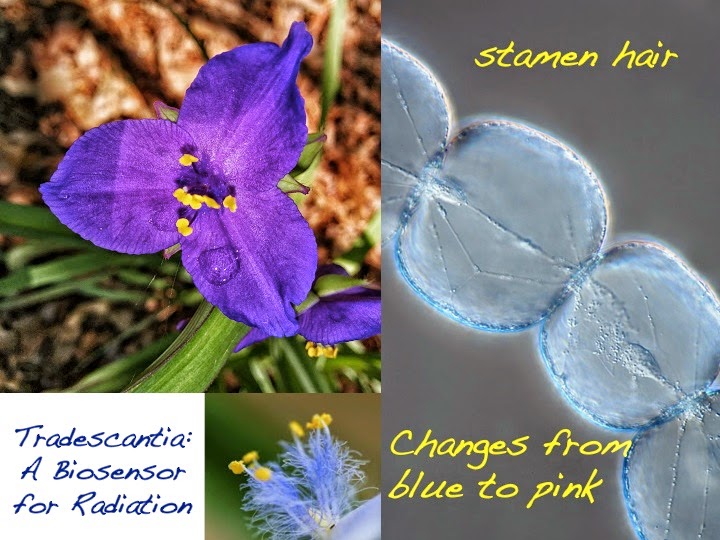
✿ The stamen hairs of the common spiderwort (Tradescantia) are made up of rows of cells in single file, like beads on a string. Fuzzy and blue, they emerge by the hundreds around the stamens that hold up the bright yellow, pollen-filled anthers in the flower center. In 1975, a scientist named Sparrow made a remarkable discovery: the stamen hairs were highly sensitive to nuclear radiation, mutating from blue to pink like the floral equivalent of the canary in the coal mine! The mutation frequency is linear down to very low doses and low exposure rates such that counting the number of pink cells as a percentage of blue ones gives an accurate reading of radiation exposure. Since the cells divide in sequence, the position of the pink cell tells when the radiation exposure occurred. The flowers have been used to monitor radiation leaks around nuclear plants in Japan or as a biosensor for chemical pollutants (http://goo.gl/GTMi9C).
✿ As if this biological oddity were not enough, the flower enjoys a romantic history dating to Captain John Smith, the legendary American settler who was plucked from the perils of death at the hands of the Powhotan tribe by the chief’s daughter Pocohontas. When Smith left Virginia in 1609, he carried with him spiderwort seeds to his friend John Tradescant the Elder, a master gardener in England. The plant was named Tradescantia virginiana in the latter’s honor (http://goo.gl/u9dwVM).
Image Credits: Tradescantia from the garden of Chris Veerabadran whose question about the flower name inspired this post. Thanks, Chris!









 madame scientist's not-so-mad musings