




Recent Comments
First Space-Earth Duet! NASA astronaut Cady Coleman teams up with legendary Ian Anderson (of Jethro Tull). Dig the way the flute (and Cady’s hair) floats in the International Space Station, while Anderson salutes the 50th anniversary of Yuri Gagarin’s first space flight.
via Joan Hogol , thanks for this amazing find! For my tribute to Yuri, see https://plus.google.com/u/0/114601143134471609087/posts/f9tJ6LpmAtN
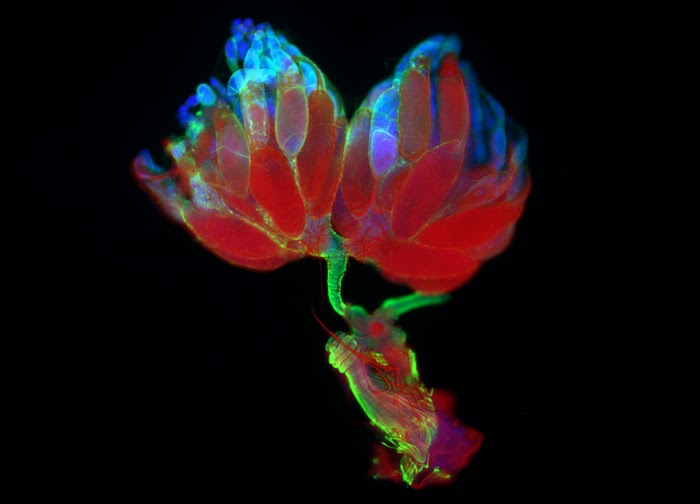
The Beauty Within. A pair of tulips? Berries? What does this look like to you?
You’ll never guess the identity of this award winning image from the 2011 Olympus BioScapes competition.
This is an image of the ovaries and oviducts of the fruit fly Drosophila melanogaster. It is one of the best systems for studying basic stem cell biology. Each ovary has 12-16 ovarioles. Stem cells are located in a niche, the most apical part, known as germarium. There are three types of stem cells: germline stem cells (GSCs), somatic stem cells (SSCs) and newly identified escort stem cells (ESCs), whose activities have been confirmed by lineage tracing and laser ablation experiments.
Read more about Drosophila stem cells: http://www.nature.com/cr/journal/v17/n1/full/7310123a.html

Why do zebras have stripes? Did you know that a zebra embryo is all black, and only acquires white stripes late in development?
• Evolutionary biologists have long pondered this. Wallace suggested that stripes provide camouflage in tall grass, but Darwin (1867) cleverly pointed out that zebras roam in open habitats where the grass is short. (Happy Birthday, Mr. Darwin!) Other theories suggest that moving stripes dazzle predators, offer visual communication in courtship or bonding, or thermoregulation (apparently stripes work better in cooling the animal than solid color). Oh, yes, stripes are fashion forward too! (Thank you Fake Science!)
• New research points to an unexpected advantage: protection from horsefly bites. Blood sucking horseflies are more than a nuisance. They spread disease and have negative fitness impact. Horseflies are strongly attracted to horizontally polarized light (waves aligned horizontally), like light reflected from bodies of water, where they lay their eggs and reproduce. Researchers showed that white and black polarize light differently, such that zebra stripes confuse the flies. Using horse models painted in different colors they showed that the best effects in keeping away flies were with natural stripe patterns found in zebras. Leopard spots are so passé.
Sources: http://jeb.biologists.org/content/215/5/iii
http://fakescience.tumblr.com/post/1517534535/why-do-zebras-have-stripes #ScienceSunday curated by Allison Sekuler and Robby Bowles .

Amoeba Fail! This poor Dictyostelium (colored green) is trying very hard to engulf a mutant yeast cell that is just too large 🙂
The orange label is on actin filaments : cytoskeletal elements that organize around the edges, ready to close off the phagosome. Myosin motors pull the actin together, like the drawstring of a purse.
Notice the force with which the amoeba ejects the yeast cell when it gives up. Then it tries again , from a different angle. Watch the excess surface membrane being thrown into ruffles before it is quickly absorbed into the cell. Not surprisingly, this video was titled Frustration!
Details: http://www.cellimagelibrary.org/images/12654
Credits: My awesome Google+ team of Kevin Staff who made the animated gif and Konstantin Makov , as usual. Thank you for making science fun!
#ScienceSunday, Allison Sekuler , Robby Bowles .

Smile!
Originally shared by Rehan Ahmad
Where do astronauts hang out?
Here’s the answer 🙂
Zipcode for the Control Center: For a protein to find its way to the nucleus of a cell, where it can turn on or off genes, it must carry a special code, known as Nuclear Localization Signal (NLS). Carriers, known as importins, recognize the NLS, and escort the protein through the nuclear pores into the nucleus. The importins themselves must be recovered by yet another system of on-off switches, the Ran proteins, driven by the breakdown of GTP.
In the video, fluorescent NLS cycles in and out of the nuclei of a dividing Drosophila embryo. The action appears coordinated because in insects, the early nuclear divisions occur without cell division creating a syncytium. These nuclear divisions are extremely rapid, occurring about every 8 minutes.
This beautiful Cell Dance is choreographed to Oxygene by Jean-Michel Jarre. If you liked the clip, watch their performance: Jean Michel Jarre – Oxygene IV


 madame scientist's not-so-mad musings