Recent Comments
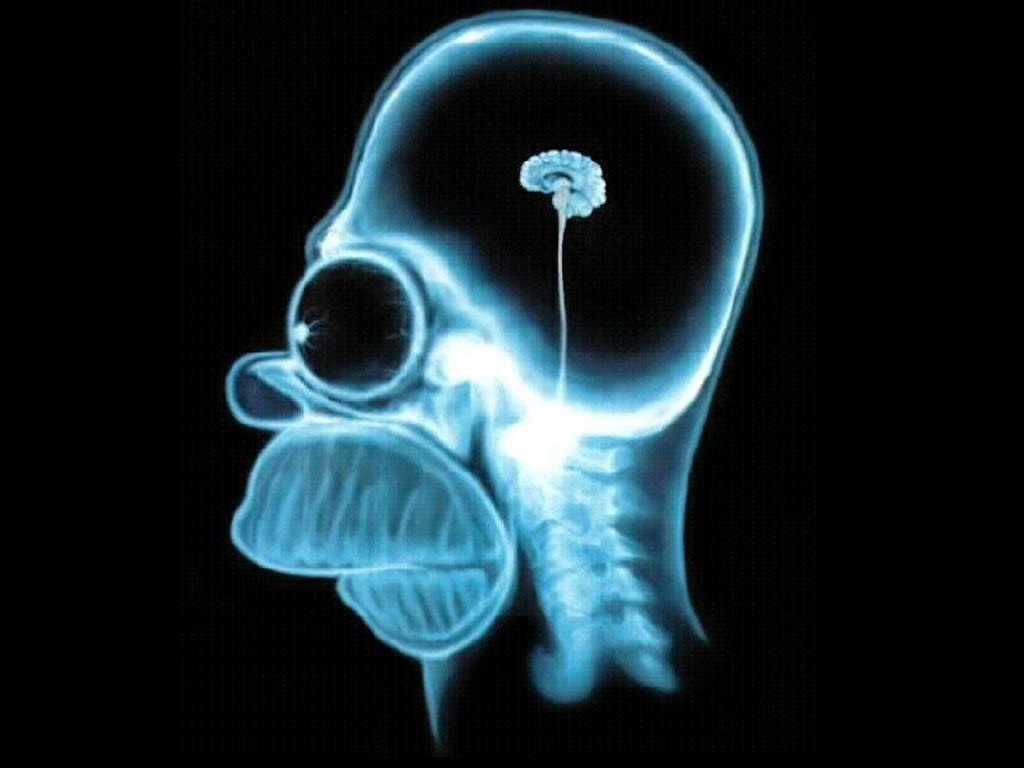
The Brain: Fun Facts. Continuing the celebration of Brain Awareness Week.
• There are about 86 billion neurons in the human brain, similar to the stars in our galaxy. A piece of brain tissue the size of a grain of sand contains 100,000 neurons and 1 billion synapses. Now, that’s a network!
• Your brain weighs 3 pounds but your skin weighs twice as much. Although only ~ 2 % of your body weight, your brain consumes 20% of your oxygen supply. An elephant’s brain is physically larger than a human brain, it is only 0.15% of its total body weight, whereas the ant has the largest brain in proportion to body size.
• The speed at which information travels down a nerve (action potential) can vary from 100 meters per second (224 miles per hour) to less than a tenth of a meter per second (0.6 miles per hour).
• There are no pain receptors in the brain. This explains how brain surgery can be performed with the patient fully conscious. So why do you have a headache?
• The brain is pink, not grey, because of blood flowing through 100,000 miles of blood vessels. This is the equivalent of 3 full soda cans of blood flow through the brain each minute.
• Nearly 80% of your brain is water. It is also one of the fattiest tissues (hence the term, fathead).
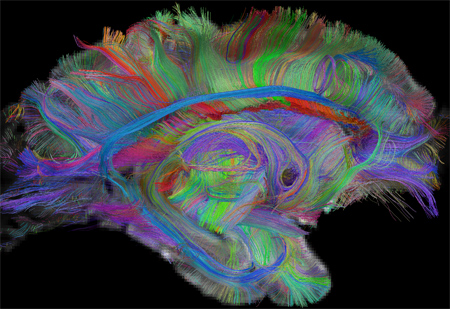
True or False? You only use 10% of your brain. This is a popular myth that has been proven false by brain imaging. While not all of the brain is active at the same time, fMRI (functional magnetic resonance imaging) shows widespread activation of the brain for even simple tasks. Take a moment to admire the connectivity of our brain in the image, made by a type of MRI called diffusion spectrum imaging.
Brain Awareness Week: Today kicks off a global campaign to focus attention on the field of neuroscience, improve public health and outreach by informing on brain research and brain disorders, and to inspire the next generation of scientists. Look for more brain posts and cool neuroscience research all this week!
Sponsored by The Dana Foundation (http://www.dana.org/brainweek/) and partnered with the Society for Neuroscience (http://www.sfn.org/index.aspx?pagename=baw_home).
A Sperms Tale: Calcium gets the Turn On! Wonder how a sperm finds the egg?
• The original guided missile: A chemoattractant released by the egg binds to its receptor on the sperm surface, and sets off a signaling cascade. First, cyclic GMP is made, which opens a set of K+ channels. These alter the voltage across the membrane to make it more negatively charged inside, which in turn opens voltage sensing Ca2+ channels. Calcium ions rush in, and direct the movement of the sperm by controlling the beating of tail (flagellum).
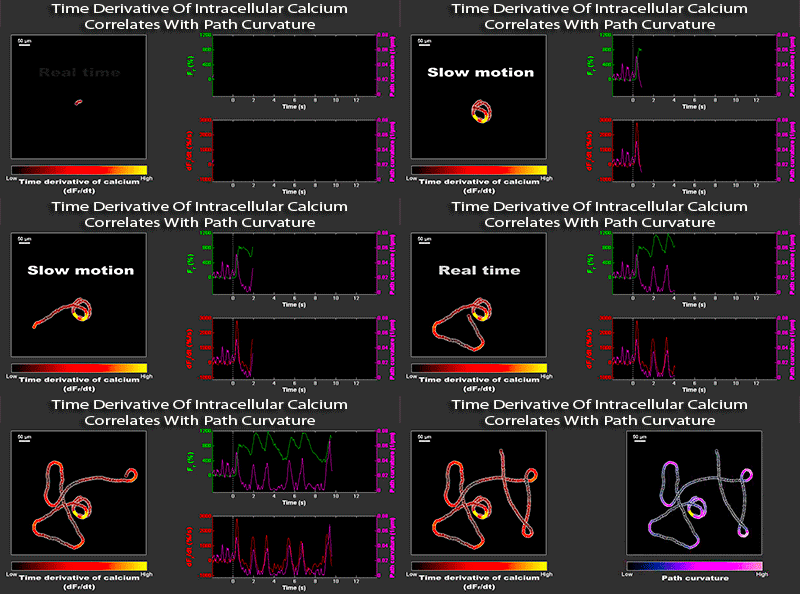
• As the sperm turns: To understand how calcium controls the sperm, researchers used a “caged” form of cGMP that could be light-activated,and a fluorescent dye to measure Ca2+ ions. Then they tracked sperm movement under a fluorescence microscope. The left panel tracks a single sperm (thick lines drawn over it), first in slow motion and then in real time. In both graphs on the right, the pink lines track the path, with turns shown as peaks. The sperm alternately makes straight runs and turns. In the upper graph, calcium levels (F) are tracked in green. Although, there is some general overlap with sperm movement, the two are not perfectly correlated. But in the lower graph, the rate of change of calcium (dF/dT, mathematically, the time derivative) matches the turns perfectly. In other words, sperms respond to change, not absolute levels of signal. The fastness of the calcium surge controls the sharpness of the turn! The path of the subsequent run depends on the steepness of the decline .
• The tail that wags the dog: How does the sperm “compute” the time derivative of calcium and how is this information translated into steering the tail? The authors describe a chemical differentiator model, in which calcium binds with differing strengths to proteins with opposing control of the tail. It’s all about chemistry!
Original Paper: Alavarez et al., 2012 J Cell Biol. http://jcb.rupress.org/content/196/5/653.full
Full Movie: http://jcb.rupress.org/content/196/5/653/suppl/DC1
☼ SPECIAL THANKS to Kevin Staff for making this animated Gif and for being the tail that wags my #ScienceSunday posts! Konstantin Makov is hereby challenged to come up with mood music for the sperm turns 😉
Originally shared by NATURE
♡ BLOOD ♡ : It is in our heart.
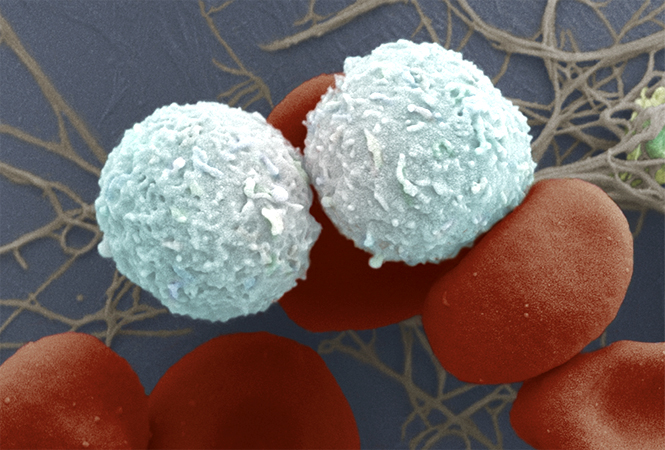
Scanning electron micrograph of human blood showing red cells, white cells, platelets (green-yellow) and fibrin (light brown).

Late for a date? Nuclear clocks are here. Atomic clocks are the time-keeping standards of today, used in countless applications including GPS technology, data transfer and particle accelerators. Nuclear clocks are estimated to be “nearly 100 times more accurate than the best atomic clocks we have now,” says Professor Victor Flambaum of the University of New South Wales.
• Atomic clocks track the orbit of electrons, essentially using them as a sort of pendulum. But the electrons are subject to slight external interference, leading to small errors. The new suggestion is to use lasers to orient the electrons in an atom so precisely that one can look through them and track a single neutron orbiting the atom’s nucleus. Neutrons are virtually immune to interference.
• This so-called single-ion clock, or nuclear clock, would be accurate to 19 decimal places or by a twentieth of a second over 14 billion years, roughly the age of the Universe.
• H/T ZME Science for the story: http://www.zmescience.com/research/nuclear-clock-most-accurate-in-world-042343/ The paper is to be published in Phys. Rev. Lett.
Feel Good Friday: 8 am on March 5, 2012. Idyllic blue ocean and ripples of surf. Suddenly, a pod of dolphins appear and beach themselves on this Brazilian coast. Watch the amazingly efficient rescue.
A new endeavor worthy of Women’s Day for Everyday! Please add your name or that of someone you know to this simple form: http://goo.gl/rvKEf
Originally shared by Buddhini Samarasinghe
STEM Women on G+
Today, me, Rajini Rao and Liz Krane were thinking of building a circle comprising of Women who work in STEM (Science, Technology, Engineering and Maths) fields. In order to ensure that this circle is fully representative of all the women in STEM, I would like to ask for nominations. Please enter your suggestions here (http://goo.gl/rvKEf). Is there anyone that you feel should be included in this circle?
Here is a list of criteria that these candidates should have:
Job should relate directly to STEM or be an advanced student of STEM
Should be female Sorry guys! The reason I am limiting this circle to women is because females are under-represented in STEM fields. STEM fields are traditionally male-dominated, and there is probably a greater need for positive female role models in this field because of prevailing stereotypes such as ‘girls can’t do math’ and so on. The circle would therefore have to consist of not only females in STEM but females in STEM who actively promote their fields and encourage others who might be thinking of STEM careers.
This is a circle for Women in STEM run by Women in STEM
Please share this post to spread the word and fill in the nominations 🙂
First Women in STEM: A Tribute to International Women’s Day. Here is a celebration of some of the brilliant women who changed the course of history for the better. Women of G+ , do you have stories of your own to share? What personal achievement are you proud of, whether in your family, community or profession?
• Marie Curie: First woman to receive a Nobel Prize, once for Physics (1903) and then again for Chemistry (1911), she pioneered the study of radioactivity. She died of aplastic anemia brought on by lethal exposure to radiation. Despite her two Nobels, she was not elected to the French Academy of Sciences by two votes.
• Mary Kies. Hats off to the First woman granted a US patent (1809) for a process to weave straw with silk or thread in hat making. This was a time when women could not legally own property independent of their husbands. Her patent is credited with boosting American industry at a time when Napoleon imposed a blockade on export of European goods.
• Ada Lovelace: Charles Babbage called her Enchantress of Numbers, History calls her First Programmer. Daughter of Lord Byron, in 1843, her notes on the Analytical Engine are credited as the first algorithm intended to be processed by a machine.
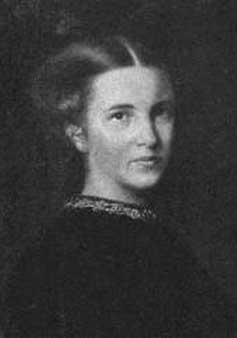
• Elizabeth Garrett Anderson: physician and feminist, first woman qualified to practice in England (1865), created a medical school for women, first Dean of a medical school, first woman to be elected to a school board and first woman mayor and magistrate in Britain. The day she passed the licensing exam, with highest marks, the Society of Apothecaries immediately amended their rules to prevent other women from obtaining a license.
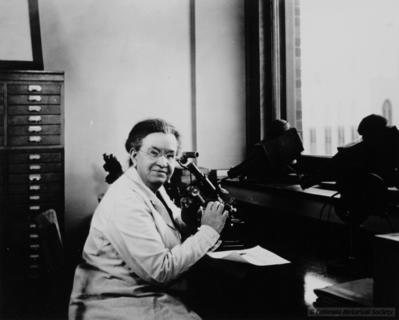
• Florence Sabin: First woman faculty at Johns Hopkins medical school (MD, 1900 from the first batch of female medical students admitted), she was also first woman to achieve Professorship there (1917), to be elected to the National Academy of Science, and head a department at Rockefeller Institute (she was passed over for Department Head at Hopkins, in favor of her own student, a male).
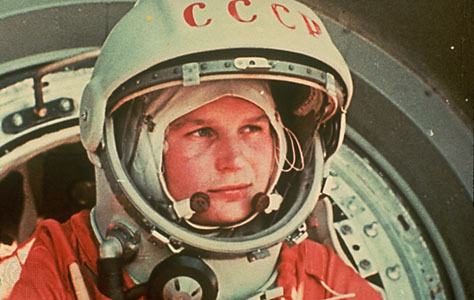
• Valentina Tereshkova: Russian cosmonaut who was the First woman in space, in 1963, aboard Vostok 6. She completed 48 orbits in 71 hours. Her call sign was Chaika (seagull), a nickname that she carries to this day. She turned 75 two days ago.
Whom did I leave out of this very short and inadequate list?




 madame scientist's not-so-mad musings