Infectious Humor: A retrovirus carries genetic information in the form of RNA instead of DNA. A genetic throwback of sorts, since usual mechanism is DNA → RNA → protein. Retroviruses need an extra step: RNA → DNA → RNA → protein. According to the RNA World hypothesis, RNA is the earliest genetic material.
The virus type on the left is a bacteriophage. The one on the right is going through a hippie phage.
via Neural Stem World Community on FB. #scienceeveryday
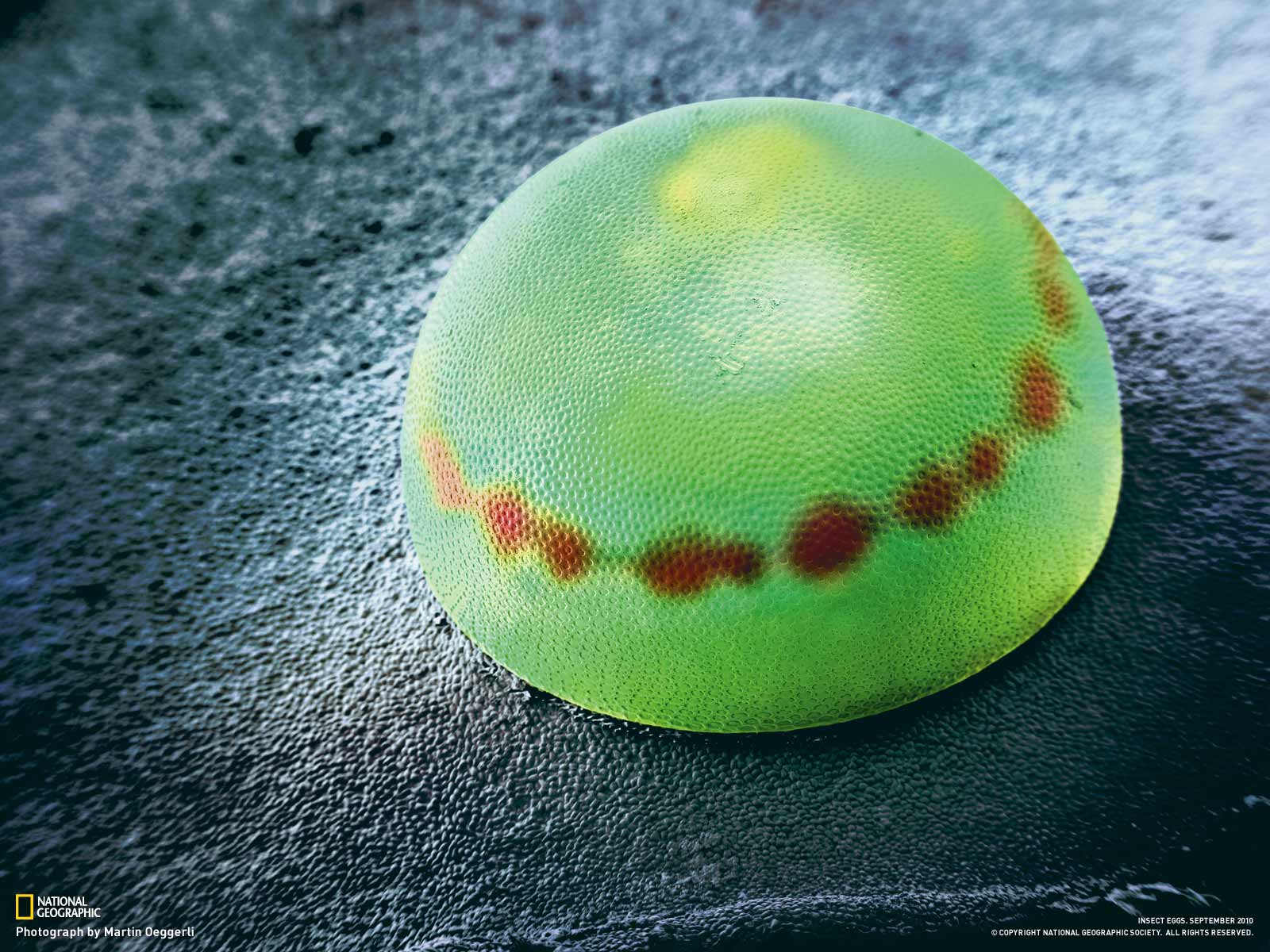
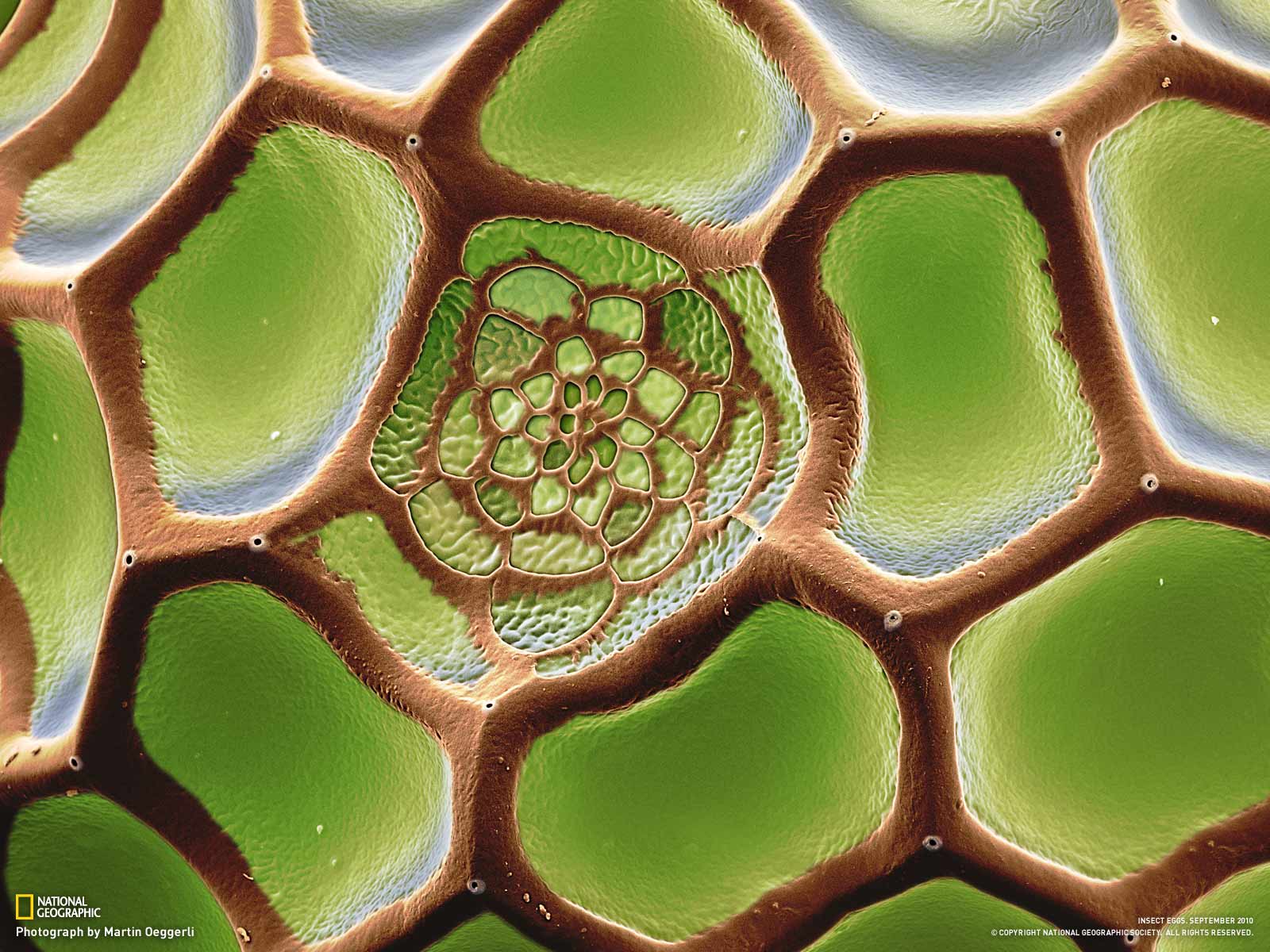
Beauty of the Butterfly Egg: Insects have been around for at least 300 million years. There are over a million species representing more than half of all known living organisms. In fact, they may account for 90% of all multicellular animals on earth.
• Yet insects abandon their young just about anywhere, leaving them to survive on their own. The secret may be hidden in their eggs: tough, yet varied, insect eggs are camouflaged or flamboyant, colorful or embellished with spines, stripes and helices. This gallery represents just one tiny fraction of diversity in the eggs: they are all butterfly eggs.
• Who knew that a butterfly egg less than 2 mm in size could be so beautiful?
MAXI CIRCLE: We’re stuffed full of science-y goodness, and reached maximum capacity for a shared circle! Keep #sciencesunday trending.
Originally shared by Science on Google+
General Science Circle Updated 6/10 (Profiles Only)
Please note that this will be the last General Science circle (i.e., we have exceeded the 500 person limit for shared circles), and Allison Sekuler, Chris Robinson, Fraser Cain, Rajini Rao, and Robby Bowles are not included in the shared circle. Help keep #sciencesunday trending by sharing this circle with your friends!
If you have a science related degree, you are a science journalist, you are a K-12 science teacher, or you curate a science page, then add your profile/page to the database (http://goo.gl/yEg7M). Please note that you also have to circle Science on Google+: A Public Database if you would like to be considered for shared circles.
THE MAKING OF A VACCINE: Deeksha Tare recounts the twists and turns in a high profile and expensive chase for the rotavirus vaccine. Read her introduction to The Deadly Virus on Wheels here: http://goo.gl/suINZ and add her to your Science circle for more Viral Posts!
#sciencesunday
Originally shared by Deeksha Tare
Vaccine for the Wheels!!
Here goes the chain of events which led to the development of the Rotavirus vaccine:
1.Early Vaccine Studies
Rotavirus was considered to be a fastidious agent until the Wa Human Rotavirus strain was discovered in the stool of an infant with diarrhoea. It was grown successfully on African green monkey kidney (AGMK) cells after 11 passages in gnotobiotic piglets.
Thought to be a potential vaccine, clinical trials were commenced but then subsequently had to be called off due to contamination issues.
Similar was the fate of another human strain derived from an asymptomatic neonate. This strain (M37) failed to show protection in clinical conditions.
2.The Jennerian approach – RotaShield
This paved way for the Jennerian approach to the vaccine development. (Remember how Jenner prevented smallpox using cowpox virus?)
There are three great things about Rota-
a. Many different strains infecting different species
b. The segmented dsRNA genome
c. Once infected, it provides life- long immunity
Thus a recombinant vaccine could be made by co infecting cell culture with two different strains, which would lead to formation of attenuated strain.
So, the scientists made a Human- Rhesus reassortant, which passed clinical trials. (RotaShield)
3.The vaccine got licensed and was brought into use
4.The Intussusception issue
Fate was not in the favour of RotaShield 😦
CDC confirmed reports of the vaccine associated Intussusception
Paul A. Offit and H. Fred Clark developed a Human Bovine recombinant vaccine (RotaTeq).
Due to the intussusception reactions caused by the previous vaccine which led to its refusal subsequently, FDA wanted companies to prove that the vaccine did not cause the rare adverse reaction (intussusception) pre-licensure. As an effect a never-seen-before trial was carried out. A study that involved more than 70,000 children from 11 countries and cost about $350 million – (the largest vaccine safety trial ever performed by a pharmaceutical company!) by Dr. Edward Scolnick, president of Merck Research Laboratories at the time.
And thus finally in February 2006, the vaccine was recommended for routine immunization in children.
This is a great success story, which also “Raised the bar for vaccine efficacy studies” as said by Offit and Clark in the book
History of Vaccine Development
Thus mankind got a much needed vaccine finally to protect it’s young from the deadly rotaviral disease.
Endless forms most beautiful and most wonderful. In the conclusion of The Origin of Species by Means of Natural Selection, Charles Darwin writes:
• “It is interesting to contemplate an entangled bank, clothed with many plants of many kinds, with birds singing on the bushes, with various insects flitting about, and with worms crawling through the damp earth, and to reflect that these elaborately constructed forms, so different from each other, and dependent on each other in so complex a manner, have all been produced by laws acting around us.”
• The final words are poetry: “There is grandeur in this view of life, with its several powers, having been originally breathed into a few forms or into one; and that, whilst this planet has gone cycling on according to the fixed law of gravity, from so simple a beginning endless forms most beautiful and most wonderful have been, and are being, evolved.”
• This award winning video was in response to a challenge by New Scientist magazine to illustrate the final words of Darwin’s book. British artist Pery Burge created these inkplosions to show how a simple spot of paint on water can spread out unpredictably, in great complexity and diversity. Her work straddles the boundary between art and science.
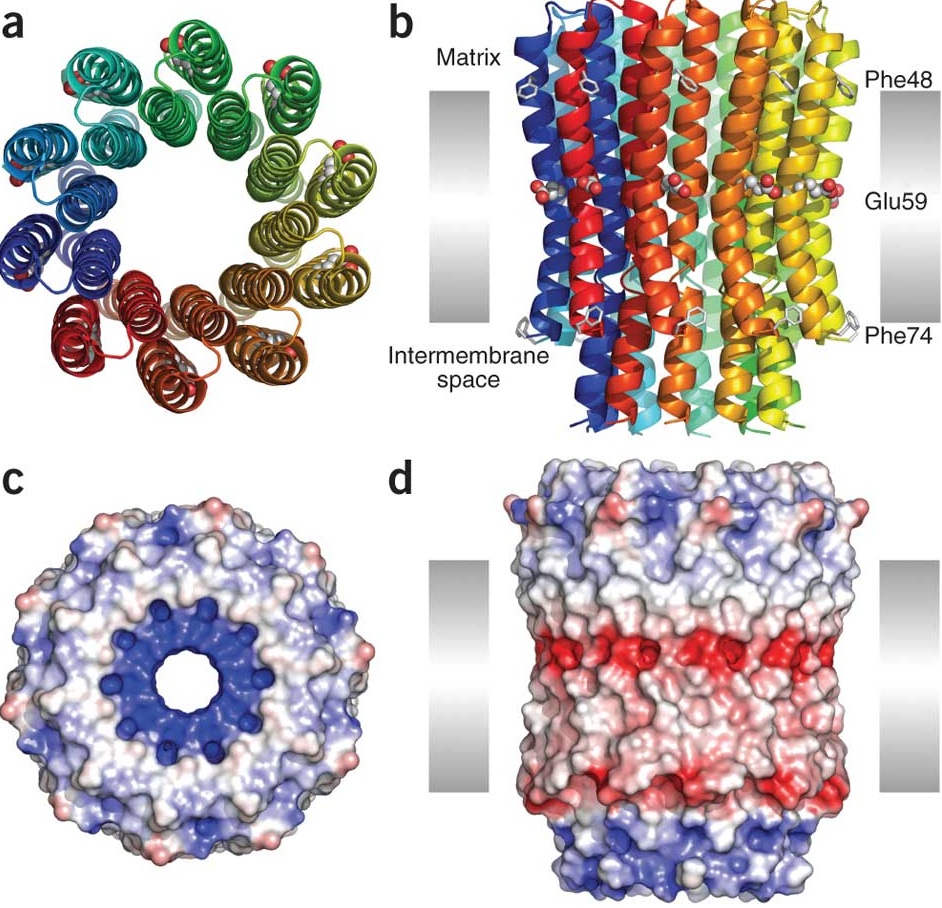
The One Ring: Structure of the c Ring of the Proton Pumping ATP synthase.
Protons are pumped across membranes to drive a rotary shaft that in turn makes ATP, the “currency of life”. ATP is used to fuel virtually all energy requiring processed in our body. For a beautiful animation of this rotary pump, see: http://goo.gl/gjiZN
Protons are ferried by the the c ring (image a), as in a merry go round. Each subunit carries a proton binding site (Glu59, image b), as it rotates. Images c and d show the electrostatic surface of this rotor, with acidic charges in red, basic in blue and neutral as white.
This structure is hot off the press and was presented by my friend David at the ATPase conference I am attending in Aspen, Colorado. It was obtained by making crystals and imaging with X-rays.
Ref: Structure of the c10 ring of the yeast mitochondrial ATP synthase in the open conformation. Jindrich Symersky, Vijayakanth Pagadala, Daniel Osowski, Alexander Krah, Thomas Meier, José D Faraldo-Gómez & David M Mueller ; Nature Structural & Molecular Biology 19, 485–491 (2012) doi:10.1038/nsmb.2284
Andrew Huxley (Nov 22, 1917 – May 30, 2012): An Appreciation.
• You may be familiar with his name. Although he was grandson to Thomas Huxley (“Darwin’s Bulldog”) and half-brother to Julian Huxley (evolutionary biologist, founding member of WWF) and author Aldous Huxley (“Brave New World”), Andrew Huxley is famous in my field of ion channel research for explaining how nerves conduct electrical signals.
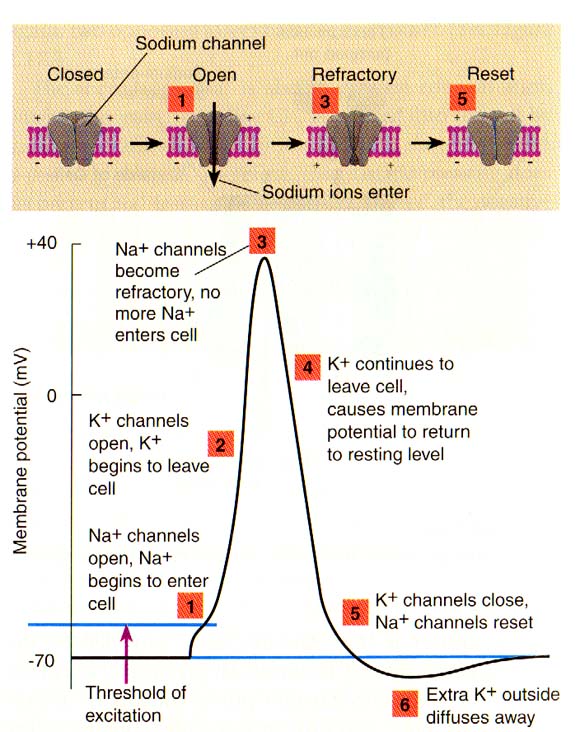
• 1n 1939, together with Alan Hodgkin, he inserted an electrode into the giant nerve of a squid. It was known that at rest, potassium ions (K+) moved out of the cell leaving the inside more negative than the outside by about 65 millivolts. When stimulated, the nerve would fire an action potential, lasting only a fraction of a millisecond. They captured the voltage changes during this fleeting action potential, showing that the charge difference reversed to positive inside the cell. Next, by diluting the sea water bathing the nerve, they showed this inward current was due to movement of sodium ions (Na+) into the nerve cell. Today, we know that these currents are carried by sequential opening and closing of ion channels. What is a squid giant axon? Watch this first: http://www.youtube.com/watch?v=omXS1bjYLMI
• Although their work was interrupted by WWII, during which Huxley turned his hands to radar and psychiatry, the two colleagues got back together in Cambridge, in 1946. They solved the set of simultaneous equations, using a postwar computing machine, to describe the ionic theory of nerve impulses. The Hodgkin-Huxley model laid the foundation for understanding how the nervous system works. For this, they received the Nobel prize in 1963.
• Huxley stumbled into Physiology by accident- he was hoping to be a physicist. “I had to do a third science, as well as the obvious subjects of maths, physics and chemistry. A chum of mine a few years older told me that physiology was a most vital subject, and I would be learning things that were still controversial.” What a perfect segue into electrophysiology!
When my children were little, of an age that believed that mothers had eyes in the back of their heads, I was (like Mary Poppins) “practically perfect in every way”. While those days have passed forever, there are still some small triumphs that I hold constant. Perfectly cooked rice is one of life’s little pleasures that I take for granted. Not al dente: Giada de Laurentis be darned, this is not pasta. Neither is it risotto..as an Asian, I never caught on to the idea of adding cheese to rice.
I remember a conversation with a stranger at an airport about rice (long layover, don’t ask). “Do you cook it from scratch”, she asked admiringly. I was astounded, “Is there any other way?” Just use a 2:1 ratio of water to rice, no further calculus required. A friend swears by the knuckle test..pour rice until it comes up to the first knuckle in your index finger. Add water to the second knuckle. What if the rice is only partway up your first knuckle? In any case, I use boiling water and prefer to retain the skin on my knuckles. So a cup measure of any kind works for me.
So here is an elegant Basmati pilaf with strands of orange and green, dotted with golden raisins, cranberries and cashews. Practically perfect in every way.
Basmati rice pilaf
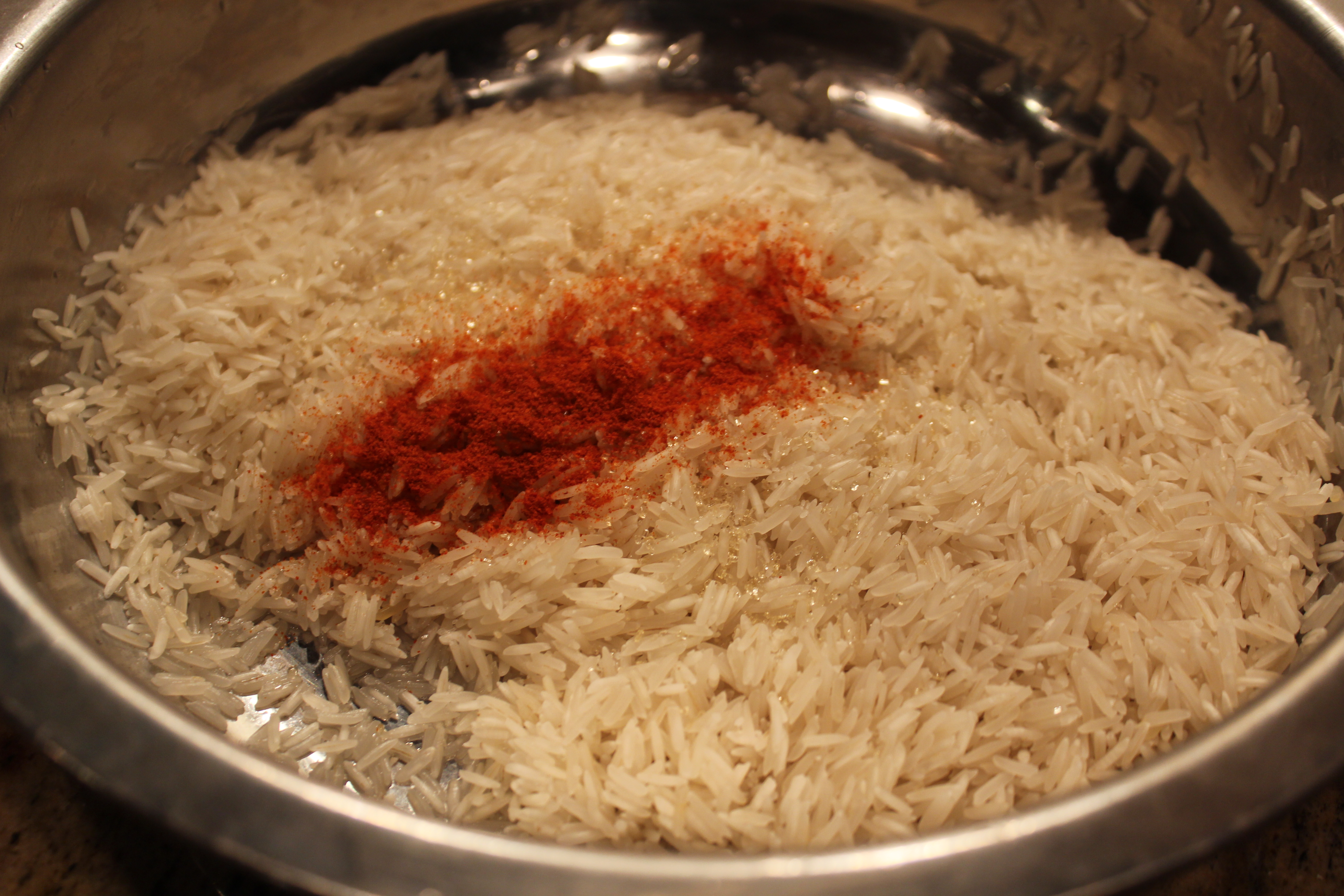
Measure out Basmati rice: I used 2 cups to generously serve four (with left overs for lunch the next day). Rinse a few times under cold running water. To drain, cover with a plate and let the water dribble out or simply tilt as much as you dare. Season the wet rice with coarse salt, a pinch of sugar and some red chilli powder. Toss together and let sit for about 20 minutes while you prep the rest of the pilaf.
Wash, drain and season rice
This step further elongates the already long grain and makes it as delicate as a flower.
Presoaking lengthens the grain
Measure out 2x the amount of water into a pot and heat on the back burner. I used 4 cups.
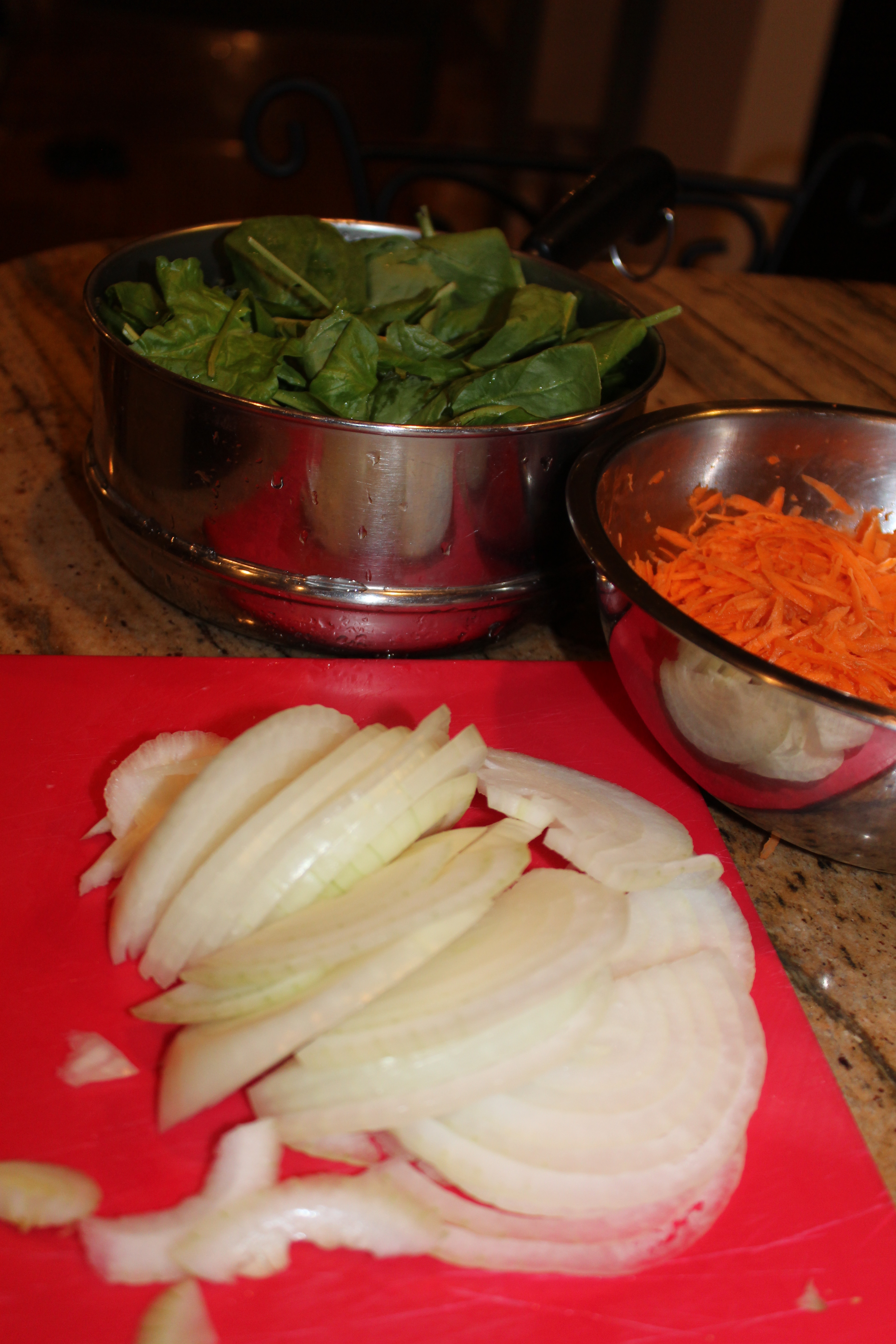
Grate 2 carrots coarsely. Do you peel carrots? Why?
Wash and roughly chop a bag of spinach. I used baby spinach, so I left them alone.
Thinly slice one sweet onion.
Prep the vegetables
Gather your spices: 2-3 cardamom pods, split (you ought to save the shells for tea, but I left them in), 2 bay leaves, cinnamon sticks, some cloves and about a tablespoon of fennel seed.
Clockwise: Bay leaves, cinnamon sticks, fennel, cloves and cardamom
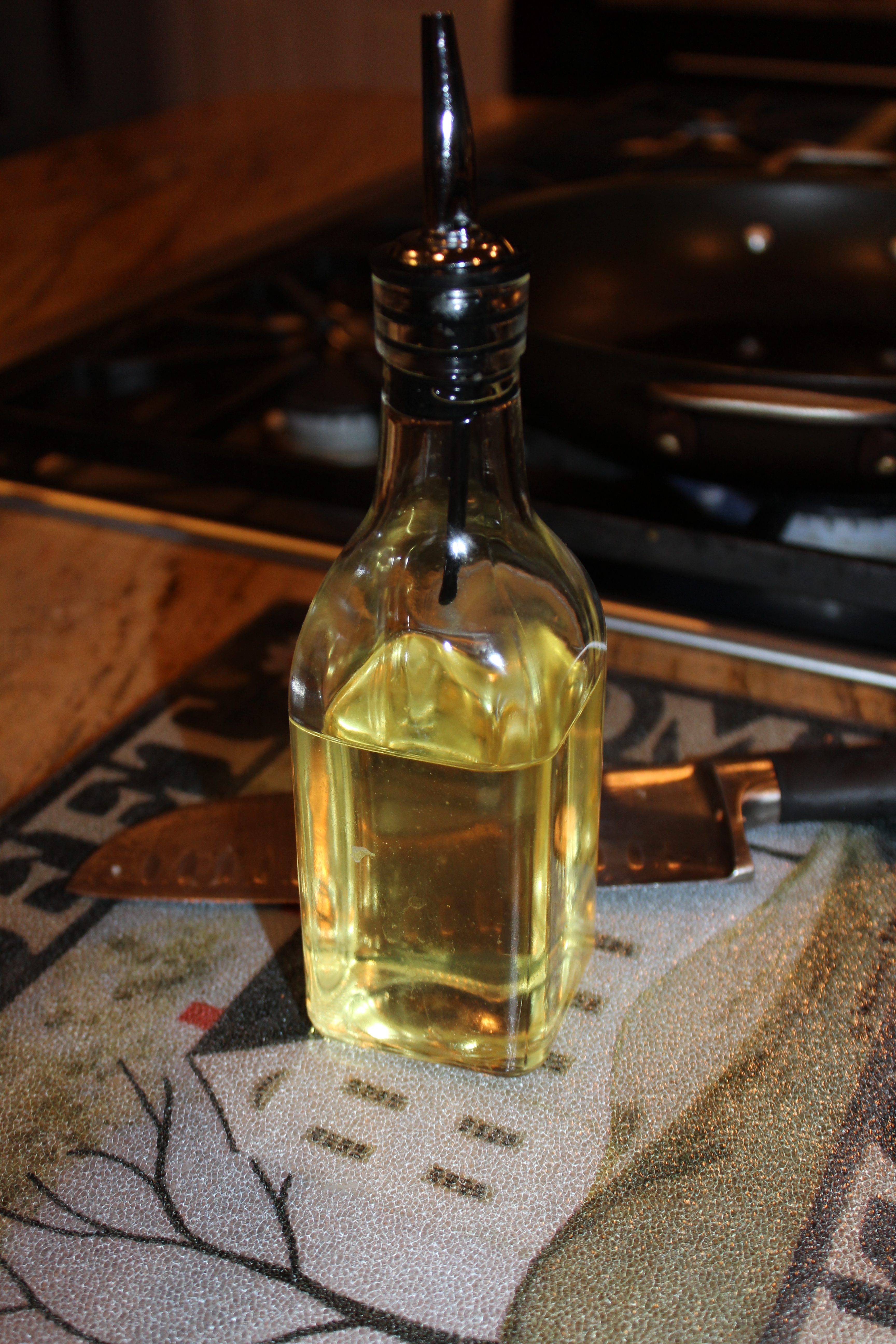
Heat some oil in a heavy bottomed pan. I like to use the broad shallow type so that the rice is not crushed by its own weight and to get squished at the bottom. A broad base also allows some golden crunchiness to develop at the bottom, Persian style.
Heat some oil in a heavy pan
Add whole spices and let sizzle for a few seconds.
Let the spices sizzle
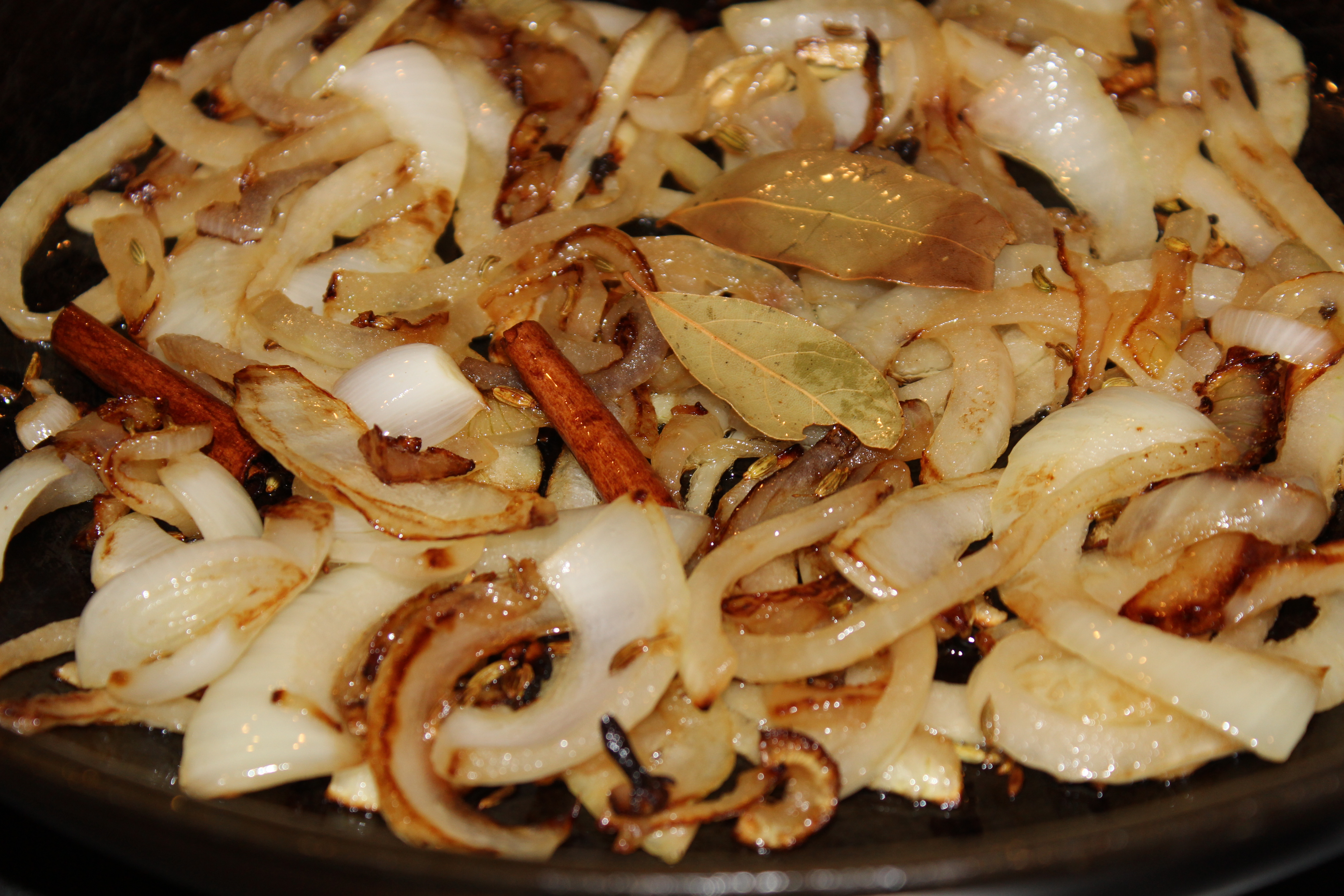
Add sliced onions and toss around on high first, then reduce heat to allow partial caramelization. You want the onions to turn partly brown so that they impart their rich color and sweetness to the pilaf.
Partly caramelize the onions
Add the grated carrots and spinach and mix in. At this point, I add a handful of dry fruits and nuts (cranberries, golden raisins, almonds or whatever you have on hand).
Mix together carrots, spinach and dried fruits/nuts
Add the pre-soaked basmati rice and toss together gently. Take care not to break the delicate grain. My mother told me so.
Gently fold in the rice
Add the pre-measured hot water and stir. I like to dot the surface with some clarified butter to infuse the rice with a heavenly, buttery flavor. Cover and let steam on low heat for about 10 more minutes.
Add hot water and dot with ghee or butter
The rice is done when the water is absorbed. I added a handful of unsalted, roasted cashews at this point. Gently toss to mix.
The pilaf is done when the water is absorbed
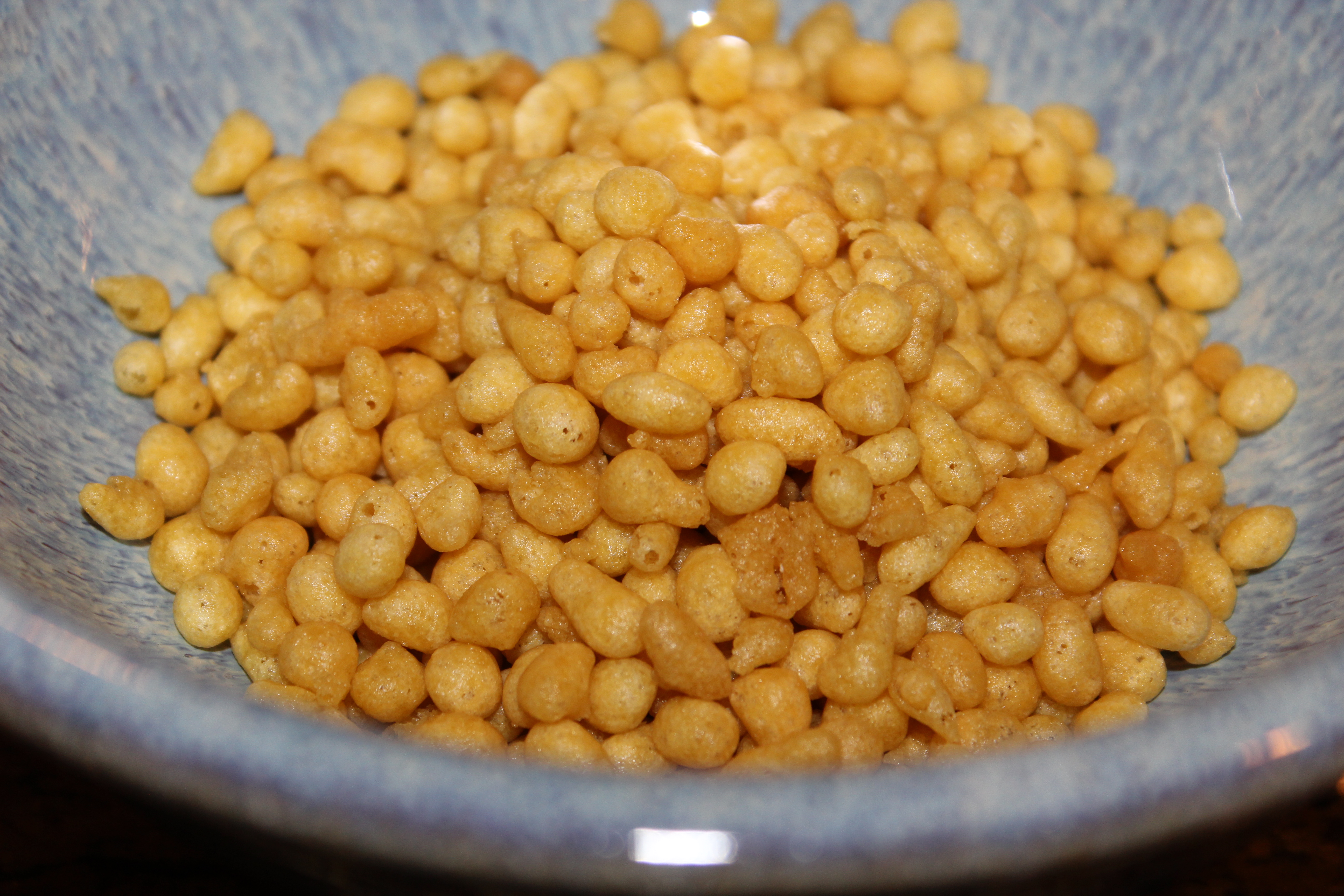
A good pulao deserves a raita. You can make this yogurt based side dish with chopped fresh tomatoes or grated cucumber or diced onion. I used a crunchy Indian snack made out of chick pea batter instead.
chick pea crunchies, boondi
Add yogurt (we make our own, with smuggled culture from India). Top with thinly sliced green chilies and chopped parsley or coriander leaves.
















 madame scientist's not-so-mad musings