CHASING A CHEETAH: The cheetah is the Bugatti Veyron of the animal world, achieving speeds of 29 ms-1 (65 mph),…

CHASING A CHEETAH: The cheetah is the Bugatti Veyron of the animal world, achieving speeds of 29 ms-1 (65 mph), almost twice as fast as their nearest rival, the greyhound. Yet, both have a similar build and use a rotary gallup as opposed to the transverse gallop used by a horse.

• To chase down the cheetah’s secret, researchers buried 8 force plates in an enclosure of UK’s ZSL Whipsnade Zoo and tempted the big cats to sprint after a piece of chicken attached to a truck starter motor. Filming at 1000 frames s-1, they measured the forces exerted on the animals’ limbs, their body motion and footfall patterns. They did the same with trained greyhounds.

• The cheetah’s stride was slightly longer than the grayhound’s. But a striking difference was their ability to change gears: increasing stride frequency from 2.4 strides s–1 at a leisurely 9 m s–1, rising to 3.2 strides s–1 at 17 m s–1. In the wild, they probably reach 4 strides s-1! In contrast, greyhounds maintained a constant stride rate around 3.5 strides s–1 across their entire speed range. Cheetahs also had a longer stance time (length of time the foot stayed on the ground), which is thought to translate to greater acceleration.

The Cars ~ Dream Away

“You better take it on the run, there’s a cheetah walking high

Liquid whispers dragonfly, charleston booties on painted toes”

REF: Hudson, P. E., Corr, S. A. and Wilson, A. M. (2012). High speed galloping in the cheetah (Acinonyx jubatus) and the racing greyhound (Canis familiaris): spatio-temporal and kinetic characteristics. J. Exp. Biol. 215, 2425-2434.

Image: http://karook.files.wordpress.com/2008/12/cheetahvelocity.jpg

Fastest Car: http://www.thesupercars.org/bugatti/2011-bugatti-veyron-super-sport/

#caturday  

Posted in Rajini Rao | Tagged | 94 Comments

People are like stained glass windows.

People are like stained glass windows. They sparkle and shine when the sun is out, but when the darkness sets in, their true beauty is revealed only if there is a light from within.

Elizabeth Kubler-Ross

Architect Armin Blasbichler’s home in South Tyrol, Italy has stained glass doors with Pantone color swatches. Check out other whimsical features: http://www.designsponge.com/2011/07/sneak-peek-armin-basblicher.html

Posted in Rajini Rao | 26 Comments

INTERIOR DNA DESIGNS.

INTERIOR DNA DESIGNS. Imagine having a DNA fingerprint on your walls. Not the jammy hand print from your five year old, but your unique genetic signature, custom framed as art.

DNA11 is a company founded by a molecular geneticist and a web designer. Send them a cheek swab and they will extract your DNA, amplify it with the polymerase chain reaction (PCR), separate the strands by gel electrophoresis and print the individualized banding pattern on a canvas frame. You can also opt for a thumb print (assuming it is not already on file with a law enforcement agency), or frame a steamy kiss.

The company hastens to note that the portraits do not reveal any personal secrets and that your sample is destroyed to preserve privacy. So you don’t need to worry about surprise paternity suits in the future 😉

Source: http://www.dna11.com/default.asp

Posted in Rajini Rao | 46 Comments

MILKY WAY ABOVE EASTER ISLAND: NASA APOD (Astronomy Picture of the Day).

MILKY WAY ABOVE EASTER ISLAND: NASA APOD (Astronomy Picture of the Day). 887 moai or stone giants stand against the barren landscape of Easter Island, averaging 13 feet tall and weighing 14 tons. Also known as “Rapa Nui” and “Isla de Pascua”, Easter Island is one of the most remote places on earth, more than 2,000 miles from Tahiti or Chile. The juxtaposition of these enigmatic moai against the grandeur of the Milky Way, makes for a beautiful image.

Image: http://apod.nasa.gov/apod/ap120618.html

Explore: http://www.pbs.org/wgbh/nova/easter/

Posted in Rajini Rao | 39 Comments

BOOKSCAPES: Books have always let us escape into fantastic places and other worlds.

BOOKSCAPES: Books have always let us escape into fantastic places and other worlds. In the rapidly approaching age of the e-book, what does one do with the enormous surplus of dusty encyclopedias and unread tomes? Artist Guy Larramee sculpts them into bookscapes so they can once more amaze and delight.

He says, “So I carve landscapes out of books and I paint Romantic landscapes. Mountains of disused knowledge return to what they really are: mountains. They erode a bit more and they become hills. Then they flatten and become fields where apparently nothing is happening. Piles of obsolete encyclopedias return to that which does not need to say anything, that which simply IS. Fogs and clouds erase everything we know, everything we think we are.”

Source: http://goo.gl/U4eJk

Posted in Rajini Rao | 57 Comments

Mystery Monday: What is this?

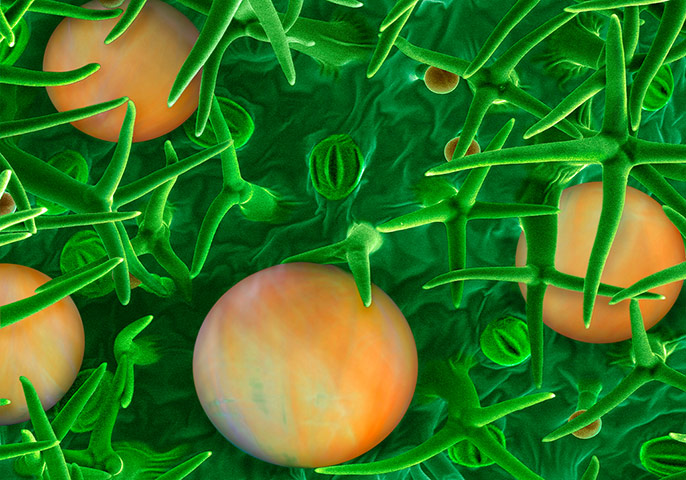
Mystery Monday: What is this? Not another alien from the movie Prometheus in all its 3D gory glory. It’s a scanning EM image of the under surface of a lavender leaf at a scale of 1/50th of a centimeter.

The globules are lavender oil, secreted from spiny glands known as trichomes. The spines also protect the leaf against pests and reduce water loss. The eye-like or elliptical structures with a narrow slit are the stomata or breathing pores.

The oil of Lavandula is used in perfumes, aromatherapy and to counter anxiety. Oddly, it also mimics female hormones. As such, use of lavender (and tea tree) oil is suspected to promote breast development in both boys and girls who are particularly susceptible to androgenic and estrogenic compounds.

Photo: Annie Cavanagh; Wellcome Images http://goo.gl/wM1M3

#scienceeveryday  

Posted in Rajini Rao | Tagged | 22 Comments

THE HOLY GRAIL: Structure of a Nanomachine If seeing is believing, how do scientists see cellular nanomachines,…

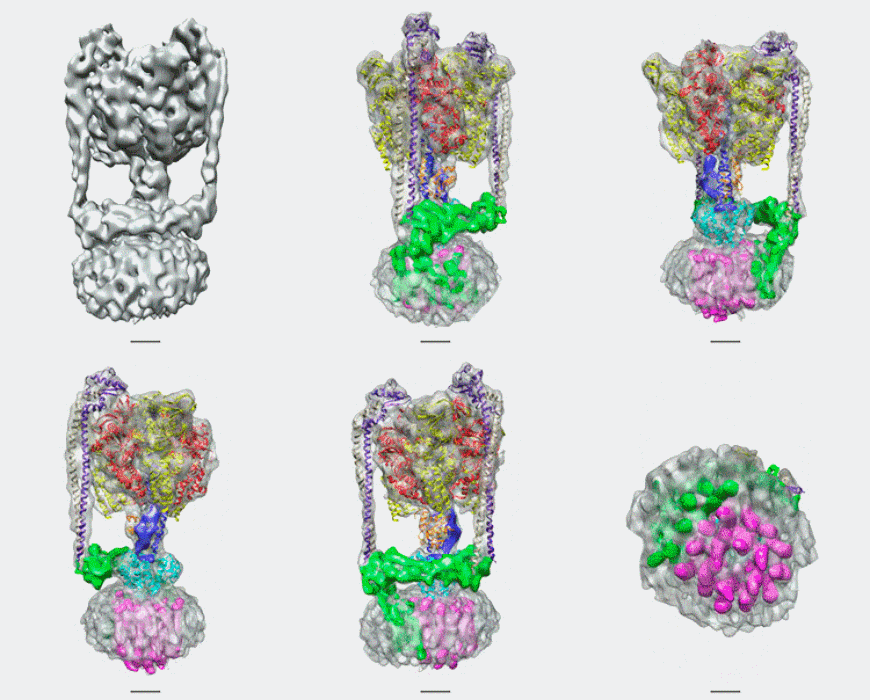
THE HOLY GRAIL: Structure of a Nanomachine If seeing is believing, how do scientists see cellular nanomachines, smaller than the wavelength of visible light? One way is to use a beam of electrons 100,000 times smaller than ordinary light to peer at individual atoms. But the energy of the powerful 200,000 volt electron beam can destroy the protein being imaged: imagine the radiation damage if you stood 20 m away from a thermonuclear device.
Take a Chill Pill: To cut down on damage to delicate chemical bonds, scientists use a variation known as Cryo EM. First, they place the purified sample on to a microfabricated carbon grid. Then they plunge it into a bath of liquid ethane that instantly vitrifies water, not allowing it to form crystals. This preserves the molecules in its native state. Using only a small puff of electrons, they image the sample in liquid nitrogen in a vacuum.  The resulting underexposed and overdeveloped image is disappointingly grainy. So they average many images of the same view to sharpen the resolution and cut down on noise. The 3D image is made from a series of tilted 2D images.

Tripping on Acid: The image seen in gray scale is at an unprecedented 9.7 angstroms resolution (or 0.97 nm) of a nanomachine from an ancient bacteria, Thermus thermophilus.  Although it functions as a rotary ATP synthase, it resembles the V-ATPase found in our cells- another rotary machine that works in reverse: breaking down ATP to acidify compartments. The V-ATPase and the ATP synthase share a common evolutionary origin seen in ancient archaebacteria like Thermus.

Intel Inside: Inside the gray outline seen by cryo-EM are the individual proteins that make up this nanomachine, observed by X-ray imaging. Compared to the ATP synthase (goo.gl/gjiZN), the V-ATPase is even more complex and sophisticated.

__________________________________________________________

Many thanks to expert gif-fer and science enthusiast Kevin Staff  who converted the original movie for your viewing pleasure! Check out Kevin’s original style and wit on his profile.

♫  Konstantin Lamanov saw the HOLY GRAIL and suggested the mystical melody of “The Holy Grail” Composed by Laurence Galian

Thank you for the musical pairing, Konstantin Lamanov as always 🙂

REF: Subnanometre-resolution structure of the intact Thermus thermophilus H+-driven ATP synthase.Lau WC, Rubinstein JL. Nature. 2011 Dec 18;481(7380):214-8. doi: 10.1038/nature10699

John Rubinstein: http://biochemistry.utoronto.ca/rubinstein/bch.html

ScienceSunday #sciencesunday  

Posted in Rajini Rao | Tagged | 31 Comments

THE KING OF FRUITS: Making Green Mango Rice.

THE KING OF FRUITS: Making Green Mango Rice. It has been said that India has only two seasons: Monsoon season and Mango season. While the monsoon replenishes Indian soil, mangoes are food for the soul.  Did you know that India holds 40% share of the world mango production?

• Having to forgo Indian mangoes was definitely a downside of emigration to the US. I don’t count Mexican mangoes: sorry Bobby Flay, I’m sure your mango salsas are nicely fibrous and vaguely sweet 😉 but these mangoes are unfit for consumption unless cooked. I brightened momentarily when President GW visited India, fell in love with the most regal of mangoes, the Alphonso, and granted special import permit for this variety, only to be foiled by the competitive Indian shopper who snaps up crates of mangoes at the going rate for gold. I recall a friend attempting to smuggle import a crate of mangoes from Toronto. At being stopped at the border and asked to throw them away, she refused indignantly. Instead, the family pulled over for an impromptu mango feast with the Customs officers joining in with gusto.

My green mango rice was inspired by a photograph shared by Feisal Kamil taken in his mother-in-law’s garden in Terengganu. The rice tastes even better after the flavors have had time to blend: delicately tangy and slightly sweet, sharply astringent with mustard, balanced out by creamy richness of coconut, all topped with crunchy peanuts and little pops of roasted mustard seeds. Enjoy!

Recipe: https://madamescientist.wordpress.com/2012/06/16/the-king-of-fruits-making-green-mango-rice/

#foodporn #food

Posted in Rajini Rao | 129 Comments

The King of Fruits: Making Green Mango Rice

It has been said that India has only two seasons: Monsoon season and Mango season. While the monsoon replenishes Indian soil, mangoes are food for the soul.  Did you know that India holds 40% share of the world mango production?

Having to forgo Indian mangoes was definitely a downside of emigration to the US. I don’t count Mexican mangoes: sorry Bobby Flay, I’m sure your mango salsas are nicely fibrous and vaguely sweet 😉 but these mangoes are unfit for consumption unless cooked. I brightened momentarily when President GW visited India, fell in love with the most regal of mangoes, the Alphonso, and granted special import permit for this variety, only to be foiled by the competitive Indian shopper who snaps up crates of mangoes at the going rate for gold. I recall a friend attempting to smuggle import a crate of mangoes from Toronto. At being stopped at the border and asked to throw them away, she refused indignantly. Instead, the family pulled over for an impromptu mango feast with the Customs officers joining in with gusto.

My green mango rice was inspired by a photograph shared by a Malaysian friend taken in his mother-in-law’s garden in Terengganu.  It is adapted from Chandra Padmanabhan’s Dakshin cook book of vegetarian, South Indian cuisine.

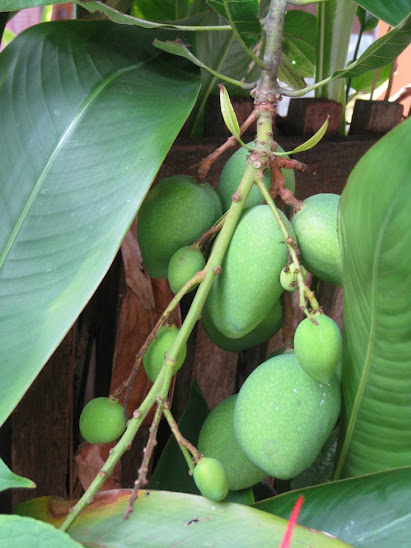
Green Mangoes in Malaysia

Green Mangoes in Malaysia

  • Cook one cup of long grained rice (Jasmine or Basmati). Preferably do this ahead. For me, that meant calling home from the gas station to ask my husband to get the rice started.  Let cool by spreading out on a platter.

Spread cooked rice to cool

Spread cooked rice to cool

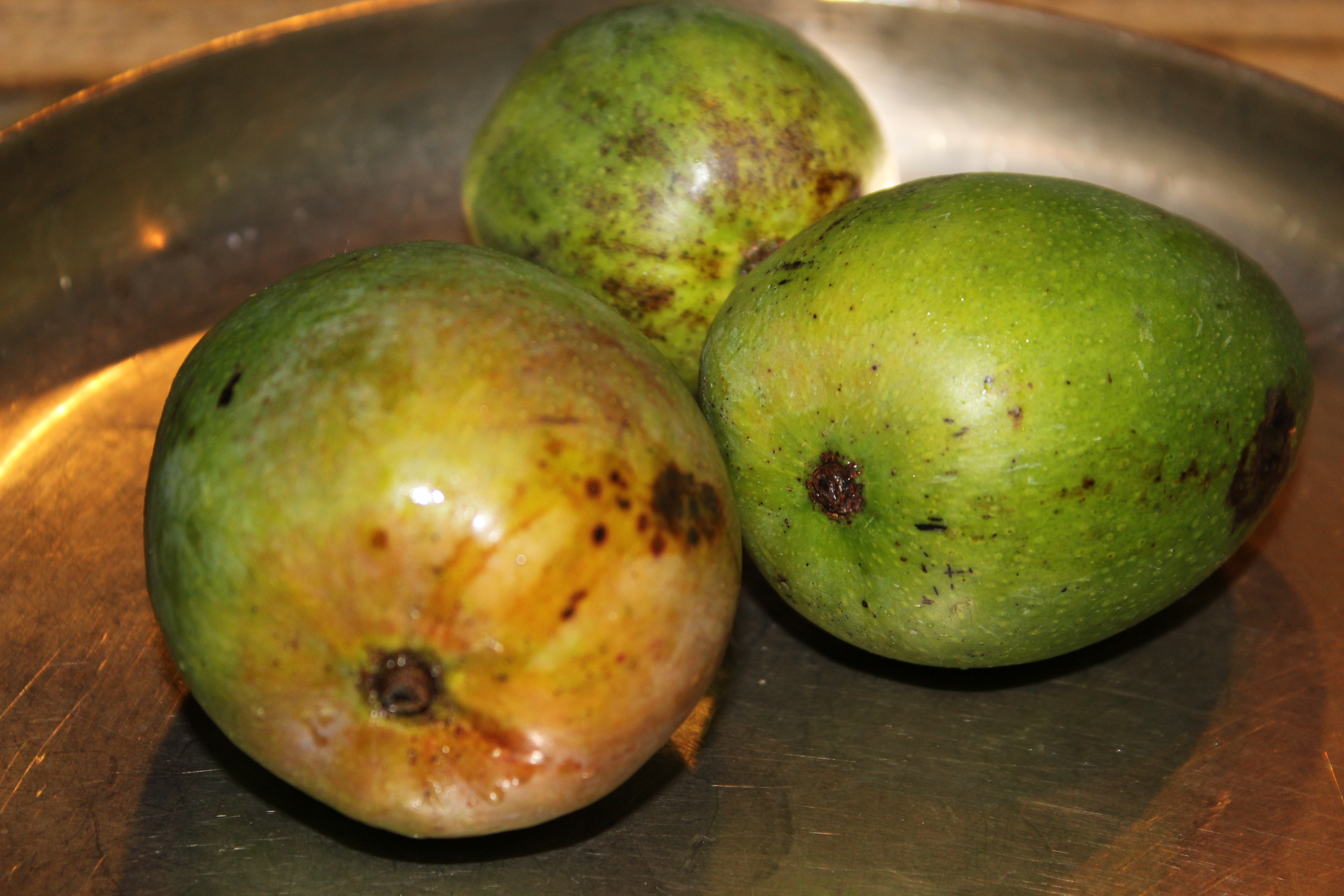
  • Green mangoes: You will need three small ones or two medium ones or one large… (you get the idea).

Three little green mangoes

Three little green mangoes

  • Peel and grate the mangoes. Mine turned out to be slightly ripe, oops. This was likely because they were sitting around for a week.

Grated mangoes: not quite unripe

Grated mangoes: not quite unripe

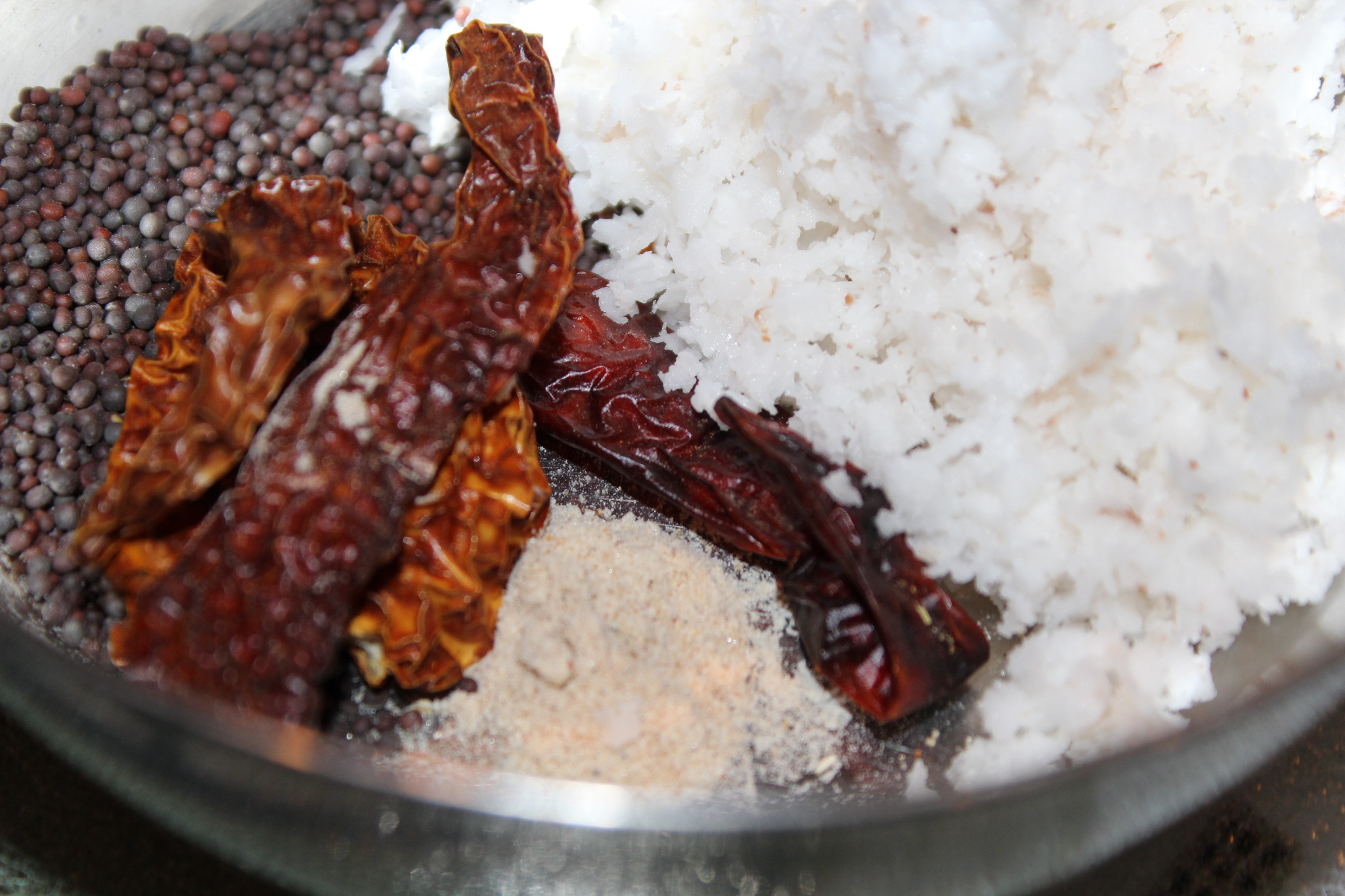
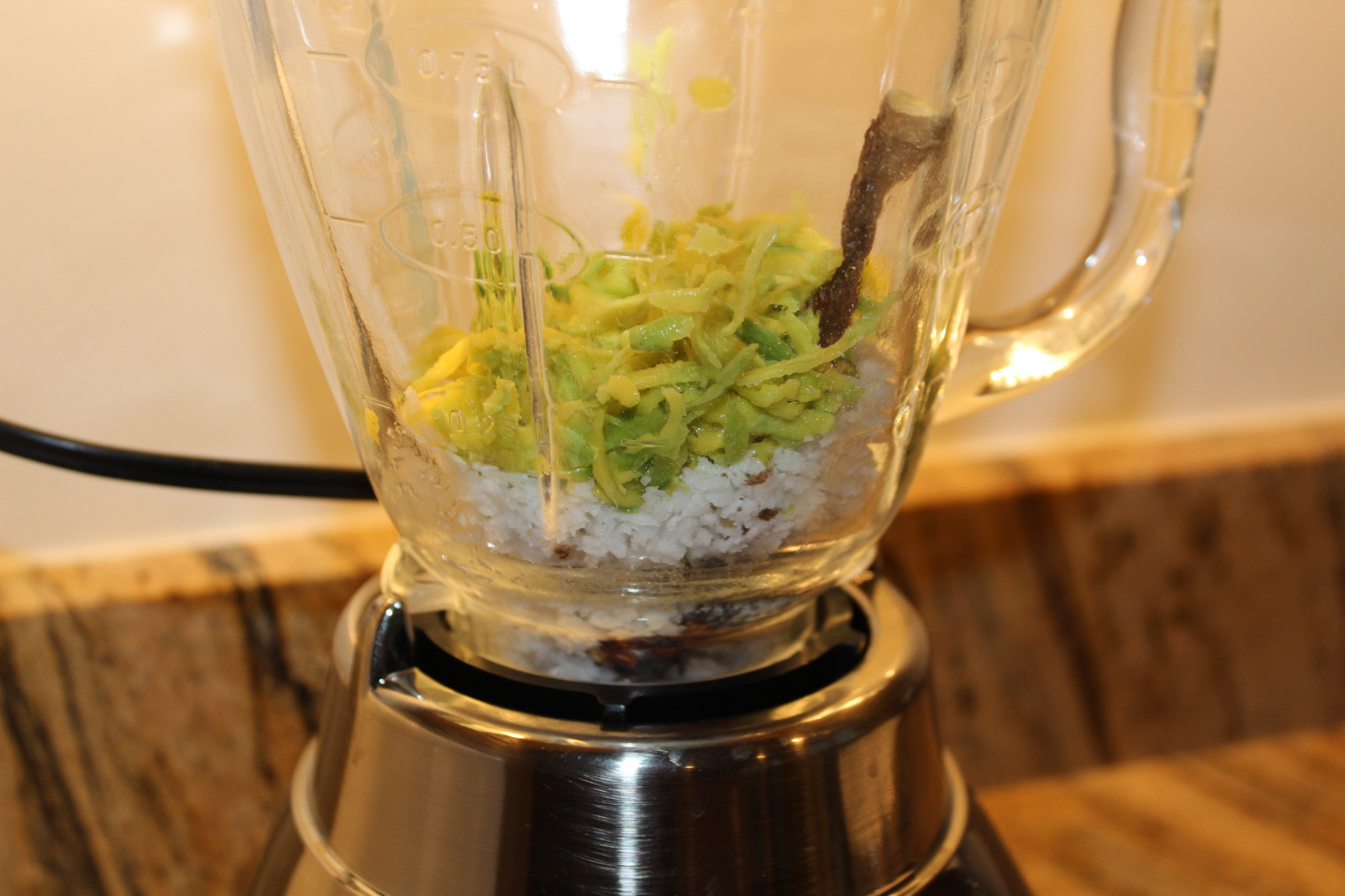
  • Grind together: One cup of grated mango, 1.5 tsp black mustard seeds, 0.5 cup fresh grated coconut, 2-4 dry red chilies, and 0.5 tsp of asafoetida powder. You can find grated coconut in the freezer section of your local Indian grocery store.  I’ve described the uniqueness of asafoetida (hing) before. It’s the Brahmin equivalent of garlic. If you don’t care to be an orthodox Brahmin or can’t locate this gum exudate (or both), try substituting a clove of garlic.

Clockwise: mustard seeds, grated fresh coconut, asafoetida powder (hing), dry red chilies

Clockwise: mustard seeds, grated fresh coconut, asafoetida powder (hing), dry red chilies

  • You will need to add a few tablespoons of water to get the blender going.

Mango chutney in blender

Mango mixture in blender

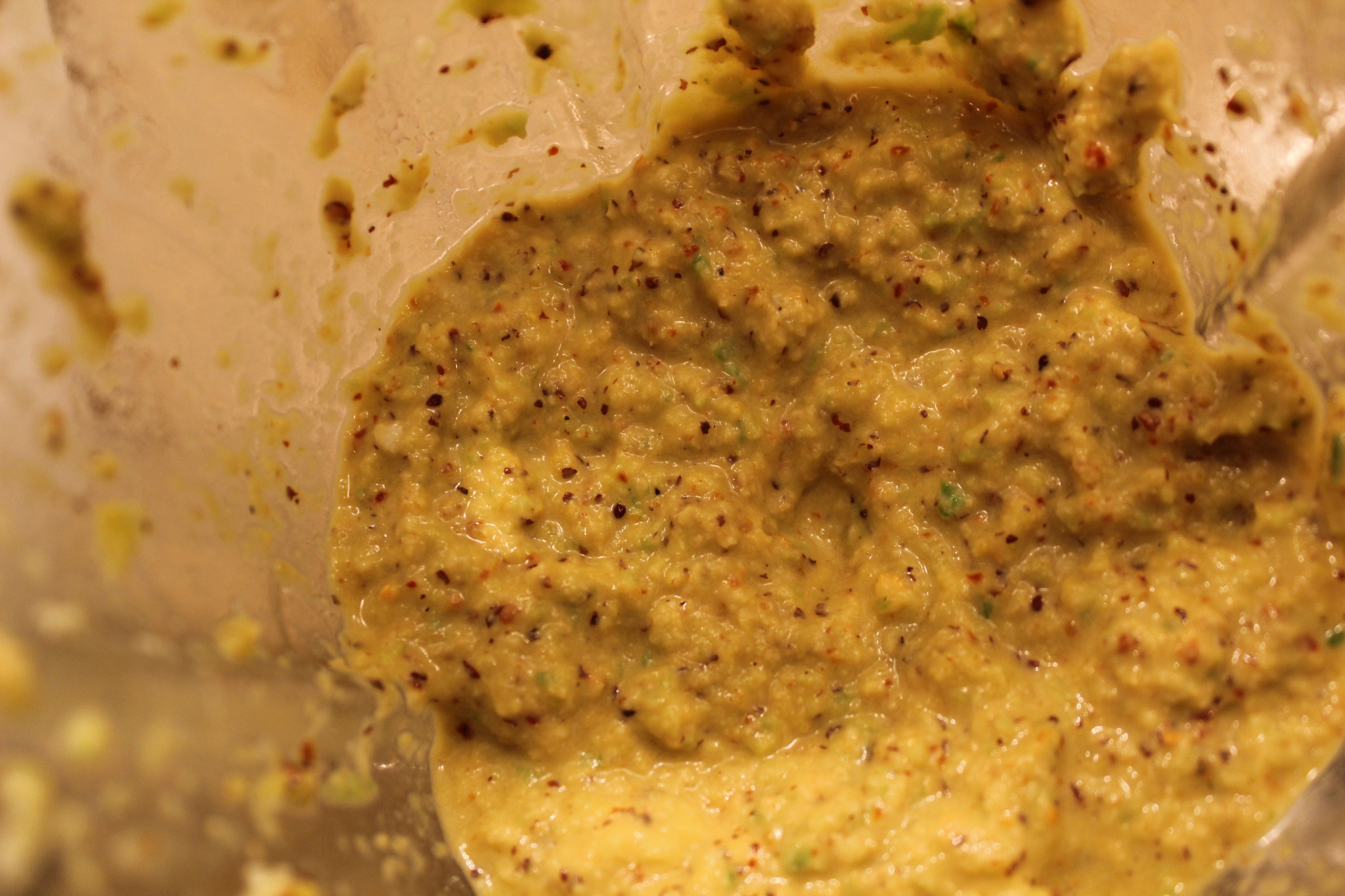
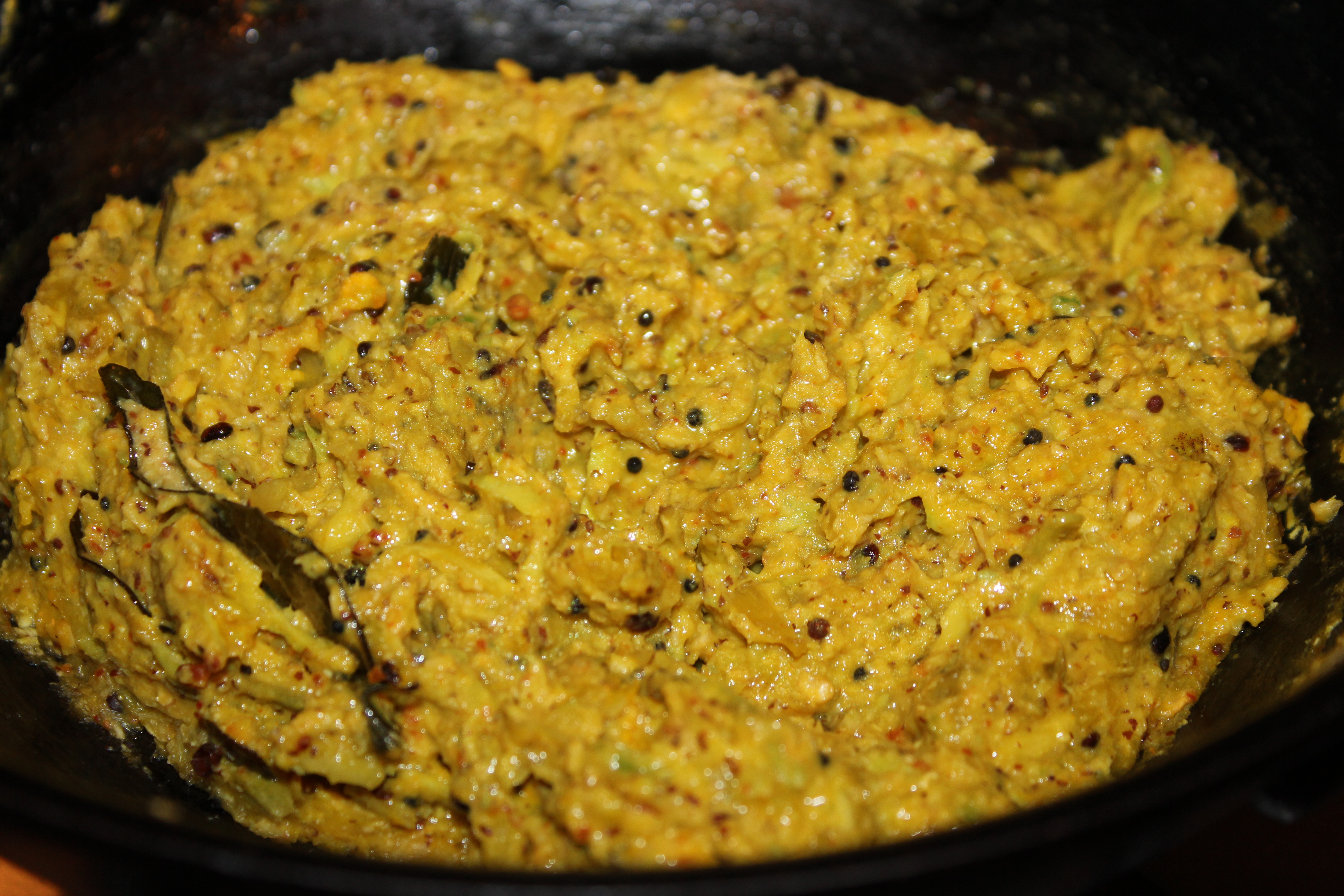
  • You should end up with a tangy, raw mango chutney with a mustardy kick to it.

Mango chutney

Mango chutney

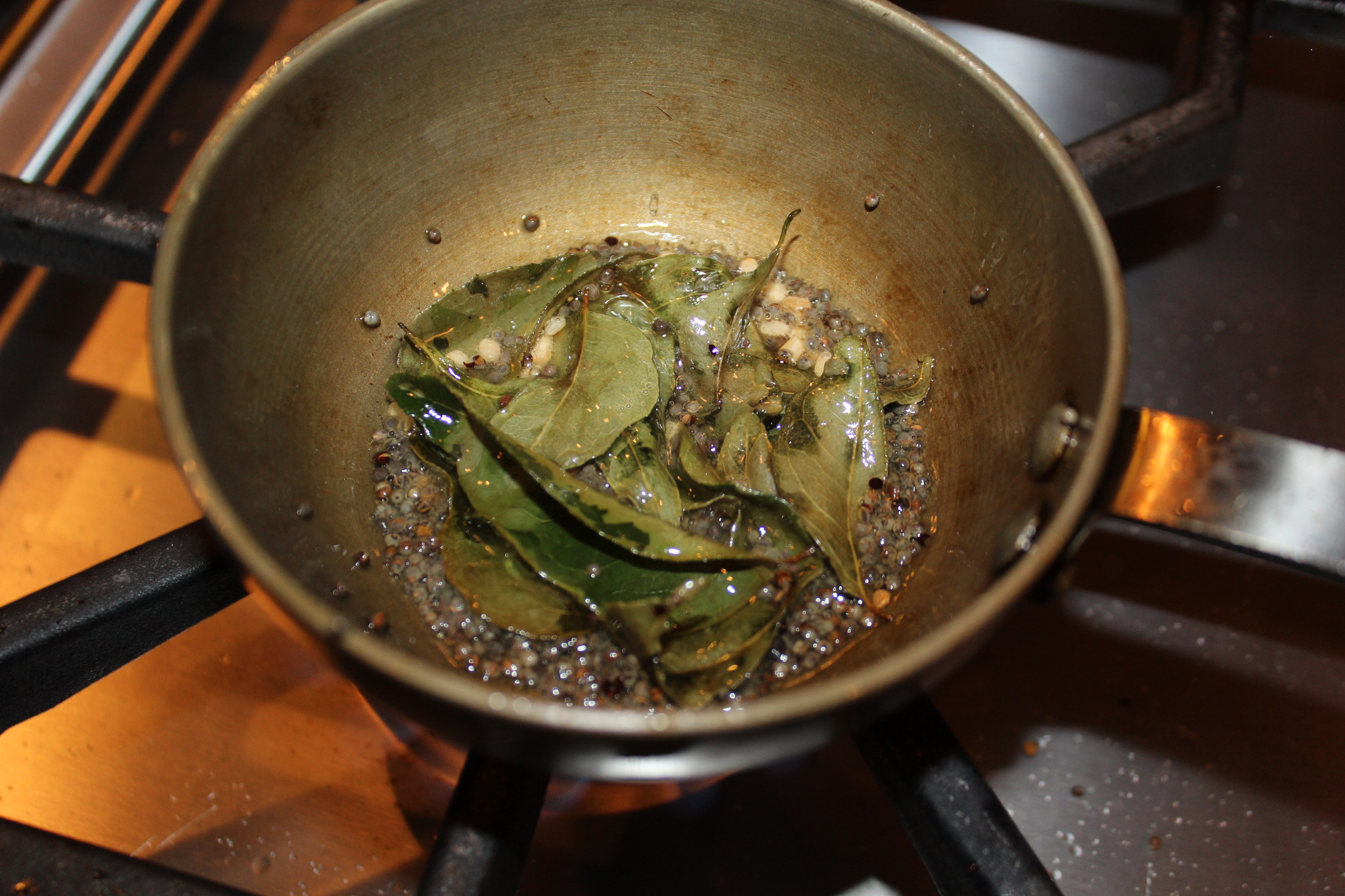
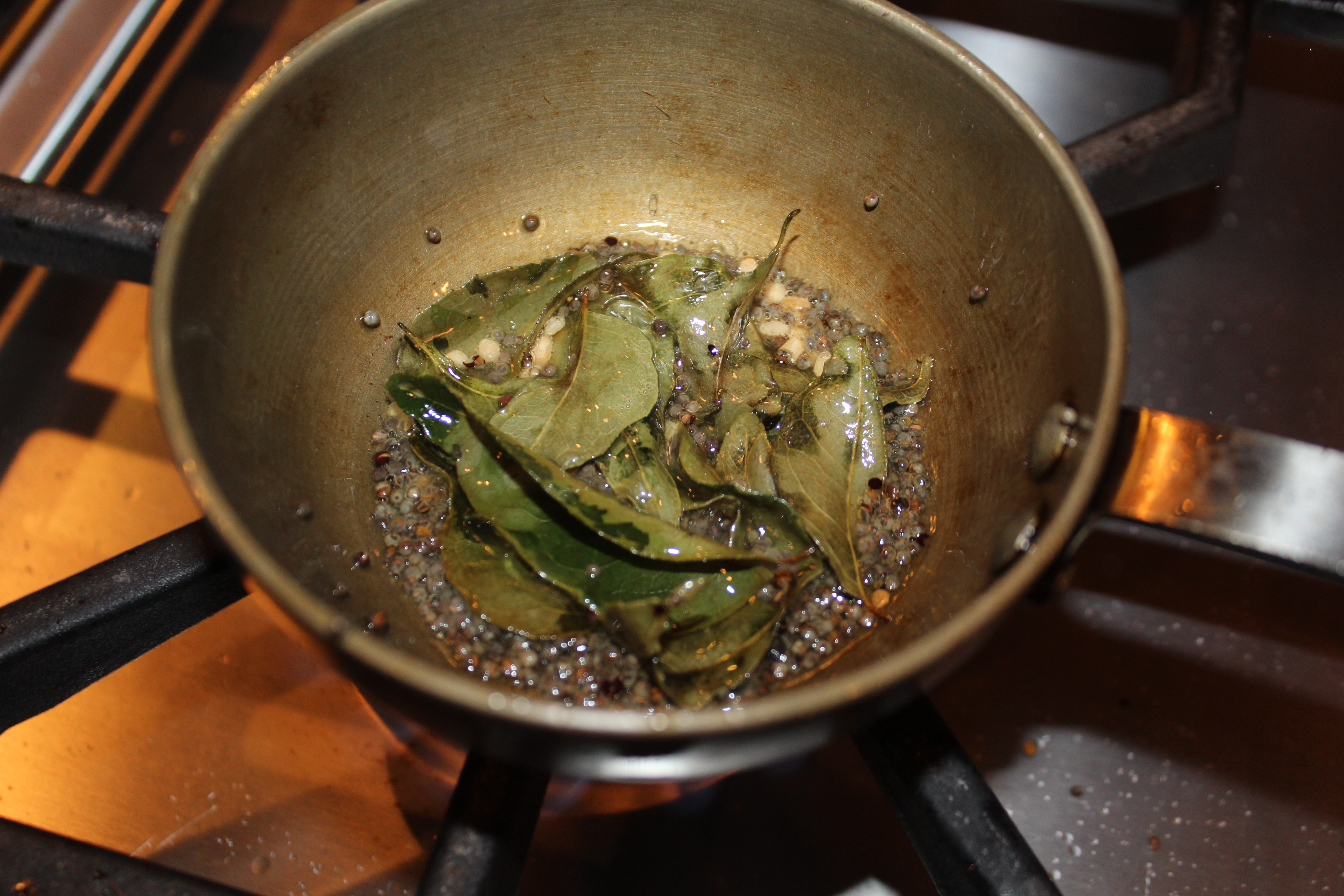
  • Tempering: A standard step in southern Indian cooking, this step adds another layer of flavor and crunchy texture to the rice. To a tablespoon of hot oil, add 1 teaspoon of mustard seeds and 1 tablespoon of split white Bengal gram (urad dal). When the mustard seeds change to pale gray and pop explosively (step back, or find a handy cover), add a handful of fresh curry leaves (kari patta; I save mine in the freezer so they are not quite as freshly green as I would like, but good enough).  If you are going to be using unroasted peanuts, add them now. Otherwise, wait until later.

Tempering mix of mustard, black Bengal gram dal and curry leaves

Tempering mix of mustard, black Bengal gram dal and curry leaves

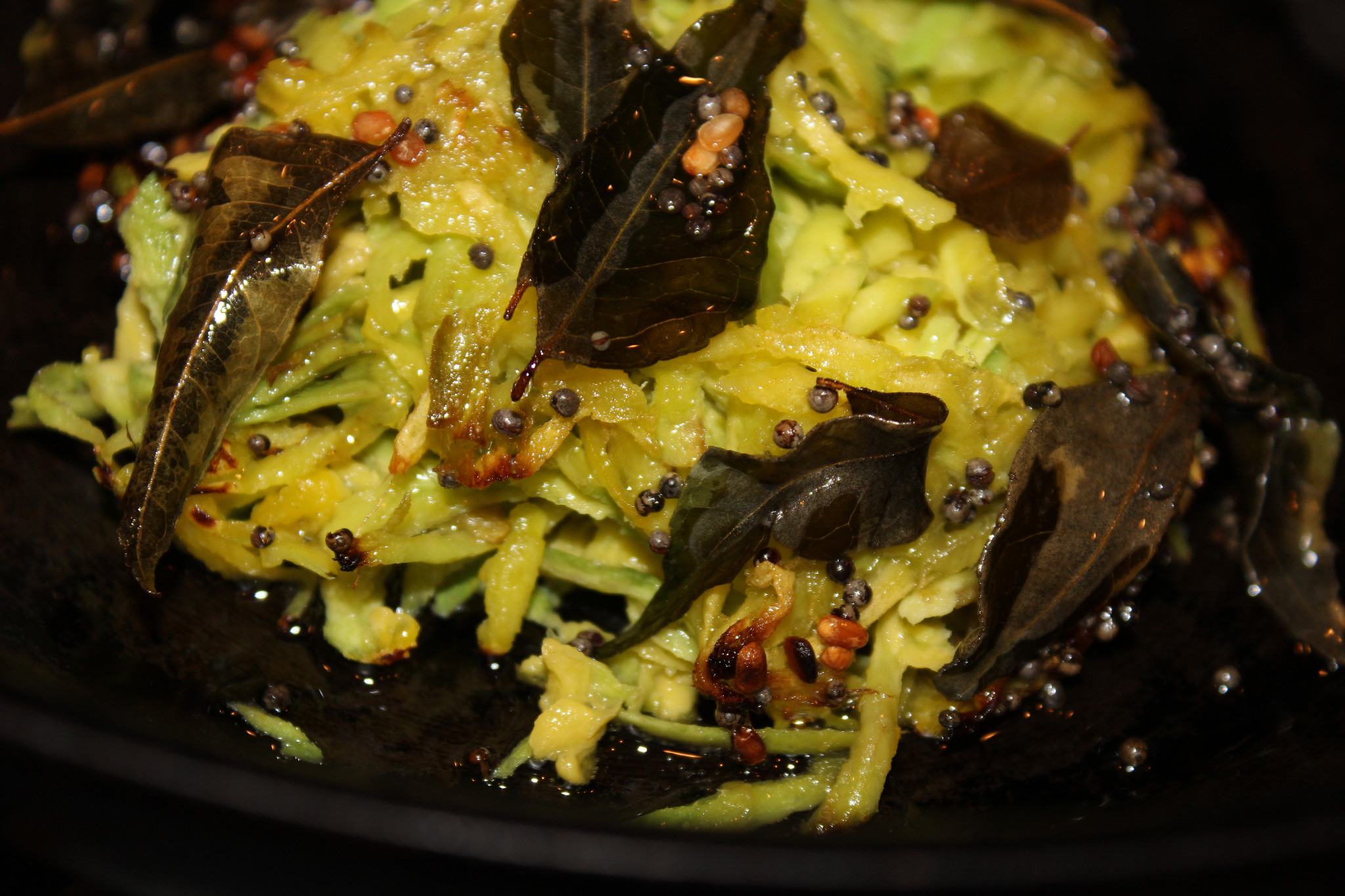
  • Add the remainder of the grated mango (0.5-1 cup, use it all up!).

Grated mango with tempering

Grated mango with tempering

  • Add the ground mango chutney and continue cooking on low heat for about 5 minutes until it is no longer raw.  Season with salt and turmeric. Let cool.

Cook down the mango chutney

Cook down the mango chutney

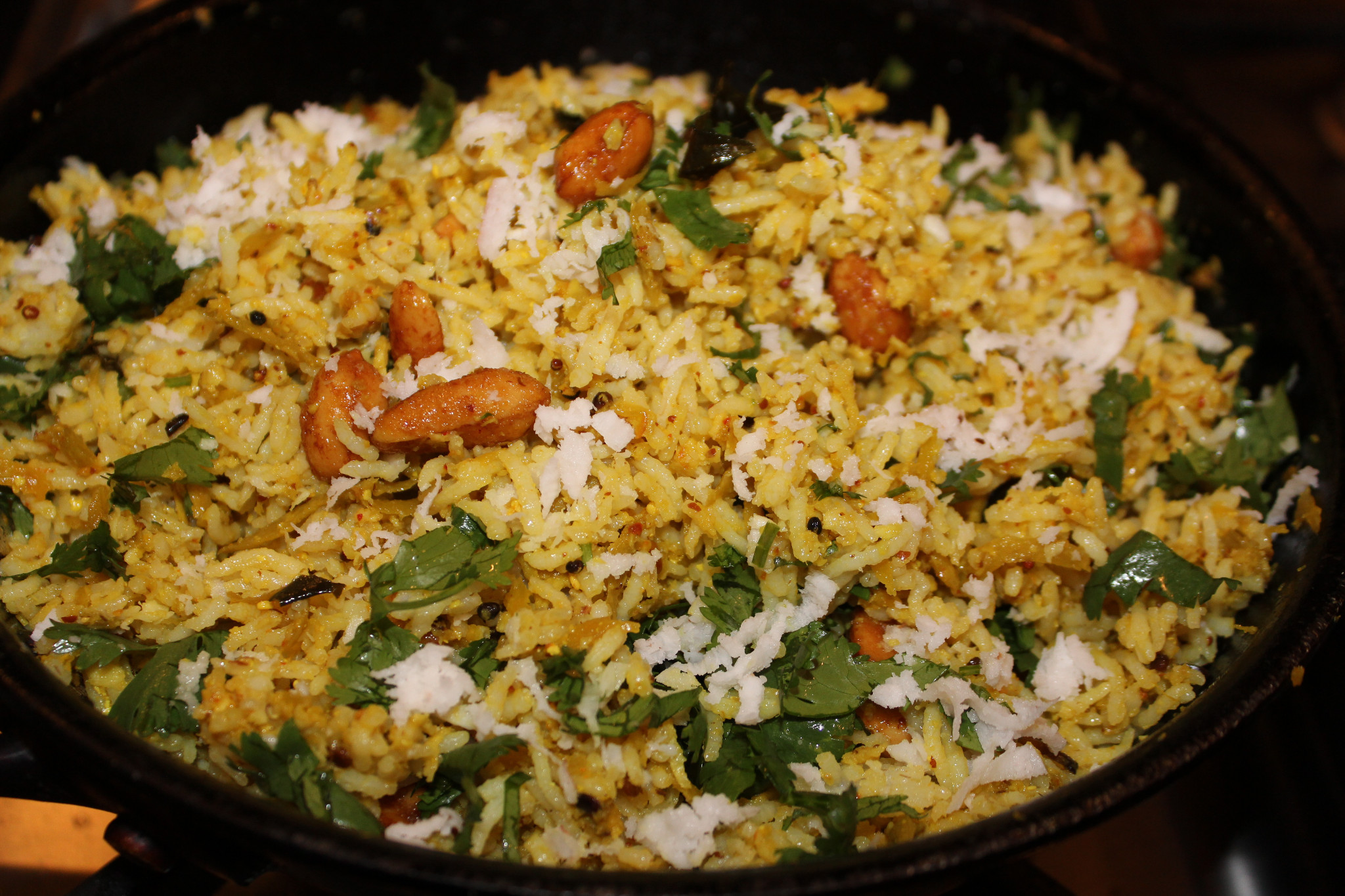
  • Assemble the mango rice: Mix the chutney gently into the rice, taking care not to mush the delicate grains in the process. I find my fingers work best for this (I washed my hands, promise). Be patient, working the mixture together so that no pockets of plain rice remain. Use a sprinkling of sesame or other oil if the mix looks dry. Add roasted peanuts, additional coconut if you feel extravagant (I did) and a sprinkling of coarse sugar to balance the tartness of the mango.

Green mango rice with peanuts and coconut

Green mango rice with peanuts and coconut

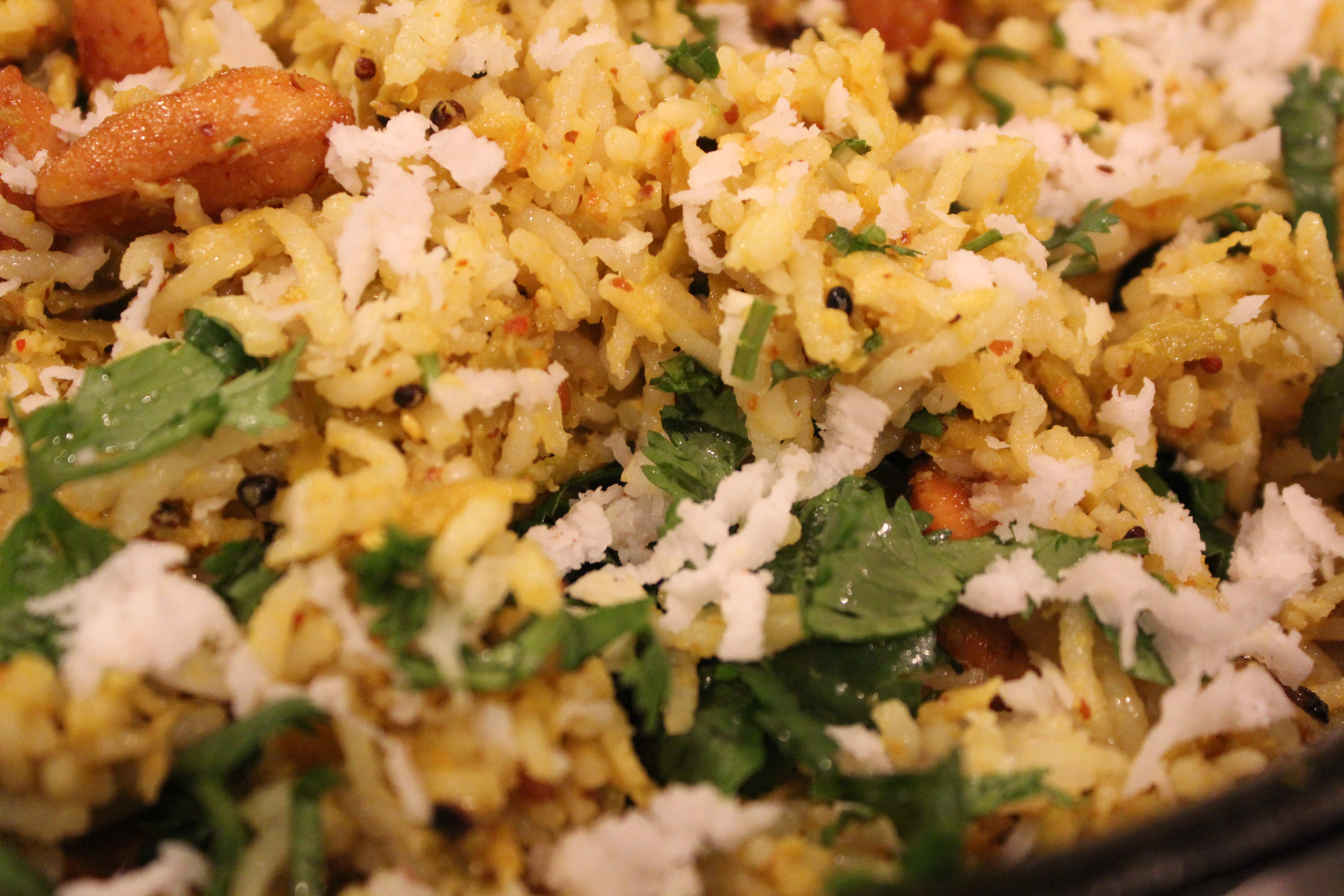
  • Garnish with chopped cilantro and a sprinkling of fresh coconut. The rice tastes even better after the flavors have had time to blend: delicately tangy and slightly sweet, sharply astringent with mustard, balanced out by creamy richness of coconut, all topped with crunchy peanuts and little pops of roasted mustard seeds. Enjoy!

Garnish with cilantro, more fresh coconut, peanuts and a sprinkling of coarse sugar

Garnish with cilantro, more fresh coconut, peanuts and a sprinkling of coarse sugar

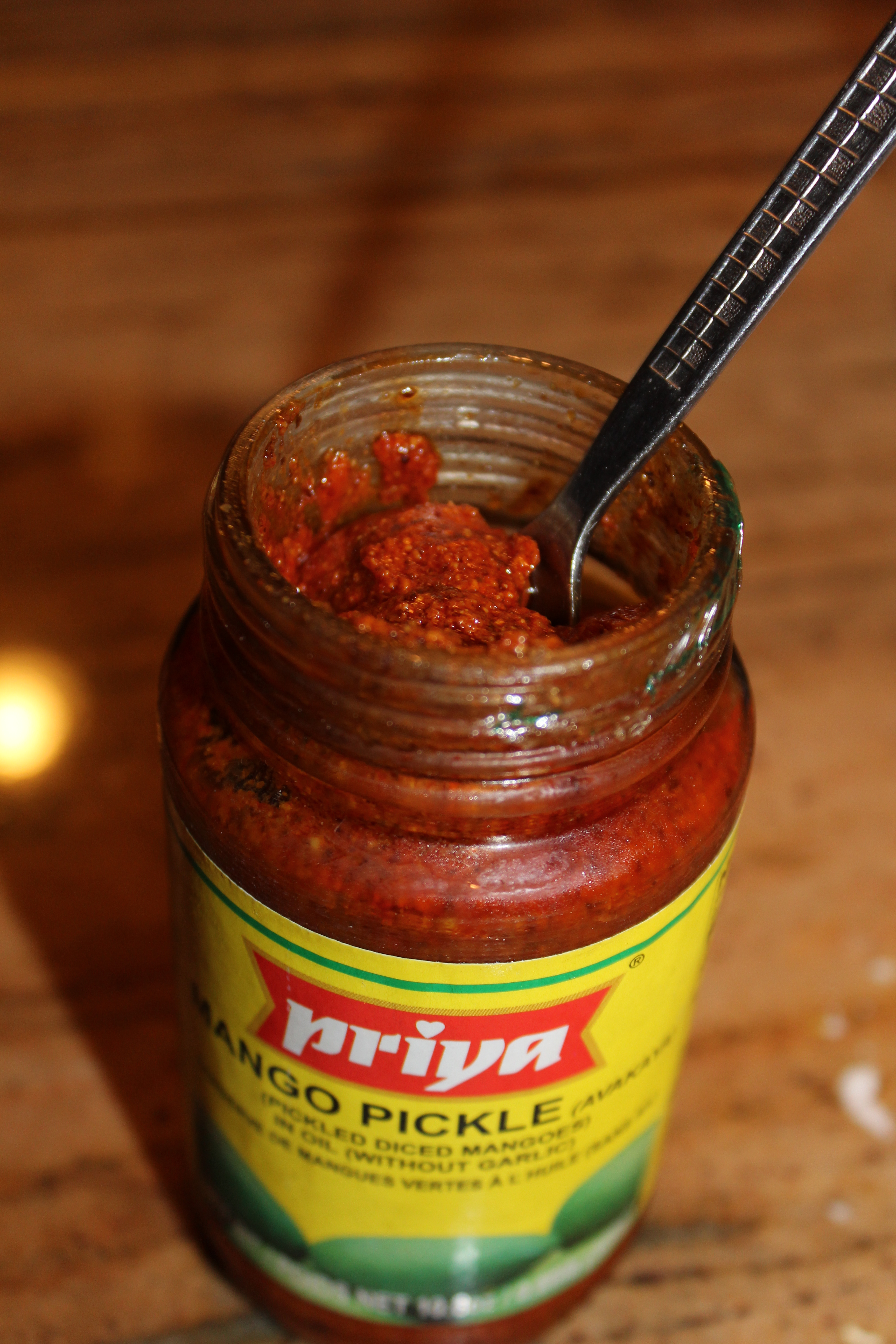
  • We ate it with mango pickle on the side!

Mango pickle

Mango pickle: note the label (without garlic! Yes, it has asafoetida instead)

Posted in FOOD, Indian food | Tagged , | 7 Comments

Stem Cells Blossom: Human induced pluripotent cells (iPSC) are stem cells made from ordinary (non-embryonic) skin…

Stem Cells Blossom: Human induced pluripotent cells (iPSC) are stem cells made from ordinary (non-embryonic) skin cells that are given a transformational cocktail of four genes (cMyc, Oct4, Klf4, and Sox2). This allows reprogramming into any adult cell, such as human brain cells shown in the video.

• This breakthrough, first reported in 2006-07 by Shinya Yamanaka (Kyoto Univ. and UCSF), is being recognized by the Millenium Technology Prize. Yamanaka shares the prize with Linux creator, Linus Torvalds.

News: http://www.panarmenian.net/eng/news/111934/

iPSC: http://en.wikipedia.org/wiki/Induced_Pluripotent_Stem_Cell

#sciencesunday #scienceeveryday  

Posted in Rajini Rao | 26 Comments