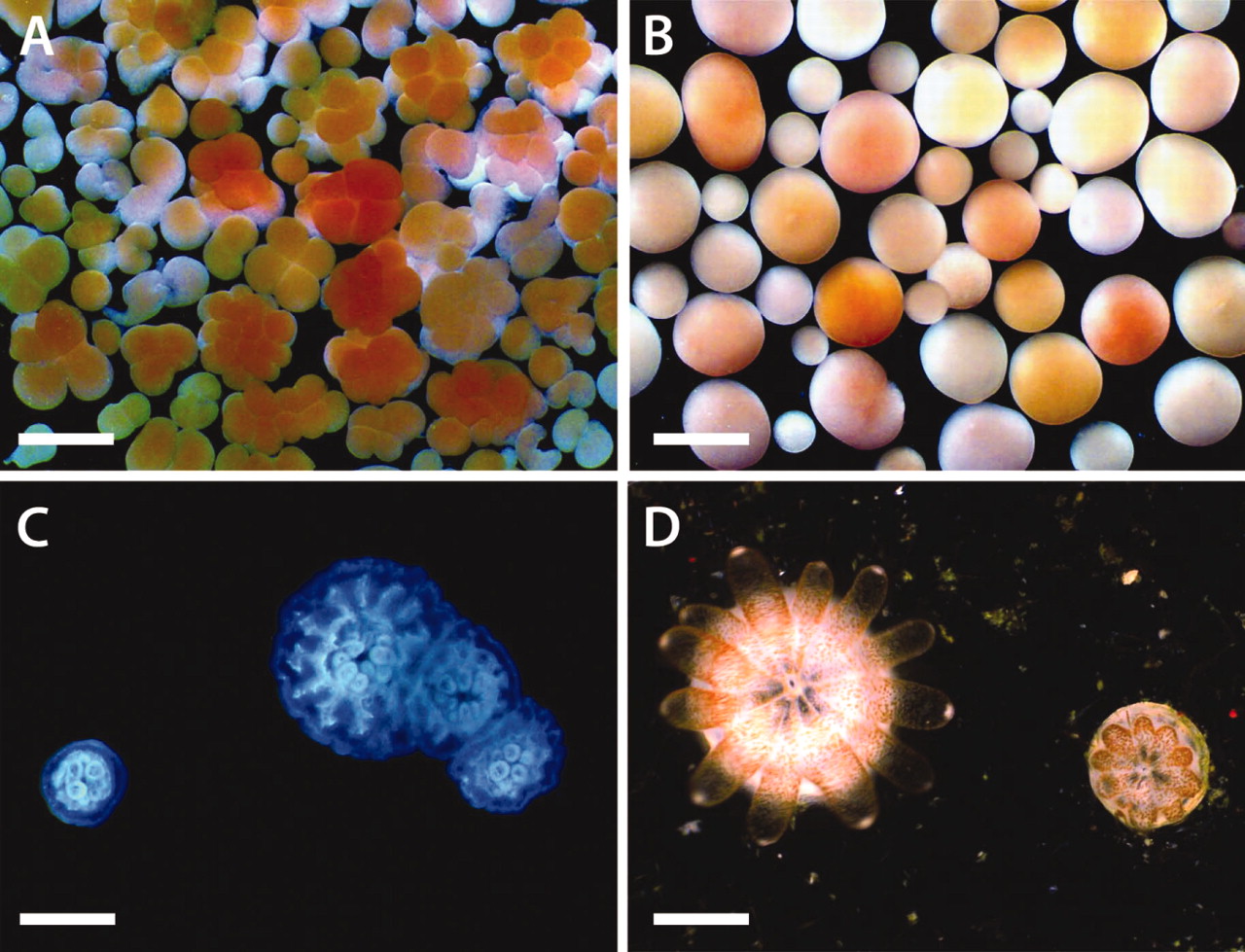
The Curious Case of Coral Clones. Coral embryos are naked. Unlike other animal embryos, they lack a protective capsule and float exposed in the ocean, buffeted by waves. Scientists observed that embryos at the 2, 4, 8 and 16 cell stage frequently break up into smaller clumps of cells (Image A). Does this mean that coral embryos in the open ocean are damaged and destroyed?
Surprisingly, each of these fragments goes on to become a complete larva (B) and then juvenile coral (C and D), exact clones of the original, only smaller . We call this ability totipotency: stem cells that can become any cell in the body. This unusual combination of sexual reproduction (to form an embryo) followed by asexual reproduction (to form genetic clones) has not been observed before. Those naked embryos are not so helpless after all!
REF: Science 2 March 2012: Heyward and Negri. Turbulence, Cleavage, and the Naked Embryo: A Case for Coral Clones DOI: 10.1126/science.1216055


 madame scientist's not-so-mad musings
how interesting- and after reading, it completely makes sense! It seems this would be very helpful information for saving/restoring damaged coral reefs.
prabhat parmal , B, C and D are different stages of development of the same organism, in this case, a coral. A is the embryo, B is the larva that comes from it, etc. The observation here is that if the embryo breaks up, it is not a problem, each bit gives rise to an independent adult, except that they are different sizes. Makes sense?
They all become exactly the same thing..genetic copies of each other. Imagine if there were hundreds of prabhat parmal s on G+ simply because the taxi cab your mom was riding in went over a speed bump 🙂
Yes, exactly Martin Sacha . Apparently, this combination has not been observed before. Straightforward asexual reproduction is common, but it has the disadvantage of not promoting genetic variation which is bad for the species in the long term (only in meiosis, when the number of chromosomes is halved, is there exchange of genetic material between pairs before they segregate). This seems to be a clever compromise.
Peter Lindelauf , the butler was guilty of following instructions of “shaken, not stirred” 😛
Very interesting.
“Corals clone in bad weather”
http://www.news24.com/SciTech/News/Corals-clone-in-bad-weather-20120302
The new study, published in the journal Science, found that if there was some turbulence in the water such as a storm, these offspring often cloned to create genetic replicas of themselves rather than break up.
jose montarig , yes..the new study they refer to is the one that I describe (the figure is from the Science paper).
Thanks Rajini Rao . Maybe one day this science of cloning will be useful for “self regeneration of limbs” research.
Agree, jose montarig . Also in understanding totipotent stem cells.
And according to Wikipedia: (https://en.wikipedia.org/wiki/Cell_potency)
Research on Caenorhabditis elegans suggests that multiple mechanisms including RNA regulation may play a role in maintaining totipotency at different stages of development in some species
What are identical twin in humans, then? Same genetic code (i assume)
Identical twins share the exact same DNA (same egg and same sperm). Fraternal twins are two different eggs (and two different sperm).
According to Wikipedia, there’s also semi-identical twins where the twins share the same DNA from the mother, but different DNA from the father. Very odd!
Identical twins can be considered related to this feature of coral. What makes coral unique/different is that the embryo is basically made to be broken apart easily to form more children (where-as when it happens in humans, it’s unintended and is essentially a “mistake”). Coral uses both sexual and asexual reproduction techniques for an evolutionary advantage 🙂
Identical twins do not share 100% of their DNA. Do a search and you will find articles about it. From what I’ve studied, there are segments of DNA that aren’t really responsible for specific traits, but do repeat various times and it’s different for everyone, even identical twins. These segments can be
used for genetic identification.
Ahh. I found a New York Times article that explains the twins not having 100% identical DNA: http://www.nytimes.com/2008/03/11/health/11real.html
Our body seems to alter our own DNA throughout our lives. I wonder if the changes are throughout our body or if they’re locational, if the body somehow is able to sync itself, or if there’s some other mechanism/reason for the DNA to change uniformly.
Exactly, david olick ! It’s epigenetics 🙂
Drew Sowersby , do try to keep up with me! 😀 This is the Tetris post (if you missed it, you will like it I think): https://plus.google.com/u/0/114601143134471609087/posts/ixnkAkHhsLj
(I see now that you did +1 it). Thank you for the wonderful link! 🙂
Do I get -1 for the smiley, Peter Lindelauf ?