Catchphrases of 2011! It’s that time of year when we review our use and misuse of the English language. How many of these did you use? Here’s what’s trending, or even gone viral .
• Awesome is the new cool. I think it is an awesome word.
• Crowdsourcing is all the rage these days and appears to be a combination of crowd and outsourcing. Google plussers in particular think it is awesome.
• Gravitas instantly confers gravitas on the user, particularly if crowdsourced.
• # Add a hashtag to make your trite comment seem witty! Note that it can be combined with Occupy for greater effect as in, “I’m hungry #goingtooccupythefridge.”
• Fail has graduated from the passe Epic Fail to #Fail
• OCDing can make your trivial occupation more awesome, as in “I’m OCDing over my Google+ circles”. Adding ADD to your self-diagnosed persona gives instant gravitas. #OccupyMedicine!
Food Rules! While you are enjoying your holiday feast today, did you wonder why some flavors come together like a match made in heaven? Wine and cheese. Tomato and basil. Green eggs and ham. Okay, maybe not the last. A new study released in Nature investigates the science behind “The flavor network and principles of food pairing”. (Do you think field trips to restaurants were part of the study?).
Hypothesis: Ingredients sharing flavor compounds taste better together than ingredients that do not. Currently held in vogue by many chefs and food scientists, this has led to new pairings of white chocolate and caviar, as they share trimethylamine and other flavor compounds, and of chocolate and blue cheese that share at least 73 flavor compounds (Chocolate, anyone?). Checkout http://www.foodpairing.com so you can experiment for yourself.
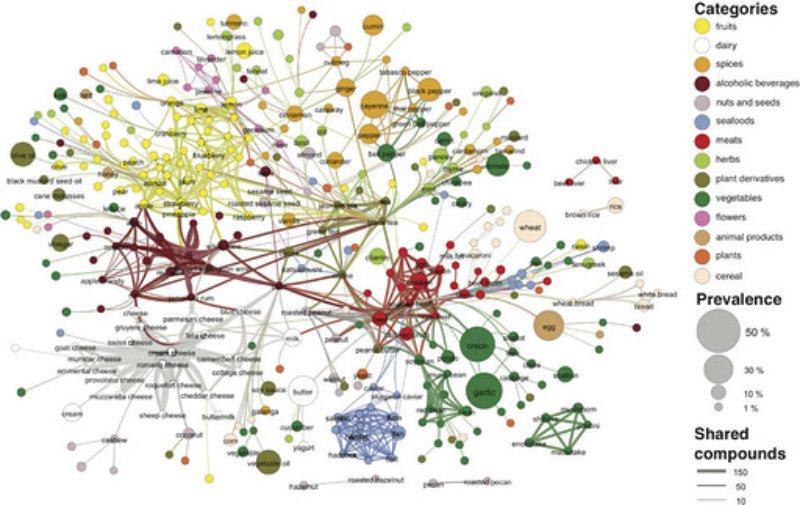
Method and Analysis: Scientists used >56,000 recipes taken from three popular sites, epicurious.com, allrecipes.com (both American based) and menupan.com (Korean). Each ingredient had on average 51 flavor compounds (previously identified by food chemists). They then constructed a flavor network in which any two nodes (ingredients) were connected if they shared flavors. The more flavors shared, the thicker the connecting line. Only statistically significant links are shown (figure).
Results: Network analysis showed that North American and Western European cuisines do indeed contain ingredients with many shared flavors. This was traced to abundant use of milk, butter, cocoa, vanilla,cream, and egg. Unexpectedly the opposite is true for East Asian cuisine! Asian food relies heavily on soy, ginger, scallions, pork and cayenne, ingredients that share very few flavor compounds. The study also identified “flavor principles”, or the most distinctive or authentic flavors of each culture: North American food relies heavily on dairy products, eggs and wheat; by contrast, East Asian cuisine is dominated by plant derivatives like soy sauce, sesame oil, and rice and ginger. (Okay, we knew this already 😉 Also, South European cuisine is closer to Latin American in its flavor profiles whereas Western European food is similar to North American.
Food for thought: As any good scientist knows, the discussion has to include evolution and fitness 😉 The copy-mutate model : each ingredient is assigned a random fitness value, which represents the ingredient’s nutritional value, availability, or flavor. For example, some ingredients are selected because of their antimicrobial properties. The mutation phase of the model replaces “less fit” ingredients with fitter ones. Meanwhile, the copy mechanism keeps copying the founder ingredients (ingredients in early recipes) and makes them abundant in the recipes regardless of their fitness value. What do you think?
I believe in Father Christmas: Greg Lake. One more for the holiday!
Recorded by Lake of Emerson Lake and Palmer in 1975, it was his biggest solo hit.
The original video, shot partly in the Sinai desert and Qumran in the West Bank, also contains shots of the Vietnam War, leading to complaints that it should not be shown with light-hearted Christmas songs (the lyrics are certainly not light hearted, though!). These images of war are a violent backdrop to a peaceful-sounding song and create a hard-hitting message. Unfortunately those scenes are missing in this version, evidently sanitized away..you can find them on other YouTube versions (I picked this for best sound quality).
Wiki: “The instrumental riff between verses comes from the “Troika” portion of Sergei Prokofiev’s Lieutenant Kijé Suite written for a 1934 Soviet film, Lieutenant Kijé.”
For all ELP and prog rock fans, including David Haddad , who mentioned this song as a favorite.












 madame scientist's not-so-mad musings