
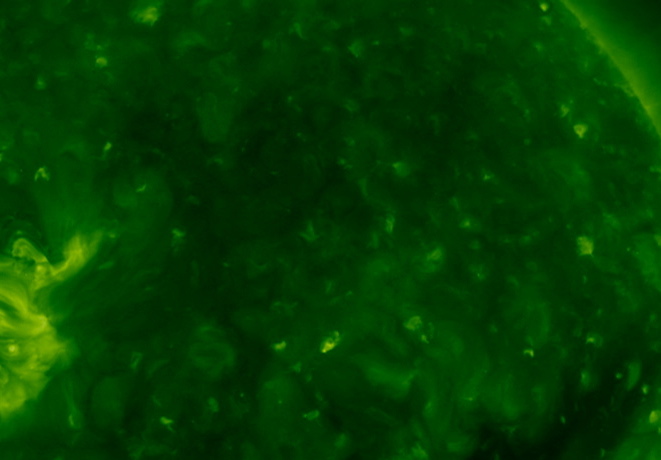
Quiz: Cellular or Celestial — can you tell the difference? Continuing with Day 3 of the week-long challenge.
They get more beautiful, but harder to crack.
Vote here: http://asterisk.apod.com/viewtopic.php?f=29&t=26313
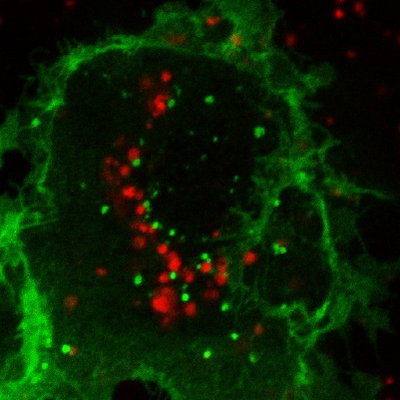

Quiz: Cellular or Celestial — can you tell the difference? Continuing with Day 3 of the week-long challenge.
They get more beautiful, but harder to crack.
Vote here: http://asterisk.apod.com/viewtopic.php?f=29&t=26313

Turn right at the Light: Physics, Meet Neuroscience! Axonal growth directs the development of the nervous system, and the repair and regeneration of neurons. Chemical and electrical cues are known to guide the growing tips of axons, but a new study published in Nature Photonics reveals that “fluidic shear forces” can also play a role.
• Starting with neurons growing in a straight line for over an hour in culture, scientists created a shearing effect on one side by using a photon-driven micromotor. To do this, they used the birefringent property of calcite beads,held in a laser trap and subjected to circularly polarized light. The result was that the beads started to spin, either clockwise or anticlockwise. This is cool, but the really interesting finding is what happens to the growing nerve tips.
• If a particle was spinning counterclockwise to the left of the axon (fluidic shear runs in the direction of growth), the axon quickly turned left (within ~350 seconds), towards the bead. Conversely, if the particle was spinning clockwise, the axon turned away from the bead. Mirror (opposite) effects were seen with spinning particles to the right of the growing tip. Not all the neurons behaved this way…some just kept going straight, but the results were statistically significant. Variations of the experiment, including changing the orientation of the spin or placing opposite spinning particles essentially confirmed their hypothesis, that the growing tips could sense mechanical force .
• The forces were estimated to be ~0.2 pico Newtons, which is the same order of magnitude detected by the hearing cells in our inner ear.
• What are the practical uses for this light driven,non-invasive technique of guiding nerve growth? “One can envision large arrays of these devices that can direct large numbers of axons to different locations,” the authors state. “This may have the potential for use in vivo to direct regenerating axons to mediate brain and spinal cord repair.”
I’ve attached a 7 second video from the publication ( .mov file, ~400 kb) which takes a minute to load. Please be patient (or tell me how to fix it)! Note the debris moving in the field, which indicates the direction of microfluidic flow .
Abstract: http://www.nature.com/nphoton/journal/v6/n1/full/nphoton.2011.287.html
Nice summary in Science Daily: http://www.sciencedaily.com/releases/2011/12/111220102632.htm
Tuesday’s Quiz: Celestial or Cellular? Hosted by the American Association of Cell Biology (ASCB), today’s mystery pix are Google Circle Blues. Decide if each image is from the heavens or from the cell.
Cast your vote here: http://asterisk.apod.com/viewtopic.php?f=29&t=26228
Answers at midnight!
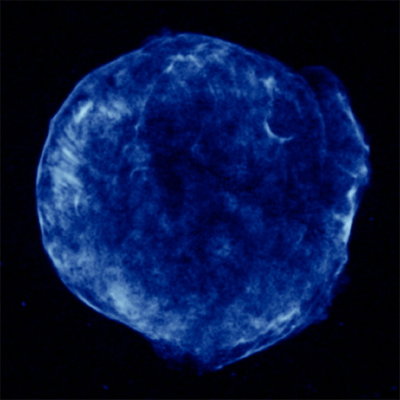
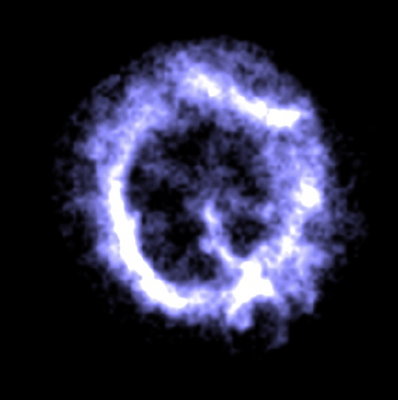
Celestial or Cellular? The American Society for Cell Biology (ASCB) is bringing you a fun quiz all this week. Each day, a pair of images will be uploaded. You decide if each image is of cellular or celestial origin.
Cast your vote here (and see high res images): http://asterisk.apod.com/viewtopic.php?f=29&t=26228
Answers will be revealed at midnight. Check back at the site to find out.
See also: http://www.cellimagelibrary.org/


 madame scientist's not-so-mad musings