Heterophylly in Holly: Science and Season’s Greetings!

Heterophylly in Holly: Science and Season’s Greetings!

⁕  From ancient tree-worshipping Druids to Romans celebrating Saturnalia, from the pagan rituals of Solstice to Hallmark cards of Christmas cheer, the prickly leaves of the Holly (Ilex aquifolium) are a familiar tradition of the season.

⁕  But not all holly leaves are picturesquely prickly. A botanist or gardener knows that the leaves can be smooth or variably serrated, even within a single bush. This is called heterophylly. Scientists took a trip to a forest in southeastern Spain where they noticed a correlation between the grazing pattern of herbivores and the location of prickly leaves- there were more prickly leaves at heights under 2.5 m, the average reach of an adult deer. They then compared the DNA in smooth and prickly leaves from the same plants. Genetically, they were identical, so what explained the difference in appearance? 

Epigenetics is the science that describes how DNA is chemically modified to turn on or off genes. Within the same branch, smooth leaves showed more DNA methylation compared to prickly leaves. These differences were not randomly distributed, but were confined to specific regions of the genome. This suggested that the Holly responded to hungry herbivores by changing which genes were turned on (a process known as transcription) to make more painfully prickly leaves. What’s nice about this swift molecular tit-for-tat is that it does not depend on the slow process of natural selection to respond to immediate pressures in the environment. 

Here’s wishing you Season’s Greetings with this science-y sprig of Holiday Holly!

#ScienceEveryday  when it’s not #ScienceSunday . 

⁕  REF: Epigenetic correlates of plant phenotypic plasticity: DNA methylation differs between prickly and nonprickly leaves in heterophyllous Ilex aquifolium (Aquifoliaceae) trees

Carlos M. Herrera and Pilar Bazaga 

http://onlinelibrary.wiley.com/doi/10.1111/boj.12007/abstract
Posted in Rajini Rao | Tagged , | 55 Comments

The Magical Math of Magicicadas

The Magical Math of Magicicadas

This post was originally published in 2014 and has been update to celebrate the emergence of Brood X in Maryland, USA in the spring of 2021.

Autumn leaves drift down, silently ushering the chilly advent of fall. Gone are the noisy days of summer, synonymous with the incessant, and insistent, chirp of the cicadas made by rapid vibration of abdominal tymbals and orchestrated by a frenzied mass of mating males. Did you know that the chirp of a cicada clocks in at 120 decibels, enough to cause permanent hearing loss in humans?!

A Plague of Primes: Periodical cicadas, of the North American genus Magicicada, have a bizarre life cycle, spending 13 or 17 years underground as immature nymphs, emerging briefly to live, love and die as adults.

Seventeen years of peaceful dreaming,

Followed by a week of screaming*.

Their coordinated emergence, triggered when the soil warms to precisely 64 degrees F, guarantees a plague of biblical proportions: the densest broods can number 1,000 cicadas per square meter! Is there a mathematical basis for 13 or 17 year life cycles? You may have noticed that both are prime numbers: divisible only by themselves and the number 1.

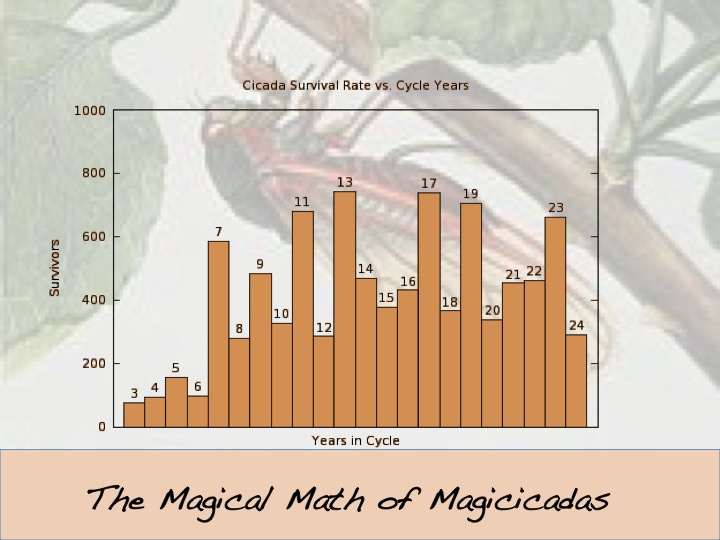
Mathemagics: In the computer simulation** graphed in the image above, notice that 13 and 17 year periods produce the most survivors. The cicadas only defense against predators is their sheer number, and their survival strategy is simple- predator satiation. The prime numbers work better because they decrease the chance that the life cycle of the cicada matches that of its predators. A 12 year life cycle, in contrast, is a particularly bad choice: predators that reproduce every 2, 4, or 6 years (all divisors of 12) would feast on the hapless cicadas. Hiding underground for long periods helps survival, but reproduction cycles that are too long may result in being out competed by other species. Shorter prime numbered cycles may be weeded out if co-emergence of different broods results in hybridization and altered life cycles in the offspring.

Allee Effect: Biologists refer to the penalty of small population size on individual fitness as Allee Effect, named after W.C. Allee who showed, in 1932, that goldfish survived better in larger populations. The Allee effect means that there is a critical population size, below which the population becomes extinct. If the Allee effect is applied to simulations of cicada populations, successful cycles are in the order 17> 13 >> 19 year cycles, all others become extinct. Without the Allee effect, all brood cycles survive (see Fig. 1 of Tanaka et al., cited below). 

Cicadian Clock: Underground, periodical cicadas undergo numerous molting stages known as instars, emerging at their 5th instar before molting for the last time into the adult form. We know that they time their emergence when soil temperature reaches 64 degrees F, but how do they track the years? It’s believed they have an internal “molecular clock” which keeps time based on changes in the tree sap they consume. Here’s a clue: in 2007 a warm January in Cincinnati was followed by a hard freeze in February, and then a normal spring. As a result, trees produced two sets of leaves that year adding up to 17 leaf sets in 16 years. Cicadas feeding underground on those trees emerged a year early!

So the next time you hear the chirp of the cicada, take a moment to appreciate the simple maths hidden within their lives! 

*“A Cicada’s Life” by Alan Rubin 

**Graph and blog: http://arachnoid.com/is_math_a_science/

#OpenAccess Ref: Allee effect in the selection for prime-numbered cycles in periodical cicadas. Tanaka et al., 2009 PNAS.

http://www.ncbi.nlm.nih.gov/pmc/articles/PMC2690011/

  #ScienceSunday  

Posted in Rajini Rao | Tagged , | 79 Comments

Courgettes with Challah

Courgettes with Challah

Zucchinis stewed in a lemony, herb infused oil. Delicious hot or cold, especially mopped up with challah bread made by my daughter! I’ve tried this recipe twice, so I’m confident about sharing it with my fellow foodies. If you have too many courgettes/zucchinis lying around, this is a great way to use them up.

First, sprinkle cubed zukes (about 3-4 cups) generously with coarse salt and let drain an hour or overnight in a colander. I used some yellow squash as well. 

Bring to boil: 1.25 cups water, 0.5 cup olive oil, juice of one lemon, crushed garlic cloves, some dry thyme and a bay leaf. Coarsely crush some black pepper corns, whole coriander seeds and fennel. (The fennel seeds were harvested from my garden. I’m still puzzling over why I didn’t get any fennel bulbs, though?). Add to the oil-water-lemony broth.

Add the cubed zucchini and 2-3 chopped tomatoes. I added a small handful of black raisins for a touch of sweetness and contrasting color. Let boil briskly for 15-20 minutes. The liquid thickens into a lovely, fragrant broth with a glossy finish. Top it off with some olives..I used the green pimento-filled ones which were rather bland, so I think the black Kalamata olives would be a better match. 

You’ll have to ask Anjana for the challah recipe 🙂

Bon Appetit! 

Credit: http://vegeyum.wordpress.com/2014/02/06/zucchini-in-oil/

Posted in Rajini Rao | 83 Comments

Hudhud Makes Landfall

Hudhud Makes Landfall

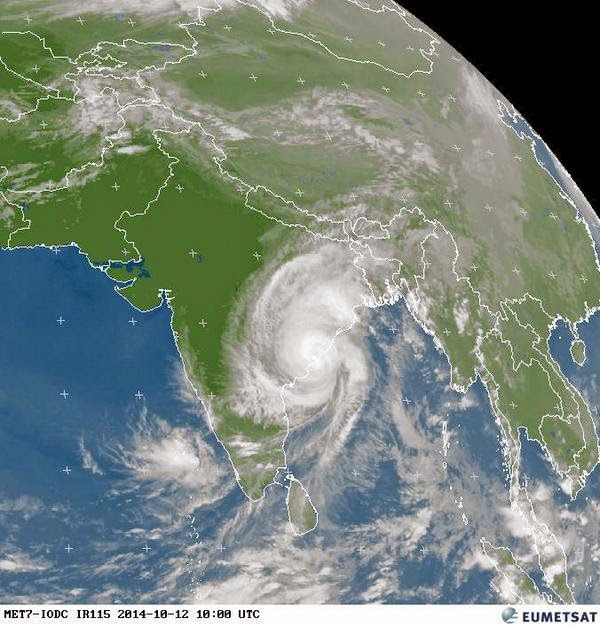
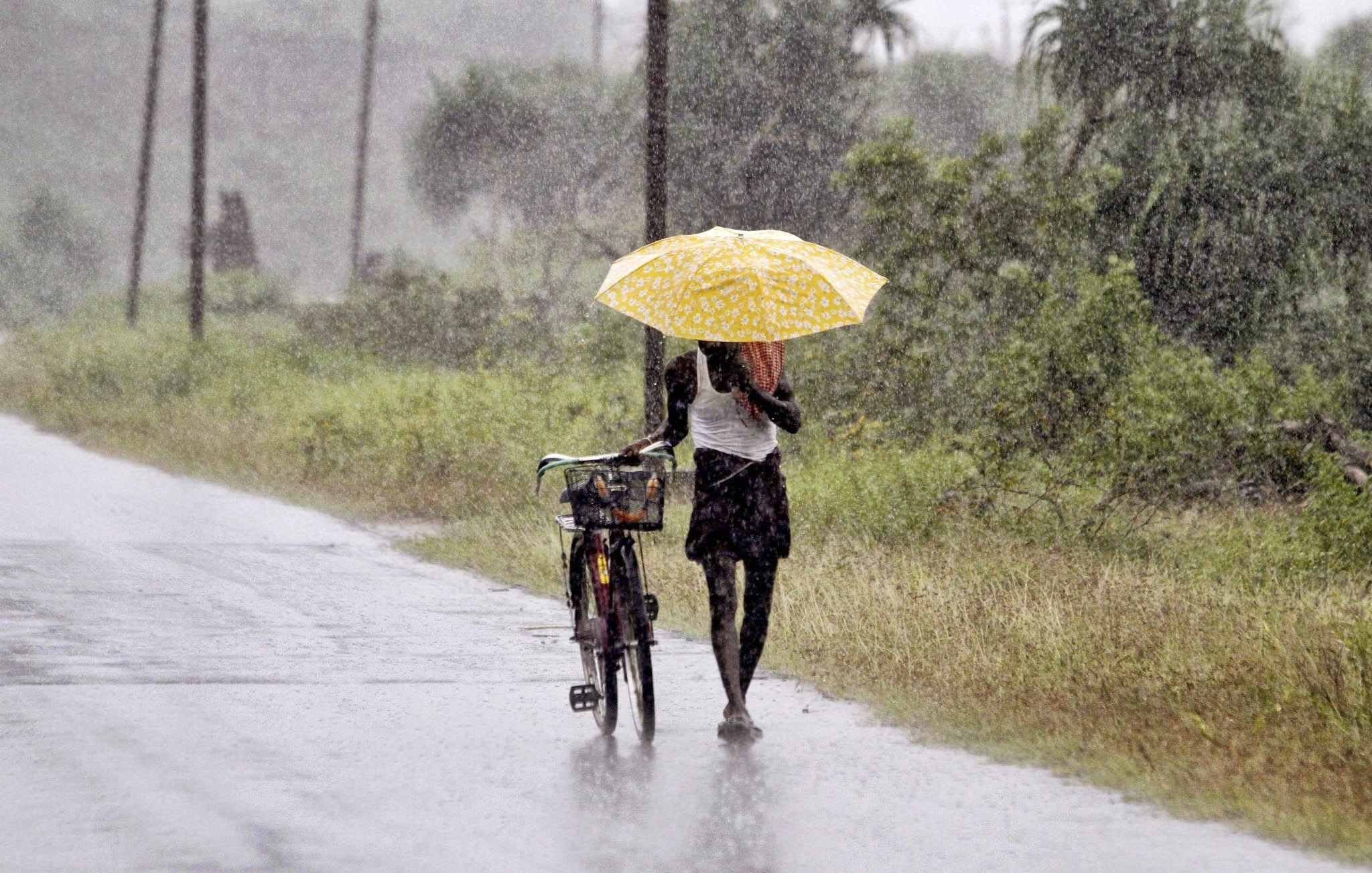
Cyclone Hudhud is pounding the eastern seaboard of India today, with winds of up to 120 mph, heavy rains and flooding, especially in the city of Vizhakapatnam (“Vizag”), a major port and naval base. 400,000 people have been evacuated from coastal villages that are home to 14 million people. The Indian Ocean is a cyclone hot spot. Of the 35 deadliest storms in recorded history, 27 have come through the Bay of Bengal — and have landed in either India or Bangladesh. Meanwhile, in Japan, Typhoon Vongfong is sweeping through Okinawa and is on its way to the island of Kyushu, with winds of 110 mph. 

What’s in a Name?: Confused about the difference between a hurricane, cyclone and typhoon? They are the same weather phenomenon, differing only in location! We use the term hurricane in the Atlantic and N.E. Pacific, whereas in the N.W. Pacific the same disturbance is called a typhoon. Cyclones occur in S. Pacific and Indian Ocean (http://oceanservice.noaa.gov/facts/cyclone.html).

Hudhud is for the Birds: Curious about this cyclone’s name? Named by the country Oman, hudhud is the colorful-crowned hoopoe bird (Upupa epops), found through Afro-Eurasia. While Americans have been naming hurricanes since 1953, cyclones have long been anonymous affairs. It was not until 2004 that eight countries (India, Pakistan, Bangladesh and Maldives along with Myanmar, Oman, Sri Lanka and Thailand) came together with a list of 64 names for cyclones. Each country gets its turn, and the names are not in alphabetical order. Watch out Nilofar (Pakistan), Priya (Sri Lanka) and Komen (Thailand) in the coming months!

Staying Safe: India’s disaster response is improving. Last year, a million people were evacuated out of the path of Phailin, the strongest cyclone in a decade, minimizing deaths to 25. Growing up in the coastal city of Calcutta, at the head of the Bay of Bengal, I recall being carried home from school through terrifying, swirling, waist-high waters. Here’s wishing that the people of Andhra and Odisha stay safe! 

For news and photos of today’s cyclone, check  on G+ or Twitter for #hudhudcyclone. 

#ScienceSunday  

Posted in Rajini Rao | Tagged , | 44 Comments

What’s for Dinner?

What’s for Dinner?

Homemade chappatis, puffed on an open flame. Make a pliant, soft dough with whole wheat (chappati) flour and water. Roll into circles and griddle-cook both sides before flipping directly on to the flame (I cheat, and use a metal grid. My mom uses her fingers, ouch). The chappatis should puff right up. Dab a small amount of clarified butter (ghee) on each, and store covered until ready to eat.

Coconut Curry with Potatoes and Peas: Grind together fresh coconut, roasted coriander seeds, roasted fenugreek seeds (just a few, or it will be too bitter), tamarind, dry red chilies. Bring to a boil with enough water to make a gravy; then, add precooked, diced potatoes and peas. Add salt and garam masala to taste and a small lump of jaggery to sweeten and balance the tartness of the tamarind. The final touch is tempering: in a tsp of oil, splutter some mustard seeds and split white lentils (urad dal). When the oil turns aromatic and the mustard seeds turn gray, attempting to escape and redecorate your clean stove top, add the curry leaves and stand back..then pour it on the coconut curry for a satisfying sizzle. 

Homemade Yogurt: 2% fat milk, boiled and cooled, then inoculated with non-commercial (i.e., smuggled from India) culture. Use a yogurt thermometer if you want to be scientific. Or not. Incubate overnight in warm spot (I once saw a friend lovingly wrap it in a child’s parka!). It is mild to taste, and moderately solid. 

Bon Appetit! What’s your dinner? 

Posted in Rajini Rao | 122 Comments

Serendipity in Science: Golden Goose Awards

Serendipity in Science: Golden Goose Awards

♦ Scientists are sometimes accused of doing ‘wasteful’ research-studying the obscure or possibly irrelevant. The late senator William Proxmire was famous for his monthly Golden Fleece award, where he called out seemingly silly research projects. One such study on the sex life of the screw worm, however, would go on to effectively cure cattle of a major parasite and save the industry over 20 billion dollars. The beauty of basic research is that one can never predict where and when the next breakthrough happens. The Golden Goose award counters this short sighted vision, and recognizes odd-sounding federally funded research which led to big dividends down the road. 

Federal tax dollars fund rat massage: In 1979, a team of researchers at Duke University were frustrated in their attempts to measure key growth markers in rat pups. When they separated the pups from their protective mothers, the markers mysteriously declined. Patiently, they ruled out nutrition, body temperature and pheromones until they noticed how vigorously the mothers groomed and licked the pups. Could tactile stimulation be important? “I couldn’t get the lab technicians to actually lick the pups”, Dr. Schanberg joked. But a stiff brush worked wonders and the pups thrived away from their mothers. A chance encounter with a psychologist led to testing the effect of infant massage on preterm babies. In controlled studies, massaged infants showed increased growth rates of up to ~50%, greater alertness and quicker hospital discharges, averaging differences of 6 days. A recent analysis estimates that these savings amount to about $10,000 per infant, resulting in a nationwide annual health care savings of $4.7 billion. Infant massage therapy is now used by nearly 40 percent of NICU’s in the US, and is on the rise. Do you have examples to share of seemingly wasteful research with unexpected benefits? 

News Story: http://www.goldengooseaward.org/portfolio-view/2014-rat-and-infant-massage/

Review on Preterm Infant Massage Therapy Research: http://goo.gl/yQgMs

From Lizard to Laboratory: my post on the 2013 Golden Goose Award http://goo.gl/Kx3bWI

#ScienceEveryday when it’s not #ScienceSunday .

Posted in Rajini Rao | Tagged , | 71 Comments

The Art of Seurat: Science and Pointillism

The Art of Seurat: Science and Pointillism

After winding through the bucolic Dutch countryside, two bus loads of scientists were disgorged at the Kröller-Müller Art Museum in Otterlo, hoping for a dose of culture to leaven our week-long immersion in research (on ATP-driven pumps; http://p-atpases.org/). To our delight, the museum was hosting the work of Georges Seurat, the master of pointillism. Fittingly, Seurat once said, Some say they see poetry in my paintings; I see only science

What’s the Point?: In contrast to traditional methods that mix pigments, pointillism is a technique where dots of pure color are applied, allowing the eye and the mind to blend the colors to give a richer and brighter effect. Although the term was first used to ridicule the technique, pointillism (also called divisionalism) gained credibility by the end of the 19th century, giving rise to neo-impressionism, cubism and modern art, and influencing other artists like van Gogh and Matisse.  Seurat’s most famous work showcasing pointillism is A Sunday Afternoon on the Island of La Grande Jatte – 1884 (http://goo.gl/WXcS48). Estimated to be made up of ~3.5 million dots, it took nearly 2 years to complete!

 A closer look reveals individual dots of blue, green, yellow and even red in the water, which give the impression of changing, shimmering color as the viewer moves towards the canvas. Our brains blend the dots into a color that is not actually there.  When pigments are mixed, they absorb light. By avoiding mixing, there is no subtractive effect and colors appear brighter. The white canvas between dots enhances this effect. 

The inner rings in the animated circles a and b appear to be different colors: pink or orange. But it’s just an illusion – revealed when the surrounding circles are stripped away. Notice also that the color surrounding the inner circles in a and c, or b and d, is the same, but the frequency of concentric rings is different, altering our color perception.

Points to Pixels: Never could Seurat have guessed that the principles behind pointillism would be so widely used in modern technology- computer and television screens light up individual pixels colored in RGB (red, green, blue) and printers deposit CMYK (cyan, magenta, yellow, and Key or black) dyes. We are all pointillists now!

Slide show pdf on Seurat: http://goo.gl/jSTsBA


Watch: Seurat. Master of pointillism, Kröller-Müller Museum. A must see!

For a related post, see, Was Matisse a Neuroscientist? http://goo.gl/0QHeeI

#ScienceSunday    

Posted in Rajini Rao | Tagged | 85 Comments

Nature vs. Nurture: Girls and STEM

Nature vs. Nurture: Girls and STEM

Why is there a gender gap in Science, Technology, Engineering and Mathematics (STEM)? You may have heard the arguments that girls find science “boring,” that their brains are “wired differently”, and that attempts to bridge the gender divide “deny human biology and nature”. Attributing the gender gap to biology misses the obvious contribution of societal and institutional biases. Co-authored by Buddhini Samarasinghe, Zuleyka Zevallos and me, our article in nature.com blogs explains how stereotype threats, lack of role models, social conditioning, unconscious bias and institutional practices create an environment where girls feel unwelcome and insecure in STEM fields. We advocate active intervention and go on to discuss effective strategies and practical ways, both simple and sophisticated, to solve the problem. 

Why should we care if girls remain underrepresented in STEM? Apart from basic fairness, if we want our best and brightest working on innovative ideas and creative solutions, it makes little sense to potentially abandon half the population. We already face many hurdles; lack of funding, lack of jobs, and pushback from science denialists backed by populist politics. We need all hands on deck to forge ahead.

We must look to nurture, not nature, for change.

Read more: 

http://blogs.nature.com/soapboxscience/2014/09/04/nature-vs-nurture-girls-and-stem

#ScienceEveryday   #stemwomen  

Posted in Rajini Rao | Tagged , | 76 Comments

Fungus Amongus: budding scientist helps solve medical mystery

Fungus Amongus: budding scientist helps solve medical mystery 

Hidden Spheres: A 7th grade science fair project has helped uncover the source of fungal infections that target patients with HIV/AIDS. One third of AIDS related deaths have been linked to infections by Cryptococcus. This fungus causes life-threatening infections in immune-compromised patients, and less commonly in healthy people, pets and animals, accounting for >1 million infections and >620,000 deaths worldwide. Named “hidden sphere” because of its tiny spores, Cryptococcus is a single-celled yeast that can propagate by budding, or it can mate in pairs to form spores that are released into the air. Fortunately, it only multiplies by budding in human hosts, and therefore cannot spread from person to person. So how do we acquire it, and what is its natural reservoir? 

Love is in the Air? : Cryptococcus gattii grows on the bark and leaves of the Australian Eucalyptus tree. Scientists speculate that the tropical fungus was inadvertently imported into the northwestern US along with the trees, and has spread to ten other tree species in the Vancouver/Oregon area including Coastal Douglas Fir and Coastal Western Hemlock. The fungus depends on chemical stimulants (myo-inositol and indole acetic acid) from plants for sexual reproduction, forming spores that are dispersed in the wind to be inhaled by unsuspecting people. Only mating allows fungal DNA to recombine, forming new, virulent strains that can survive in unfriendly environments such as the warm bodies of humans. After fatal outbreaks were reported in the Pacific Northwest area, patients with  AIDS and other immune illnesses have been advised to stay away from forests. Historically, C. gattii has been infecting people in California for years, although the fungus has not been found on eucalyptus trees and other usual suspects there. Tracking down the environmental hideout would help warn susceptible people of the danger in the hidden spheres. 

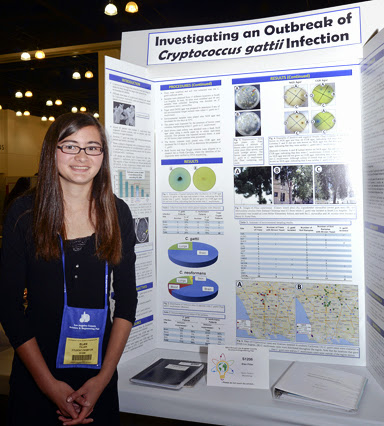
Nailing the Niche : Schoolgirl Elan Filler’s father, a scientist, helped connect her with microbiologist Joseph Heitman of Duke University. For her science fair project, Elan collected fungal samples from local trees, cultured them on petri plates, and sent them to postdoc Deborah Springer who analyzed the DNA and compared it to samples found in patients in the area. They found a perfect genetic match with samples harvested from three species- Canary Island pine, New Zealand pohutukawa and American sweet gum, to patient samples collected in the past decade. With her science sleuthing recently reported in a publication in PLOS Pathogens, here’s hoping that young Elan is inspired to find her niche in research and science!  

Science Trivia Challenge! What does V8 vegetable juice (Campbell Soups) have to do with Cryptococcus

#OpenAccess  paper with Elan Filler as co-author: http://www.plospathogens.org/article/info:doi/10.1371/journal.ppat.1004285

NPR News Story: http://goo.gl/EQa9Pp

C. gatti infections: http://en.wikipedia.org/wiki/Cryptococcus_gattii

H/T KQED SCIENCE for the news find! 

#ScienceSunday     #STEMWomen  

Posted in Rajini Rao | Tagged , , | 32 Comments

Algal Blooms and Microcystins: The Fouling of Lake Erie

Algal Blooms and Microcystins: The Fouling of Lake Erie

A Colorful History : Often called blue-green algae, cyanobacteria are neither restricted to blue and green hues nor are they true algae. They bring a carmine tinge to the Red Sea and make the Spirulina-eating African flamingos blush pink. When these simple bacteria appeared some 3.5 billion years ago*, they produced oxygen by photosynthesis, changing the fate of the earth forever. Then in the Precambrian era, according to the theory of endosymbiosis, they were co-opted as chloroplasts into the cells of green plants. They also form nitrogen-fixing nodules in the roots of plants and partner with fungi to colonize barren new lands as lichen. Little wonder that scientists consider them the most successful group of microbes ever. But as Shakespeare mused: Why then, can one desire too much of a good thing?

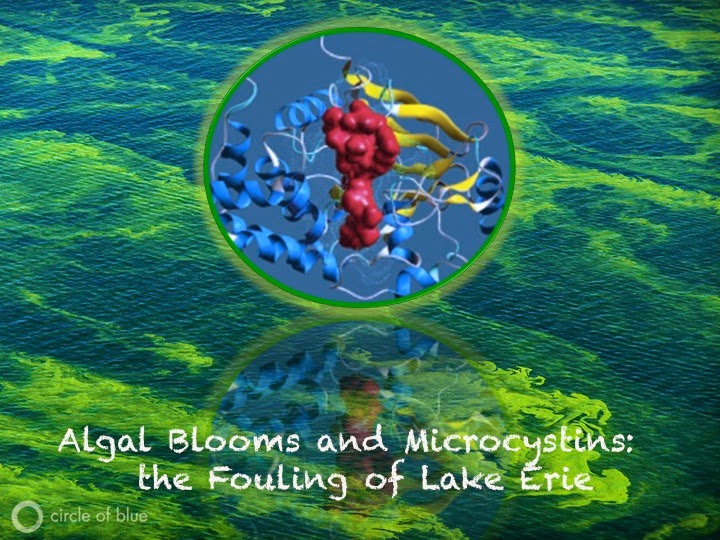
Toxic Blooms: Ever opportunistic, cyanobacteria can rapidly increase in biomass to form thick green scum euphemistically known as blooms on the surface of shallow lakes. Over-fed with nutrient run-off from fertilized farmlands, sewage disposal or industrial waste, the blooms in turn feed bacteria, which then consume dissolved oxygen, killing off fish and creating dead zones. That’s not all: the blooms produce potent toxins that target the liver, brain and skin. The worst offenders are microcystins: cyclic compounds that fit snugly into the pocket of a class of enzymes known as protein phosphatases (image) and block their tumor-suppressing activity. In 1996, 76 dialysis patients at a clinic in Caruaru, Brazil, died from acute liver failure after water contaminated with microcystins was used in renal dialysis treatment. Their cyclic structure makes microcystins resistant to most water treatment processes, and boiling only concentrates the toxin. The building blocks that make up the toxin are unusual (non-protein amino acids) , and cannot be broken down by enzymes found in our cells. Recently, algal blooms in Lake Erie forced the shut-down of the entire water system in the city of Toledo, leaving half a million residents with no water. Given that this is becoming “the new normal” (http://goo.gl/dPyrtG) in many freshwater supplies around the world, what is the solution?

Bioremediation: There are no short term solutions to the blooming problem! We can cut back on fertilizer use, although faster acting, more efficiently utilized phosphate formulations actually encourage algal growth. Fortunately, we can exploit the chemical warfare in the battleground of the blooms themselves. It’s thought that cyanoblooms produce these toxins to protect themselves from heat and oxidation stress. But competing bacteria like Sphingomonas secrete enzymes that can degrade microcystins. Research on natural bioremediation by culturing beneficial bacteria and studying their genetic and biochemical pathways could help nip future blooms in the bud.   

Ref (image inset): http://biolinks.co.jp/pdf/MOCT.pdf

Ref ( #openaccess ): Cyanobacterial Toxin Degrading Bacteria: Who Are They? http://www.ncbi.nlm.nih.gov/pubmed/23841072

#ScienceEveryday  when it’s not #ScienceSunday  

*Edit: Corrected from 3.5 mya , thanks Martin Vogel ! It turns out that cyanobacteria are the oldest known fossils, from Archaean rocks of Western Australia. This is very cool, since the oldest rocks are only a little older: 3.8 billion years old!


Posted in Rajini Rao | Tagged , , | 46 Comments