Happy Birthday David Gilmour. Singer, songwriter and lead guitarist of former Pink Floyd turns 66 today. This is also the anniversary of the release of his latest solo album, On an Island . Guest performers include Graham Nash, David Crosby and late PF keyboardist Richard Wright. The album entered the UK charts at #1, the first for Gilmour outside of Pink Floyd.
World War I Era Living Portraits: July, 1918. 18,000 soldiers and officers gathered at Camp Dodge, Iowa to assemble into these patriotic formations, all in an effort to gather support for the war effort. Photographers Arthur S. Mole and John D. Thomas captured images of an Eagle, the Statue of Liberty, Woodrow Wilson and even Uncle Sam. Many of the men, dressed in wool uniforms, fainted in the 105 degree heat.
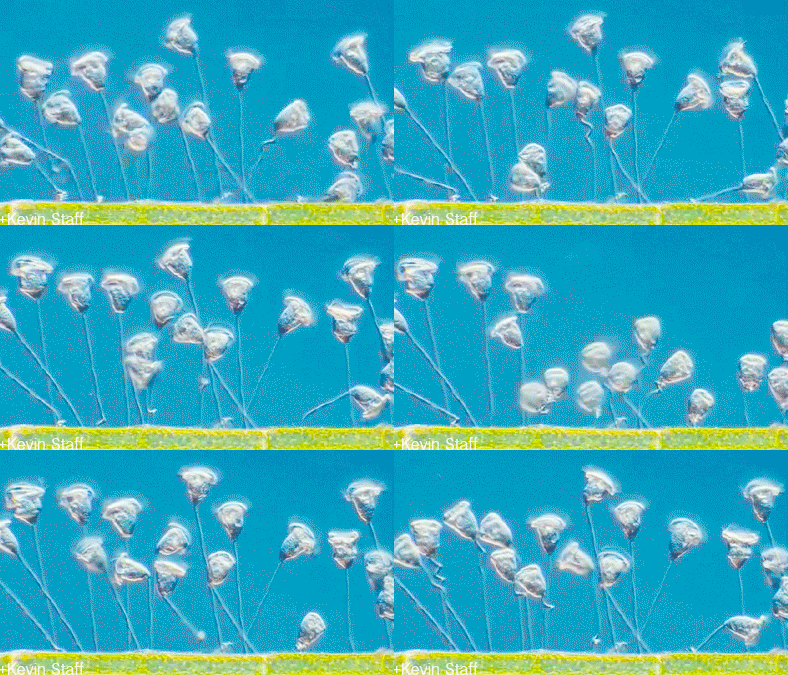
Fastest Spring in Nature: Vorticella!Don’t blink now , but what you see as a graceful drifting up of the champagne-glass like body actually comes after an incredibly rapid contraction (~5 milliseconds) of the stalk. For its size, Vorticella convallaria is one of the fastest moving organisms on the planet.
What is this? Vorticella is a protozoan that attaches to solid objects (here, a layer of algae) through extremely strong natural adhesives. The 40 μm body is held up by a 150 μm long stalk.
How do they do this? Inside the stalk is a contractile spring, called the spasmoneme, which rapidly winds helically in response to binding calcium. The calcium signal is propagated down the stalk as a wave, after release from the body. This is similar to a muscle contraction, except that Vorticella is 10 times faster.
How fast is it? Contraction speed is estimated at 10 cm s−1. Expressed in units of lengths per second (Ls−1) (standard for muscle contraction), this works out to around 200 Ls−1. This speed is an order of magnitude faster than the fastest muscles, which contract at around 20 Ls−1. The tensile force is up to 500 nNewton. Young’s modulus of the stalk is around 1 kPa.
Why do they do this? Contraction is a defense mechanism to protect Vorticella from environmental hazards such as turbulent water.
♫ Music for Science ♫: Konstantin Makov suggests listening to The Beatles – Maxwell’s Silver Hammer (2009 Stereo Remaster) while you marvel at Nature’s fastest spring. Is Maxwell pounding on the little heads with an invisible hammer? Thank you, Konstantin, for being funny and clever as always.
Fastest Gif-er on G+: Thank you Kevin Staff for being tolerant of my requests and obliging me for #ScienceSunday once again!
Tetris: Played in real time with microscopic optical tweezers! The video shows 42 glass microspheres (1 μm diameter) trapped by laser beams and steered by a computer.
What is an optical tweezer? Invented by Arthur Ashkin of Bell Labs in the 80’s, this is the closest we have to a tractor beam. US Secretary of Energy Steven Chu won the 1997 Nobel for its use in trapping neutral atoms. Small dielectric objects, from beads to bacteria, can be trapped by a highly focused laser beam. The force of radiation pressure is exploited to manipulate these objects. The method is sensitive enough to measure displacements of 1 angstrom: the diameter of a H atom!
Biophysicists use optical tweezers to measure movement and force generated by single molecules such as an enzyme walking along a DNA ladder or a motor like kinesin, dragging the bead along the tracks of a microtubule. (More on single molecule biophysics in subsequent posts).
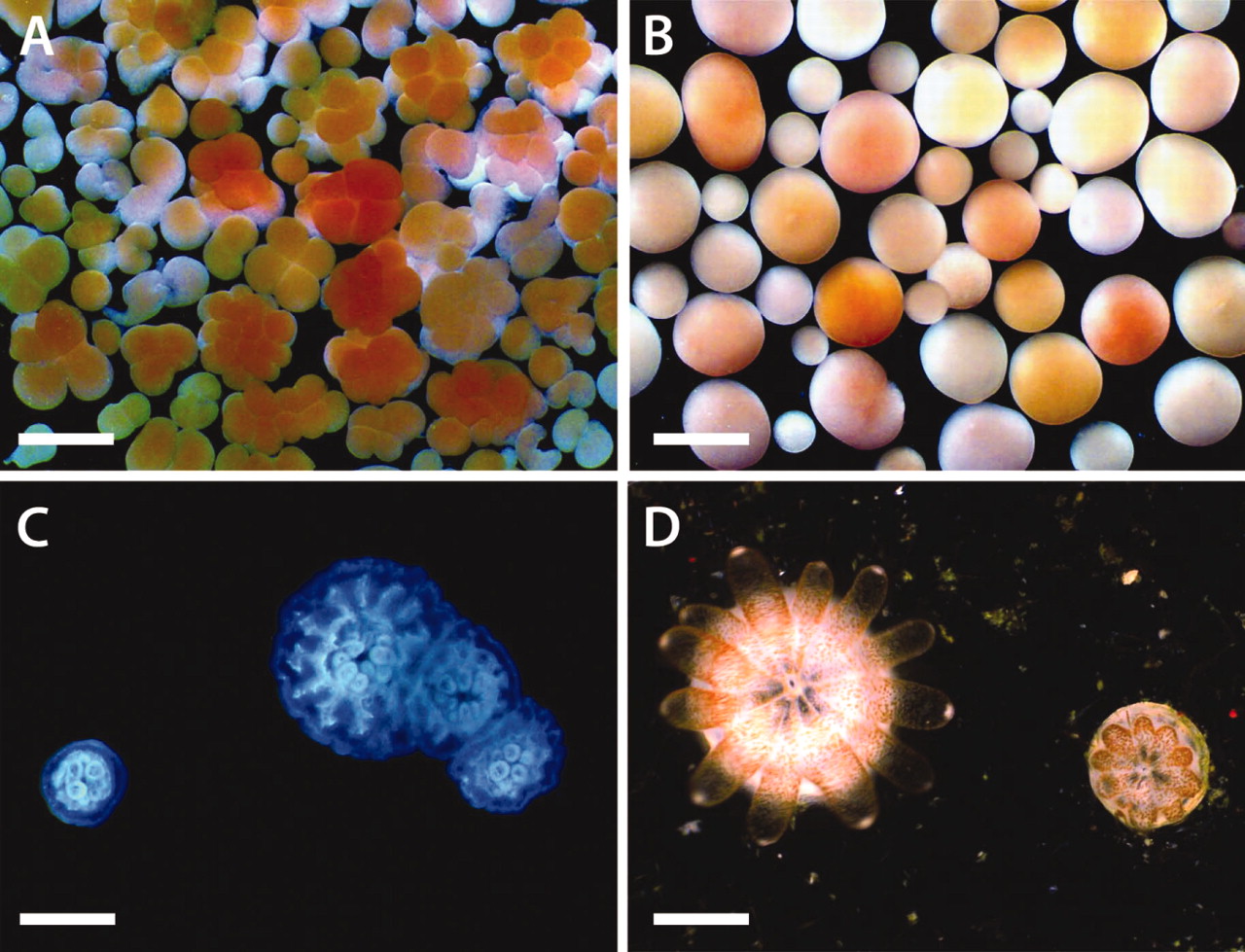
The Curious Case of Coral Clones. Coral embryos are naked. Unlike other animal embryos, they lack a protective capsule and float exposed in the ocean, buffeted by waves. Scientists observed that embryos at the 2, 4, 8 and 16 cell stage frequently break up into smaller clumps of cells (Image A). Does this mean that coral embryos in the open ocean are damaged and destroyed?
Surprisingly, each of these fragments goes on to become a complete larva (B) and then juvenile coral (C and D), exact clones of the original, only smaller . We call this ability totipotency: stem cells that can become any cell in the body. This unusual combination of sexual reproduction (to form an embryo) followed by asexual reproduction (to form genetic clones) has not been observed before. Those naked embryos are not so helpless after all!
REF: Science 2 March 2012: Heyward and Negri. Turbulence, Cleavage, and the Naked Embryo: A Case for Coral Clones DOI: 10.1126/science.1216055
Stop Motion Animation made with 12,000 pieces of paper! Singer-songwriter Josh Ritter’s story is told entirely from 2D paper cutouts. It starts with a night time drive in a black and white winter forest, transitions into pastels and explodes into a trippy, psychedelic dream. This is creative.









 madame scientist's not-so-mad musings