

Recent Comments

RARE, PINK EYED KATYDID found in the Cederberg caves of South Africa; this species of grasshopper-like insect was found by Piotr Naskrecki , an entomologist, photographer and author of Relics: Travels in Nature’s Time Machine. Piotr suggests that these rare creatures are genetically orphaned, left behind from the Pleistocene era and surviving only in the cool temperatures of caves.
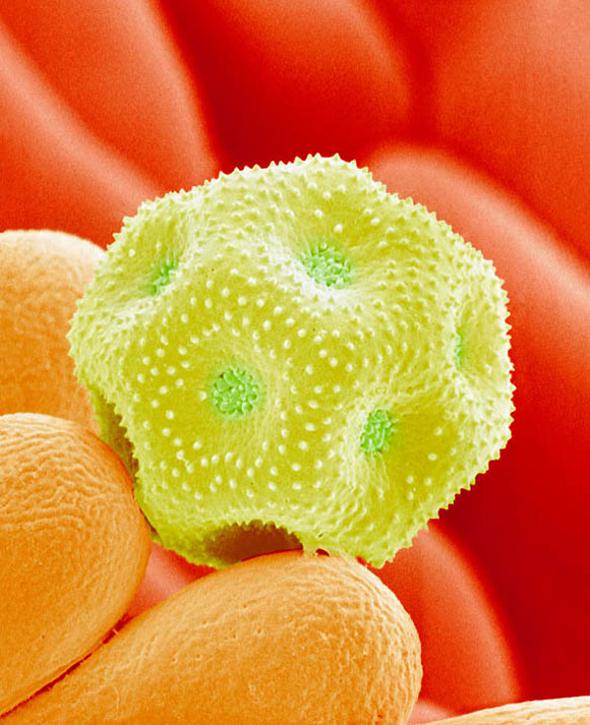
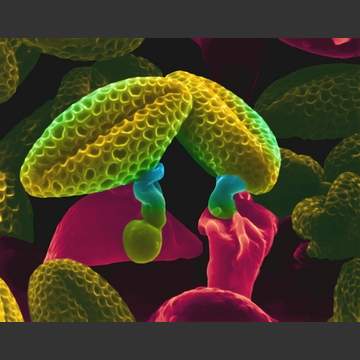
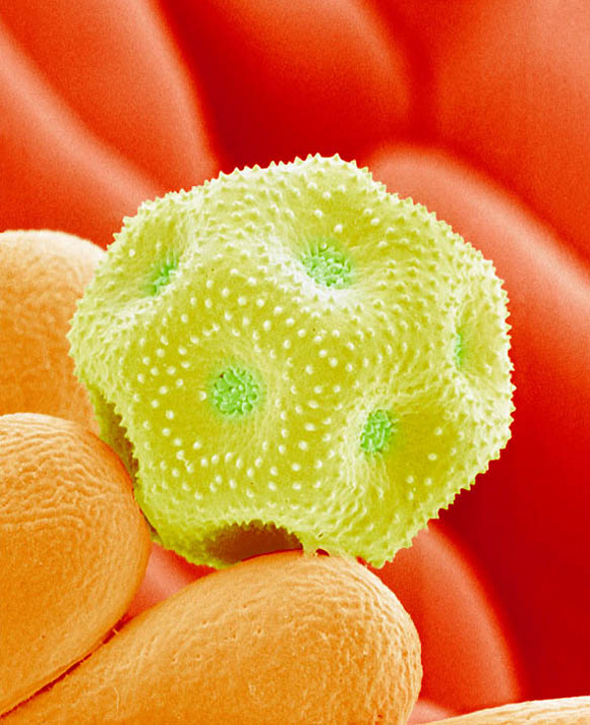
POLLEN! It’s springtime, and pollen (like love), is in the air. Indulge in some botanical porn, in the name of art and science!
• Size matters. Pollen grains range from 10-100 microns -the largest pollen is just visible to the eye. Only tiny, wind borne pollen cause allergies. The larger ones disseminated by bees are harmless.
• Did you know that a birch tree can produce 100 million pollen in a year? That’s a lot of wastage.
• When the male pollen lands on the flower stigma, it rapidly elongates into a tube: corn pollen tubes may grow 8 or 10 in. to reach the ovaries.
• Pollen tubes elongate at rates unequalled elsewhere in the plant world. Maize pollen tubes can grow as fast as 1 cm h−1. That’s a length 1000x the diameter of the pollen grain per hour.
• Pollen tubes need a lot of energy to germinate. They burn 40–50 fmol ATP s−1 per grain, 20x higher than a leaf.
• The leading edge of a pollen tube shows oscillating surges of calcium. Watch here: Calcium Oscillations in the Arabidopsis Thaliana Pollen Tube
• Palynology is the study of pollen and spores. Pollen grains have characteristic patterns of ridges, spines, and knobs that are so diverse that plants can be identified by the appearance of their pollen. Pollen is used as a tool in forensic palynology to trace activity at mass graves in Bosnia, catch a burglar who brushed against a Hypericum bush at the crime scene, and has even been proposed as an additive to track bullets.
• Pollination in the words of Emily Dickinson:
“Come slowly—Eden
Lips unused to Thee—
Bashful—sip thy Jessamines
As the fainting Bee—
Reaching late his flower,
Round her chamber hums—
Counts his nectars—
Enters—and is lost in Balms.”




 madame scientist's not-so-mad musings