FLOWER POWER: The insignificant little plant, Arabidopsis thaliana or thale cress, is a boon to biological research.

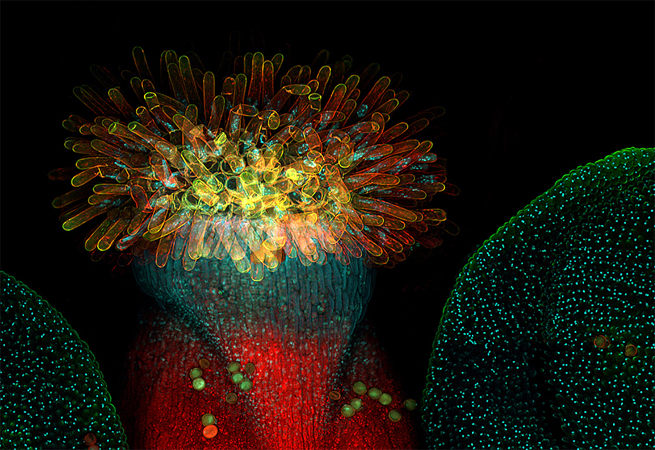
FLOWER POWER: The insignificant little plant, Arabidopsis thaliana or thale cress, is a boon to biological research. And even the most ordinary flower looks beautiful through the eyes of a microscope, does it not?

• Those of us focused on understanding human disease don’t pay much attention to research in plants. But plant biologists have taught us about micro RNAs, transposons, active demethylation, ‘decoy’ RNAs, and more. The wonderful world of genetics was first revealed through the patterns of inheritance of sweet peas, by one Austrian friar named Gregor Mendel.

• That’s why I go to a plant conference once every few years. I never know what I may pick up and plant biologists are gracious enough to listen to our animal work.

#floralfriday FloralFriday

Image: Mendel’s Dream Arabidopsis flower captured with confocal microscopy by Heiti Paves, Centre of Excellence ENVIRON, Estonia.

Posted in Rajini Rao | Tagged | 74 Comments

Latest Update on Science Circles

Latest Update on Science Circles

Originally shared by Science on Google+

Science Circles Categorized by Discipline

Here are the links to the most recent shared circles coming out of Science on Google+: A Public Database.

Profiles

All Disciplines: http://goo.gl/UvpIl

Anthropology and Sociology: http://goo.gl/l7d0k

Astronomy: http://goo.gl/ZjHQX

Biology: http://goo.gl/aUQUb

Chemistry: http://goo.gl/wMigv

Computer Science: http://goo.gl/W0MSi

Ecology: http://goo.gl/G0FA1

Engineering: http://goo.gl/twVxT

Geology and Earth Science: http://goo.gl/sc6bi

Mathematics: http://goo.gl/tPNPo

Neuroscience: http://goo.gl/tDFhg

Philosophy of Science: http://goo.gl/IxiGl

Physics: http://goo.gl/ctkLc

Psychology: http://goo.gl/VeSEI

Science Teachers: http://goo.gl/Fxg7o

Science Writers: http://goo.gl/12bkO

Pages

All Disciplines: http://goo.gl/8ZfqM

Astronomy: http://goo.gl/8OluC

Biology and Neuroscience: http://goo.gl/qoiCd

General Science: http://goo.gl/nnPuf

Geology and Earth Science: http://goo.gl/ttcvk

Physics: http://goo.gl/W498t

Psychology and Neuroscience: http://goo.gl/HetDu

Posted in Rajini Rao | 11 Comments

Le LOLCAT (http://goo.gl/JA89A)

Le LOLCAT (http://goo.gl/JA89A)

Posted in Rajini Rao | 20 Comments

THE FASTEST FLIGHT IN NATURE: Set to the joyful crescendo of Verdi’s Anvil Chorus.

THE FASTEST FLIGHT IN NATURE: Set to the joyful crescendo of Verdi’s Anvil Chorus.

High-Speed Spore Discharge Mechanisms among Fungi: The fungus Pilobolus kleinii, lives a shitty life. Literally growing on dung, it must fling its spores as far out as possible to land on fresh grass where it can get eaten by a herbivore to complete its life cycle.

• Researchers used ultra-high-speed video cameras running at maximum frame rates of 250,000 fps to analyze the launch process. Launch speeds ranged from 2 to 25 m s−1 and corresponding accelerations of 20,000 to 180,000 g propelled spores over distances of up to 2.5 meters.

Squirt Guns: Spores sit atop long fluid filled stalks that are pressurized by osmosis. Hydrostatic pressure was generated by the combined osmolality of sugar alcohols and inorganic ions. Up to 100 mM of these osmolytes generate a turgor pressure of0.44 MPa or 4.4 atm. These are not unusual pressures for fungi, but the remarkable engineering ensures controlled and rapid rupture of the pressurized squirt guns that allow the nearly instantaneous release of energy and discharge of the spores.

• This video shows a montage of the fungus’s amazing launches set to Verdi’s Anvil Chorus.

For some prurient Pilobolus porn see Ballistic fungus Pilobolus crystallinus

Reference: http://www.plosone.org/article/info%3Adoi%2F10.1371%2Fjournal.pone.0003237

Posted in Rajini Rao | 54 Comments

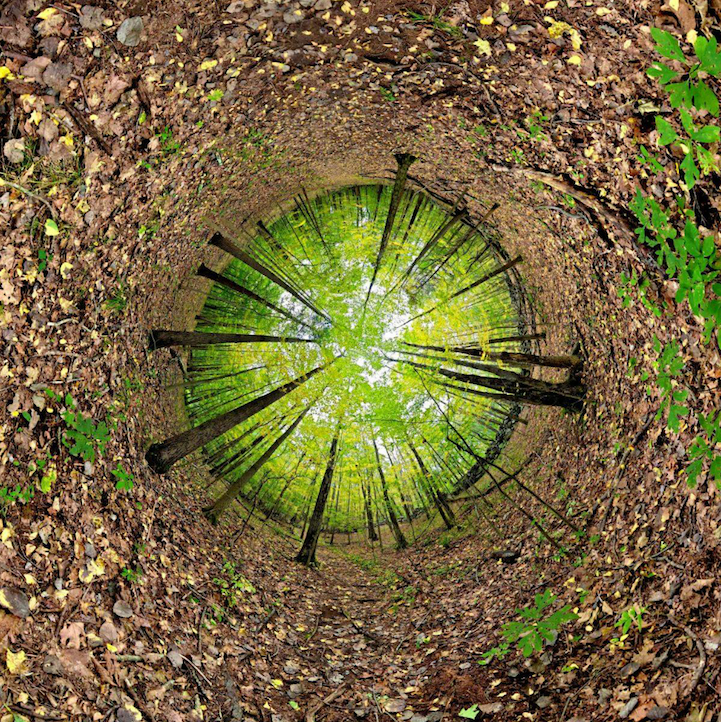
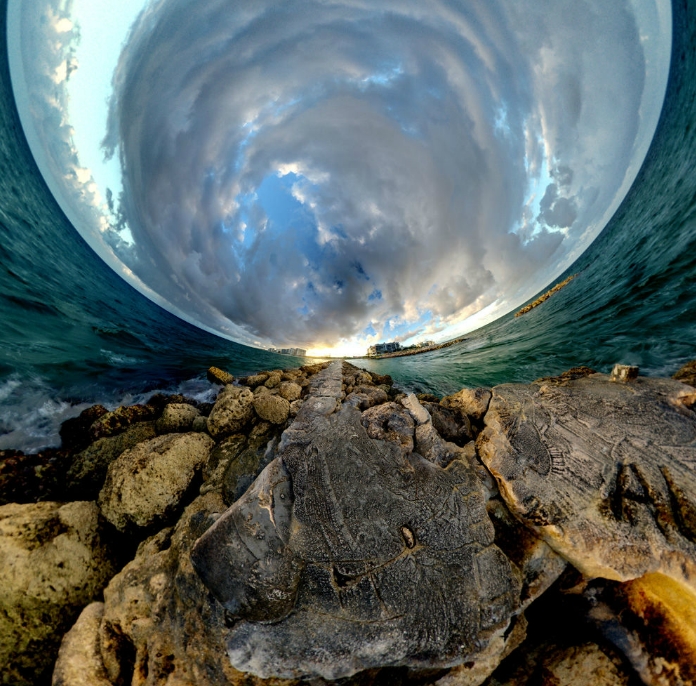
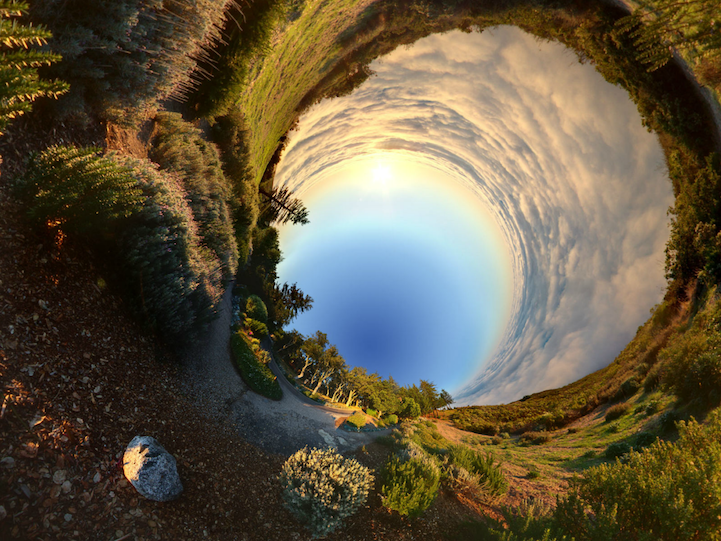
SURREAL CIRCLES: In his series Alternative Perspectives, photographer Randy Scott Slavin portrays a 360 degree view…

SURREAL CIRCLES: In his series Alternative Perspectives, photographer Randy Scott Slavin portrays a 360 degree view of our world by seamlessly stitching together hundreds of shots. The result is surreal art, grounded in reality. He inspires us to “go out and explore the world and take a look at the monuments and reimagine them in a different way”.

Source: http://goo.gl/2Ut69

Posted in Rajini Rao | 339 Comments

THE VISIBLE HUMAN: a complete, anatomically detailed, three-dimensional scan of the male and female human body.

THE VISIBLE HUMAN: a complete, anatomically detailed, three-dimensional scan of the male and female human body.

How was this done? The male cadaver was frozen in gelatin and cut horizontally at 1 mm intervals into 1,871 slices and photographed to give 65 GB of high resolution images. The female was cut at 0.3 mm intervals resulting in ~40 GB of data. In addition, the bodies were scanned by CT (computer assisted tomography) and MRI (magnetic resonance imaging).

If that wasn’t macabre enough: Both bodies were donated to science but because the donors did not know their specific use and the male died by lethal injection, ethical issues have been raised. Also, these are not perfect bodies. The male lacks one testicle. The female shows signs of cardiovascular disease.

Art and Anatomy: Artist Lisa Nilsson was inspired by the images to create painstakingly realistic replicas with rolled up paper, an art form known as quilling. Her artwork takes weeks to create and sells for up to $7,000.

See the slide show here: http://www.huffingtonpost.com/2012/04/26/lisa-nilsson-art-paper_n_1456502.html

Watch complete scan (1:15 min) in HD: it is stunning The visible human project – Male (HD)

Sponsored by the US National Library of Science (NLM), the goal of this ambitious project was to facilitate scientific discovery and teaching of anatomy. http://www.nlm.nih.gov/research/visible/visible_human.html

H/T to Daniel Mariani who found the animated gif from Reddit (original creator unknown). Chad Haney knows way more about imaging than I do.

ScienceSunday

Posted in Rajini Rao | 59 Comments

WHEN EINSTEIN MET TAGORE: An attempt to explain Truth and Beauty at the intersection of Science and Spirituality.

WHEN EINSTEIN MET TAGORE: An attempt to explain Truth and Beauty at the intersection of Science and Spirituality. It was July 14, 1930 when Einstein met Rabindranath Tagore- poet, polymath and first non-European to win the Nobel for Literature (for Gitanjali).

Regardless of your philosophy, religion or lack thereof, the following conversation will blow your mind. Excerpt:

EINSTEIN: Truth, then, or Beauty is not independent of Man?

TAGORE: No.

EINSTEIN: If there would be no human beings any more, the Apollo of Belvedere would no longer be beautiful.

TAGORE: No.

EINSTEIN: I agree with regard to this conception of Beauty, but not with regard to Truth.

TAGORE: Why not? Truth is realized through man.

Read more here: http://www.brainpickings.org/index.php/2012/04/27/when-einstein-met-tagore/

The conversation goes from the tangibility of a table to Pythagorean geometry, concluding with:

EINSTEIN: Then I am more religious than you are!

TAGORE: My religion is in the reconciliation of the Super-personal Man, the universal human spirit, in my own individual being.

Many Thanks to Pravin Bhojwani for the original share!

Posted in Rajini Rao | 135 Comments

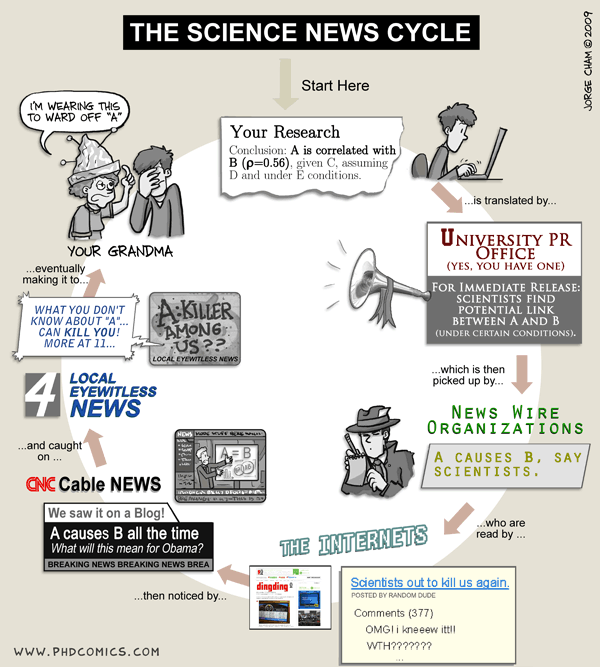
FRIDAY FUNNIES: SCIENCE MYTHS : Why do novelists, filmmakers and newspaper journalists get science so wrong?

FRIDAY FUNNIES: SCIENCE MYTHS : Why do novelists, filmmakers and newspaper journalists get science so wrong? Perhaps, scientists don’t communicate too well. Writing for Science, Adam Ruben imagines this conversation:

MICHAEL CRICHTON: What if mosquitoes drank dinosaur blood before being encased in amber? Would it theoretically be possible to extract that blood and clone dinosaurs from the DNA?

A SCIENTIST: No.

MICHAEL CRICHTON: So, yes?

Perhaps, the truth had better not be told? 😛

Myth: Scientists follow the scientific method as it was taught in high school: Observation, Question, Research, Hypothesis, Experiment, Conclusion .

Truth: In reality, the way scientists work is more like: Fiddle Around, Find Something Weird, Retest It, It Doesn’t Happen a Second Time, Get Distracted Trying to Make It Happen Again, Go to Chipotle, Recall the Original Purpose of Your Research, Start Over, Apply for Funding for a Better Instrument, Publish Some Interim Fluff, Learn That Someone Has Scooped You, Take Your Lab in a New Direction, Apply for Funding for the New Direction, Collaborate With an Icelandic Poet, Eat Chipotle With an Icelandic Poet, Co-Write Scientifically Accurate Ode to Walrus, Get Interested in Something Unrelated, Apply for Funding for Something Unrelated, Notice That 20 Years Have Passed.

Any Icelandic Poets out there? Madame Scientist would love to collaborate.

Source: From PhD Comics (image) and the ever-funny Adam Ruben (Science : http://goo.gl/46Oqm)

Posted in Rajini Rao | 49 Comments

◐ BLACK AND WHITE ◑ Stunning imagery captured by NASA’s Voyager and Cassini spacecrafts, put together by Sander van…

BLACK AND WHITE ◑ Stunning imagery captured by NASA’s Voyager and Cassini spacecrafts, put together by Sander van den Berg to music by Cinematic Orchestra. The 1:53 min video is called Outer Space.

H/T to Sakis Koukouvis for the share via his wonderful blog: http://www.scoop.it/t/science-news

Posted in Rajini Rao | 37 Comments

Catch me!

Catch me! Synthetic nanofibers reach out like fingers and capture a nanoparticle. Each fiber is 1/1000th the width of a human hair. Inspired by biology, Harvard’s Joanna Aizenberg uses nanofabrication strategies to design completely synthetic structures capable of complex functions.

Here, liquid evaporates around an ordered array of epoxy bristles to confer bending forces. These forces spontaneously shape the nanofibers into Medusa like helical bundles, and bundles of bundles, that can capture and release small particles for drug delivery or photonics. In essence, the bundles store elastic energy and information.

The work sounds like fun too. Aizenberg said, “Indeed,our helical patterns are so amazingly aesthetic that often we would stop the scientific discussion and argue about mythology, modern dreadlocks, alien creatures, or sculptures”.

Read More: http://aizenberglab.seas.harvard.edu/index.php?show=research_project&proj=51

Posted in Rajini Rao | 50 Comments