☼ Ride, Sally Ride!

Ride, Sally Ride! On June 8, 1983, Sally Ride blasted off into space on the space shuttle Challenger, breaking through the gender barrier as the first American woman in space. She passed away today of cancer, at age 61. Former astronaut Charles Bolden spoke of her grace and professionalism and said, “She will be missed, but her star will always shine brightly”.

☼ Sally joined NASA in 1978, as part of the first group of women astronauts. She went on two shuttle missions, served on many NASA review panels and later continued as physics professor at the University of California, San Diego. A Stanford graduate, she earned four degrees as well as a doctorate in physics. She was a varsity tennis player too. Later, she went on to promote young women achieve success in STEM careers.

Source: http://www.nasa.gov/topics/people/features/ride.html

Watch: Sally Ride: 25 Years Later

Posted in Rajini Rao | 26 Comments

Your Feel-Good Story of the Day: 83 year old Shila Ghosh is hunched with age but her spirit is feisty.

Your Feel-Good Story of the Day: 83 year old Shila Ghosh is hunched with age but her spirit is feisty. Every day, she changes two buses and finds her way from the outskirts of Calcutta to the busy Exide crossing on Chowringhee Road. There, she sells home made chips for an average of $3 in earnings each day.

24 year old college student Sufia Khatoon watched from across the street. Wanting to do something, she posted her observations on Facebook. Soon, she had mobilized a small group who gave the octogenarian a small cash donation, a shawl, and some warm wishes. They even bought her entire stock of chips for the day! Shila Ghosh is thrilled, but insists that she can continue to earn a living. Meanwhile, the gesture has rallied more young people to come together to make a difference.

Watch Shila in this short clip: Kolkata: Student helps woman raise sales through Facebook

Read her story here: http://tiny.cc/a2kthw

Facebook Page: Our World, Our Initiative.

Posted in Rajini Rao | 44 Comments

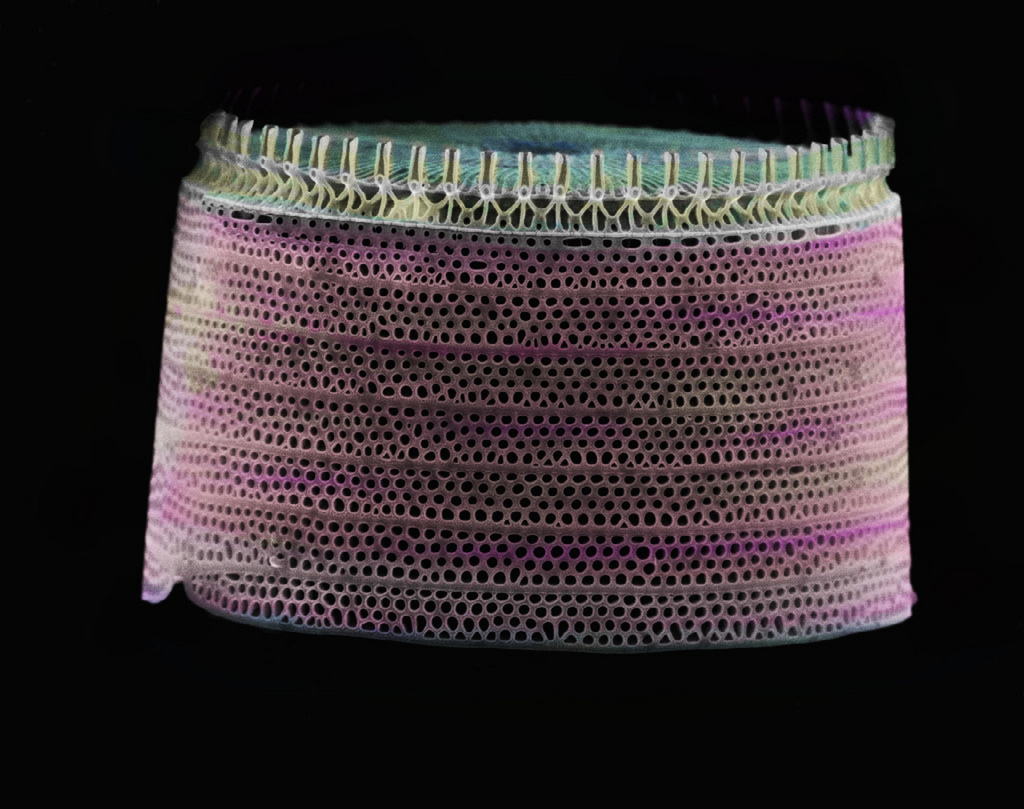
Living Photonic Crystals: These scanning electron microscope images of tiny diatoms have been digitally colored.

Living Photonic Crystals: These scanning electron microscope images of tiny diatoms have been digitally colored. But in real life, their glass-like skeletons have a special property of interfering with light waves, reflecting light in different colors depending on the viewer’s angle, much like an oil slick on water. This is because the array of tiny holes studding the diatom surface match the wavelength of visible light and behave as photonic crystals.

• Photonic crystals are optical nanostructures which affect the path of photons just as semiconductors affect electrons. They have periodic (repeating) changes in dielectric constant. Photons pass through this structure – or not – depending on their wavelength. The repeating pattern of solid and water filled holes on diatoms make them natural photonic crystals.

• Diatoms could be used to make iridescent cosmetics, paints and fabrics and even credit card holograms. They are cost-effective and biodegradable. Up to 1 tonne of diatoms can be made per day, starting with only a few cells. Diatoms are microscopic, photosynthesizing single celled microorganisms. Did you know that they produce a quarter of the oxygen that we breathe?

Images: Diatoms looking like various artifacts, from a pill box to a peanut were selected from http://www.flickr.com/photos/galfaye/

#scienceeveryday  

Posted in Rajini Rao | Tagged | 67 Comments

RIP, Rajesh Khanna: Bollywood star of yesteryear has died at the age of 69.

RIP, Rajesh Khanna: Bollywood star of yesteryear has died at the age of 69. He had a huge fan following from his romantic roles. I like this song for the beautiful lyrics, from the critically acclaimed 1971 film Anand, also starring superstar Amitabh Bachchan, and sung by Mukesh.

“Kahin door jab din dhal jaye

Saanjh ki dulhan badan churaaye, chupake se aaye

Mere khayaalon ke aangan mein

Koi sapanon ke deep jalaaye, deep jalaaye”.

Somewhere distant when the day falls

The bride of dusk softly approaches

In the courtyard of my mind

Someone lights the lamp of my dreams.

#rajeshkhanna  

Posted in Rajini Rao | Tagged | 43 Comments

How to Write Good: I’m working on a research paper and I have to remind myself of these golden rules. :)

How to Write Good: I’m working on a research paper and I have to remind myself of these golden rules.   🙂

• Avoid Alliteration. Always.

• Eschew obfuscation.

• One word sentences? Eliminate.

• Don’t repeat yourself, or say again what you have said before.

• The passive voice is to be avoided.

• Avoid cliches like the plague. (They’re old hat.)

• Foreign words and phrases are not apropos.

• Poofread carefully to see if you any words out.

• Don’t overuse exclamation marks!!!

• Take the bull by the hand and avoid mixing metaphors.

• Be more or less specific.

• Understatement is always best.

• Who needs rhetorical questions?

• And always be sure to finish what

More: http://goo.gl/eDTuP

Posted in Rajini Rao | 95 Comments

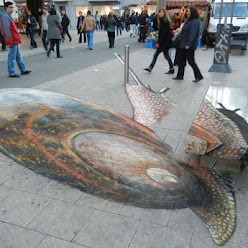
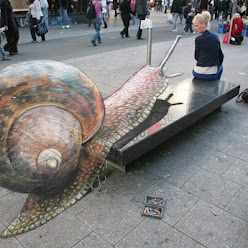
ANAMORPHOSIS: An art form where the image is greatly distorted, appearing only from a specific vantage point or upon…

ANAMORPHOSIS: An art form where the image is greatly distorted, appearing only from a specific vantage point or upon reflection in a cylindrical mirror (or reflecting cones and pyramids). The painting (by Julian Beever) on the pavement is fragmented and meaningless to most viewers. But find the sweet spot, and Whoa! A giant snail appears to crawl on the city bench. (www.julianbeever.net)

• Leonardo da Vinci is thought to have made the first anamorphic drawing in 1485, at a time when Renaissance artists were experimenting with perspective (Leonardo’s Eye -Illusion).  Hidden images conveyed dangerous political statements, heretical ideas, and even erotic images.

The Ambassadors: A famous example is the 1533 painting by Hans Holbein called “The Ambassadors”. When viewed from an extreme angle, a smudge at the bottom in an otherwise conventional painting reveals itself to be a grinning skull. Hans_Holbein the younger_The Ambassadors (amazing skull )

What does it mean? Holbein’s skull – Part one | Paintings | The National Gallery, London

Medusa’s Head pays homage to the legend of Perseus, who could only look upon the snake headed monster in the reflection of his shield: http://www.moillusions.com/2011/12/an-anamorphic-medusa-painting.html

What are your favorites in illusory art?

Posted in Rajini Rao | 42 Comments

PROMISE FOR PARKINSONS: Neural Stem Cells.

PROMISE FOR PARKINSONS: Neural Stem Cells. In Parkinsons disease, cells producing dopamine die off (for unknown reasons), resulting in tremors, rigidity and worse. Treatment consists of supplements of dopamine and surgical implantation of wires that provide electrical impulses for movement. For a decade, scientists have been trying to regrow nerve cells using stem cells, but these cells only made limited amounts of dopamine. Also, there were concerns that dopamine neurons developed from human stem cells could trigger growth of tumors.

• Recently, Lorenz Studer’s group at Memorial Sloan Kettering in NYC found the right chemical signals to coax stem cells into dopamine neurons. The neurons survived and restored activity in three animal models: mouse, rat and monkeys. The primate work was important because previous studies had shown that rodent brains required fewer working neurons to overcome symptoms.

• Dr Studer said: “We now have the right cells, but to put them into humans requires them to be produced in a specialized facility rather than a laboratory, for safety reasons. We have removed the main biological bottleneck and now it’s an engineering problem.”

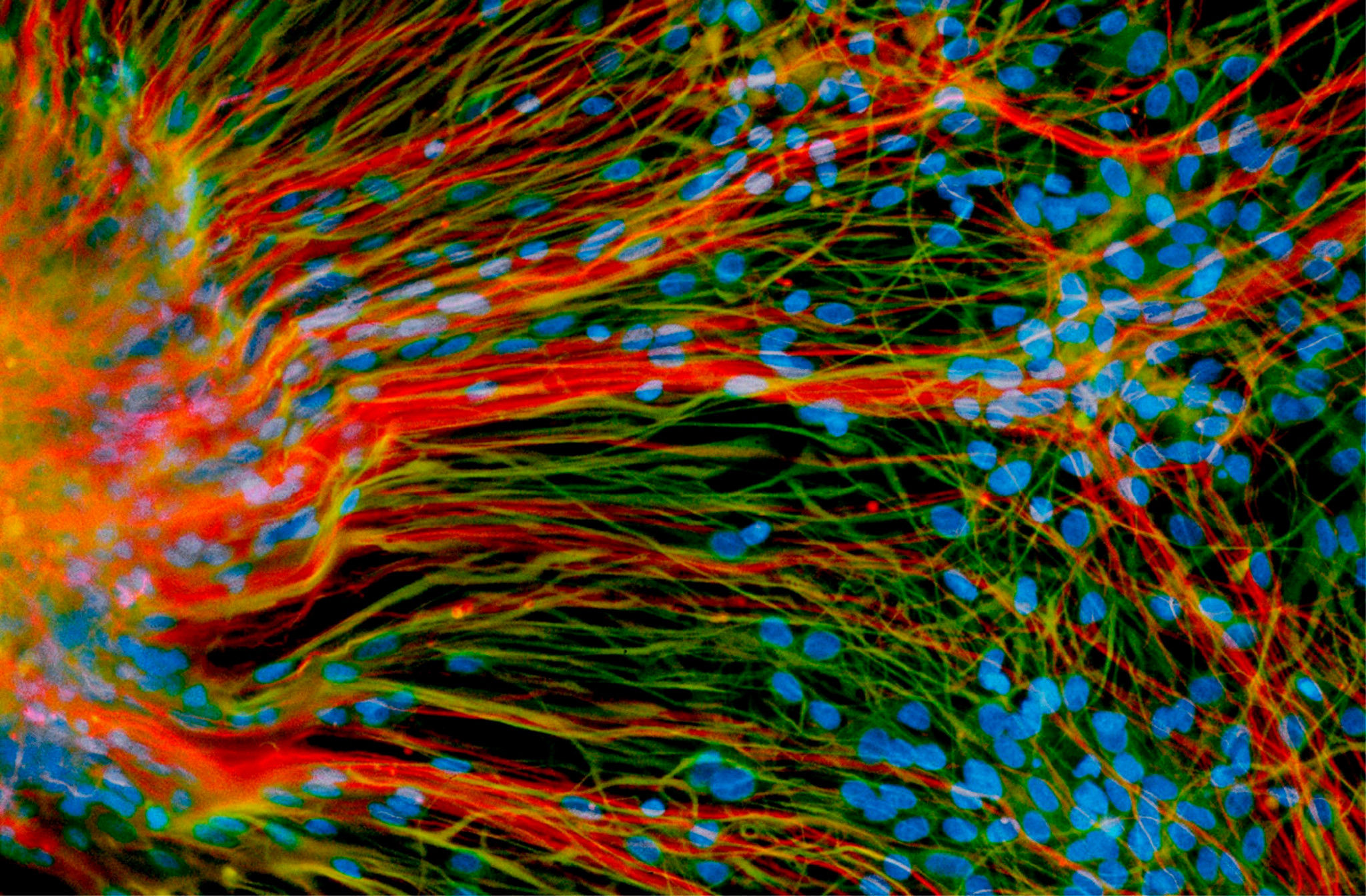
Image: Derived from human embryonic stem cells, precursor neural cells grow in a lab dish and generate mature neurons (red) and glial cells (green), in the lab of University of Wisconsin-Madison stem cell researcher and neurodevelopmental biologist Su-Chun Zhang.

Ref: Dopamine neurons derived from human ES cells efficiently engraft in animal models of Parkinson’s disease. Kriks et al. doi:10.1038/nature10648

#sciencesunday ScienceSunday 

Posted in Rajini Rao | Tagged | 44 Comments

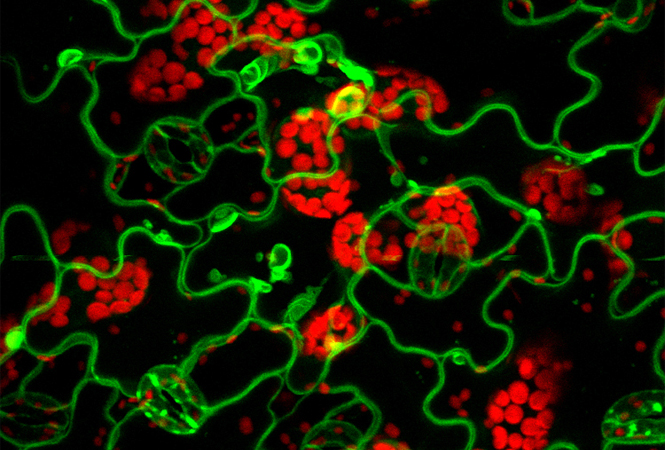
Jigsaw Puzzle: The undersurface of a leaf is tiled with flat cells in a puzzling pattern (outlined in green).

Jigsaw Puzzle: The undersurface of a leaf is tiled with flat cells in a puzzling pattern (outlined in green). This inter-digitating pattern is controlled by antagonistic signaling pathways that make alternating lobes and indentations. Green stomata dot the surface. These are breathing pores, flanked by two kidney shaped guard cells. The red splotches are chloroplasts, that harvest light energy to make plant sugars.

• Blue light/UV-A activates light sensing proteins (phototropins and cryptochromes) which set off a signaling cascade. A proton pump on the cell membrane is activated, making the inside of the cell more negative. This opens voltage-activated potassium channels which let K+ into the guard cells. Water follows the ions (osmosis) and the cells become turgid. This swelling opens the pore. Stomatal opening can be controlled by photosynthesis, drought stress and much more. More images and explanation at: http://goo.gl/5aBFh

Watch: Las estomas – the stomata

The higher magnifications are especially lovely.

Image: Confocal microscopic image of lower surface of Arabidopsis leaf; By D. Page Baluch, Mrinalini Muralidharan and Tsafrir Mor, Arizona State University.

#scienceeveryday  

Posted in Rajini Rao | Tagged | 28 Comments

Eeek!

Eeek!: The Smithsonian Store offers this acrylic, Glow-in-the-Dark computer mouse with a real spider for $28. Arachnophobic? Try their beetle version (http://goo.gl/sludF) for half the price.

Pros: USB compatible, creeps out co-workers, purple

Cons: Not wireless, creeps out co-workers, purple

H/T HuffPo

Posted in Rajini Rao | 91 Comments

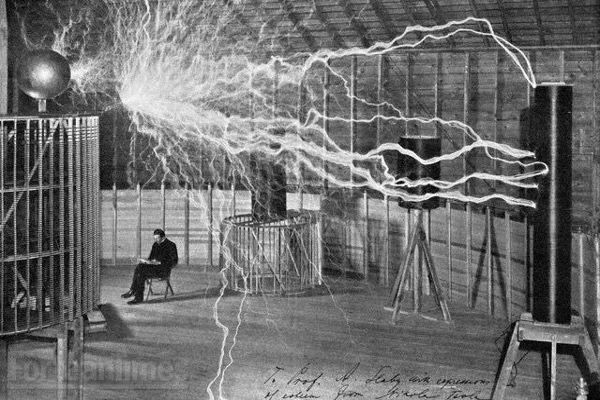
Happy Birthday, Tesla:  Nikola Tesla was born during a lightning storm at the stroke of midnight on the 10th of July…

Happy Birthday, Tesla:  Nikola Tesla was born during a lightning storm at the stroke of midnight on the 10th of July 1856. His midwife exclaimed, “He’ll be a child of the storm,” to which his mother replied, “No, of light.”

Image: A publicity photo taken in 1899 at Nikola Tesla’s laboratory in Colorado Springs, Colorado, where the inventor worked before he established his Wardenclyffe laboratory on Long Island. The photo was a double exposure — his pose and the sparks recorded at different times — helping him avoid electrocution. The “magnifying transmitter” pictured here was said to produce millions of volts of electricity.

Credit: Yugoslav Press and Cultural Center, caption from New York Times.

#teslatuesday  

Posted in Rajini Rao | Tagged | 21 Comments