Flowers that Fly: Science of the Butterfly Wing

Flowers that Fly: Science of the Butterfly Wing

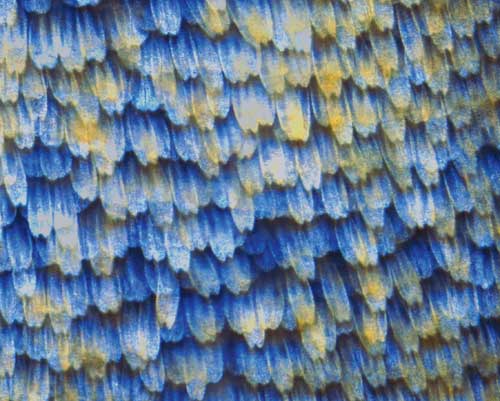
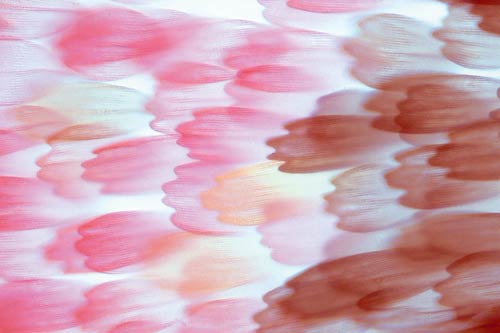
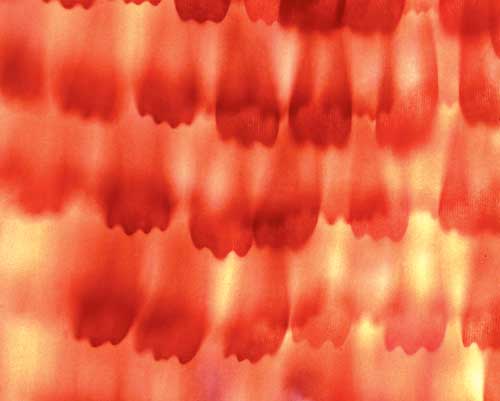
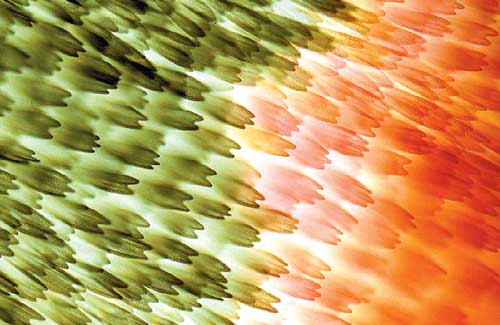
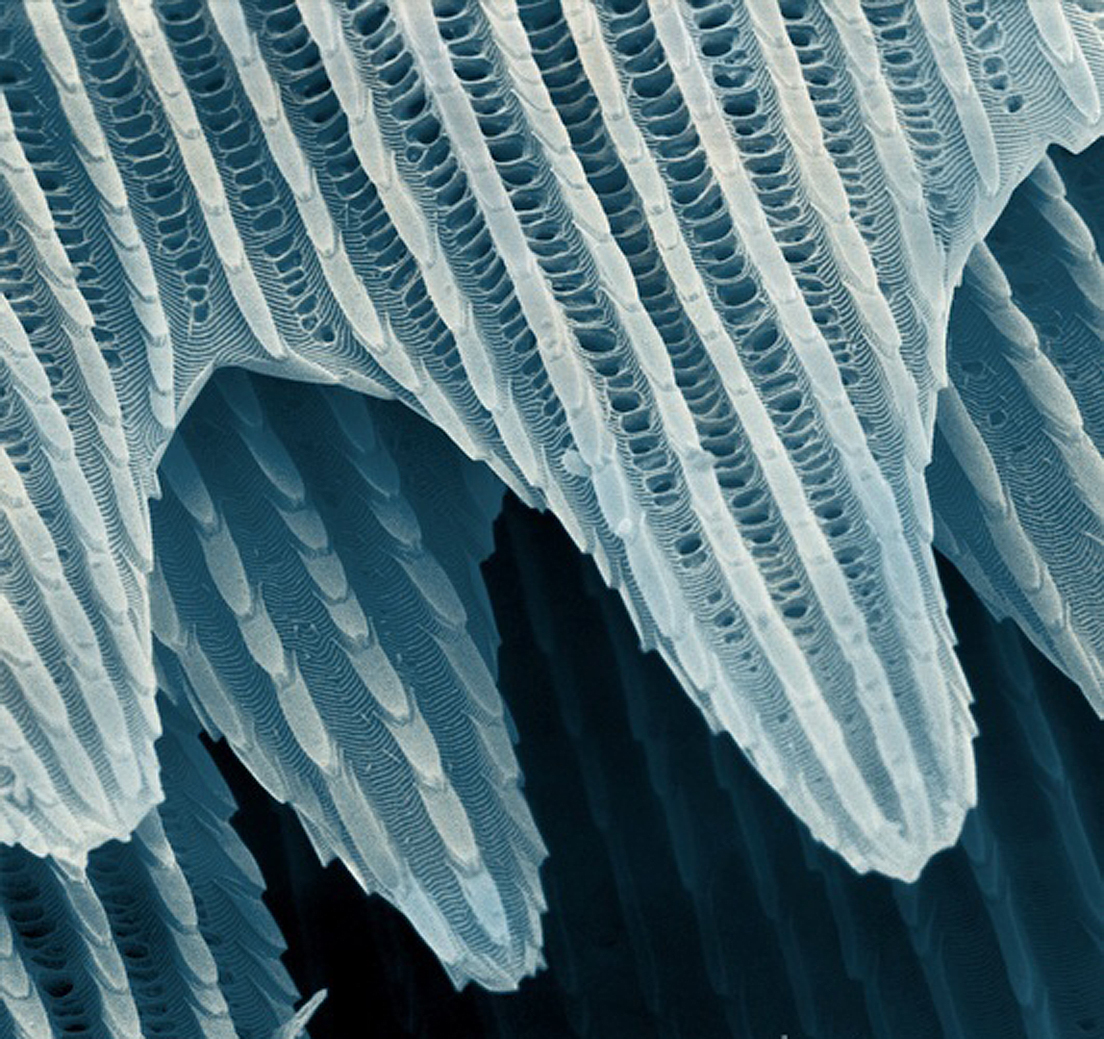
Butterflies are beautiful: Their eggs rival Faberge’s for sheer art. The migration of the Monarch butterfly holds navigational secrets still beyond our ken. But the wings are truly remarkable for their mimicry, polymorphism (variation) and aposematism (warning coloration). Like tiny shingles on a roof, microscopic overlapping scales cover the wings with brilliant, iridescent colors.

Structural Coloration: Black and brown colors are from melanin, but the blues, greens and reds are created by the microstructure of the scales and not by pigments. Originally observed by Robert Hooke and Isaac Newton, the principle of wave interference was described by Thomas Young a century later. Surfaces scored with fine parallel lines or thin layers on the same scale as the wavelength of light reflect multiple sets of waves. These can interfere with one another by adding or subtracting, to give rise to iridescence.

For more, see: http://en.wikipedia.org/wiki/Structural_coloration

A Quick Getaway: The scales of a butterfly wing readily detach, allowing for quick escape from a spider’s web or predator’s grasp. Thomas Eisner experimented by dropping various insects on a spider web. Of the butterflies and moths, he noted, “They all left impact marks on the webs where scales became detached to the viscid strands. Moth scars we came to call such telltale sites, and soon learned that they were common.” Most birds largely ignore butterflies. It turns out they are rather difficult to catch, without a large net, due to their erratic flying trajectories. Read Thomas Eisner’s essay on Butterfly Wings: http://goo.gl/5Sfon

• Beauty of the Butterfly Egg: http://goo.gl/0cnas

• Migration of the Monarch Butterfly: http://goo.gl/WuT6z

• If you like Opera: Maria Callas (Μαρία Κάλλας): Madama Butterfly – Puccini

Blue-Butterfly Day by Robert Frost:

It is blue-butterfly day here in spring,

And with these sky-flakes down in flurry on flurry

There is more unmixed color on the wing

Than flowers will show for days unless they hurry.

But these are flowers that fly and all but sing:

And now from having ridden out desire

They lie closed over in the wind and cling

Where wheels have freshly sliced the April mire.

#ScienceSunday  

Posted in Rajini Rao | Tagged | 63 Comments

Give Me a Hand

Give Me a Hand

☼ A quadriplegic woman, paralyzed from the neck down from a neurodegenerative disorder, was able to feed herself chocolate and give high-fives thanks to the most sophisticated prosthetic arm yet, with 7 degrees of freedom. Within the second day of training, she was able to perform basic tasks, with a 92% success rate of controlling the robotic arm. This study is the first to demonstrate feasibility of human brain implants to control an external device .

Brain-Machine Interfaces convert brain signals into movement. The researchers first mapped the signals generated in the patient’s brain when she thought of moving her arm and programmed the response of the prosthetic arm accordingly. Two small computer 4mm chips were implanted into the patient’s left motor cortex. The chips were 96 channel microchips designed to detect and record small electrical potentials that motor cortex brain cells produce when executing a movement. “The result is a prosthetic hand, which can be moved far more accurately and naturalistically than previous efforts.”

Future Scenarios include tactile feedback using sensors to feed into the patient’s sensory cortex, wireless communication, and possibly activation of the patient’s own muscles with implants.

Story and Videohttp://www.livescience.com/25600-quadriplegic-mind-controlled-prosthetic.html

Original paperhttp://extremelongevity.net/wp-content/uploads/brain-machine1.pdf

#ScienceEveryday  

Posted in Rajini Rao | Tagged | 67 Comments

Circle IV: Science Pages

Circle IV: Science Pages

Fourth of Four Circle Shares that cover all disciplines of Science on Google Plus.

#ScienceSunday  

Originally shared by Science on Google+

Ultimate Science Page Circle

Spice up your stream with this nice set of Science Pages!

Join the Science on Google+ Community: http://goo.gl/uhJCN

Applied and Mathematical Sciences: http://goo.gl/l0prd

Natural Sciences: http://goo.gl/t8ljm

Social Sciences and Communication: http://goo.gl/vqyNS

Add your Profile/Page to Science on Google+: A Public Database 

If you have a science related degree, you are a science journalist, you are a K-12 science teacher, or you curate a science page, then add your profile/page to the database by filling out this form (http://goo.gl/yEg7M). Please note that Profiles also have to circle Science on Google+: A Public Database if you would like to be considered for shared circles .#scienceeveryday   #science   #publiccircles   #sharedcircles

Posted in Rajini Rao | Tagged , , , | 3 Comments

Circle III: Social Sciences and Communication

Circle III: Social Sciences and Communication

 Third of Four Circle Shares that cover all disciplines of Science on Google Plus.

#ScienceSunday  

Originally shared by Science on Google+

Social Sciences and Communication

This circle will give you exposure to Anthropology, Economics, Linguistics, Philosophy, Psychology/Neuroscience, Sociology, and it also contains K- 12 Science Teachers and Science Writers.

Join the Science on Google+ Community: http://goo.gl/uhJCN

Applied and Mathematical Sciences: http://goo.gl/l0prd

Natural Sciences: http://goo.gl/t8ljm

Ultimate Science Page Circle: http://goo.gl/Gu1EX

Add your Profile/Page to Science on Google+: A Public Database 

If you have a science related degree, you are a science journalist, you are a K-12 science teacher, or you curate a science page, then add your profile/page to the database by filling out this form (http://goo.gl/yEg7M). Please note that Profiles also have to circle Science on Google+: A Public Database if you would like to be considered for shared circles .#scienceeveryday   #science   #publiccircles   #sharedcircles

Posted in Rajini Rao | Tagged , , , | Leave a comment

Circle II: Applied and Mathematical Sciences

Circle II: Applied and Mathematical Sciences

Second of Four Circle Shares that cover all disciplines on Science on Google Plus.

#ScienceSunday  

Originally shared by Science on Google+

Applied and Mathematical Sciences

This circle will give you exposure to Computer Science, Engineering, Maths, and Physics.

Join the Science on Google+ Community: http://goo.gl/uhJCN 

Natural Sciences: http://goo.gl/t8ljm

Social Sciences and Communication: http://goo.gl/vqyNS

Ultimate Science Page Circle: http://goo.gl/Gu1EX

Add your Profile/Page to Science on Google+: A Public Database 

If you have a science related degree, you are a science journalist, you are a K-12 science teacher, or you curate a science page, then add your profile/page to the database by filling out this form (http://goo.gl/yEg7M). Please note that Profiles also have to circle Science on Google+: A Public Database if you would like to be considered for shared circles .#scienceeveryday   #science   #publiccircles   #sharedcircles

Posted in Rajini Rao | Tagged , , , | Leave a comment

Circle I: Natural Sciences

Circle I: Natural Sciences

 First of four Circle Shares that cover all disciplines of Science on Google Plus.

#ScienceSunday  

Originally shared by Science on Google+

Natural Sciences

This circle will give you exposure to Astronomy, Biology, ​Chemistry, Ecology, ​​​​​Geography, Geology, and Neuroscience.

Join the Science on Google+ Community: http://goo.gl/uhJCN

Applied and Mathematical Sciences: http://goo.gl/l0prd

Social Sciences and Communication: http://goo.gl/vqyNS

Ultimate Science Page Circle: http://goo.gl/Gu1EX

Add your Profile/Page to Science on Google+: A Public Database 

If you have a science related degree, you are a science journalist, you are a K-12 science teacher, or you curate a science page, then add your profile/page to the database by filling out this form (http://goo.gl/yEg7M). Please note that Profiles also have to circle Science on Google+: A Public Database if you would like to be considered for shared circles .#scienceeveryday   #science   #publiccircles   #sharedcircles

Posted in Rajini Rao | Tagged , , , | 4 Comments

From Protein Folding to Punjabi Pea Paneer

From Protein Folding to Punjabi Pea Paneer

✿ Making fresh Indian cheese, or paneer, used to be a bit of a production in my home. My mother would start with not-so-fresh milk (why “waste” good milk, was her reasoning), bring it to a boil and then add lemon juice. In fascination, I watched the rapid separation of flocculant white curd from transparently greenish whey. That was my first encounter with the biochemistry of protein denaturation, although I would go on to ruin perfectly good batches of enzymes during my graduate career.
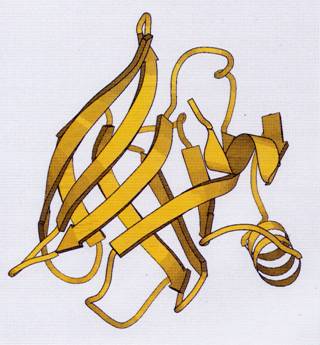
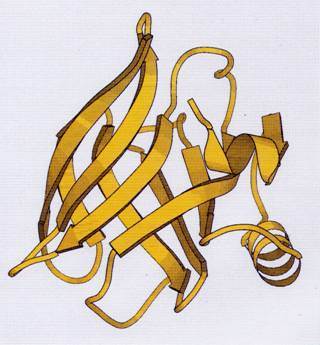
Proteins must be folded properly – into elegant ribbons, twisted helices, graceful loops and tight turns – not only to function properly but also to stay in solution (image 2). Too much heat, salt, acid or any number of adverse conditions cause proteins to unfold just enough to get their sticky inside parts to glom together. In a concerted show of protest, they leave the solution as a precipitate. Which brings us back to cheese. The curd is gathered into cheesecloth and suspended over a bowl to drain, before being packed into a brick under some heavy pots and pans. These days, one just reaches into the freezer of the local Patel Brothers for a perfectly rectangular brick of paneer.

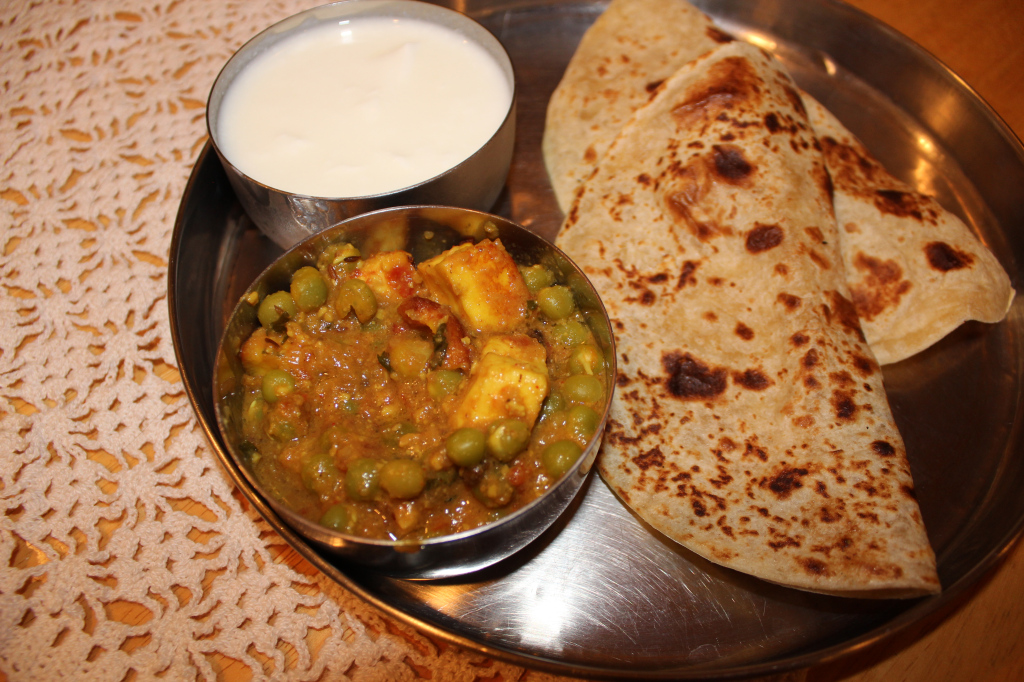
✿ This quintessential Punjabi dish of peas and paneer is called Mattar Paneer. The gravy is vegan, with richness of cashew nuts in place of dairy cream. You can make this dish entirely vegan by replacing the paneer with baby potatoes boiled in their jackets (Alu Mattar..mmm!) or a cheese substitute of your choice.

✿ Recipe, a memorium to a lost G+ friend, and a harrowing tale of protein denaturation from my graduate student days at: https://madamescientist.wordpress.com/2012/12/10/from-protein-folding-to-punjabi-pea-paneer/

#ScienceEveryday  

Posted in Rajini Rao | Tagged | 154 Comments

Precious Purses:  Who is the Artist?

Precious Purses:  Who is the Artist?

Caddisflies are common insects of the order Trichopterae resembling butterflies. The larvae build protective tubes held together with silk, often incorporating grains of sand, bits of shell and twigs from their aquatic environment. Artist Hubert Duprat wondered what would happen if he upgraded their raw material with gold shavings, pearls and turquoise. The larvae obliged by creating beautiful art!

☼ In this collaborative project between the insects and the artist, the lines between the craftsman and the creator are blurred. Is the insect the true artist, or merely the executer of Duprat’s creative expression? 

#ScienceEveryday   

Watch: Caddis Fly Larva Art

More: http://www.cabinetmagazine.org/issues/25/duprat.php

Posted in Rajini Rao | Tagged | 61 Comments

From Protein Folding to Punjabi Pea Paneer

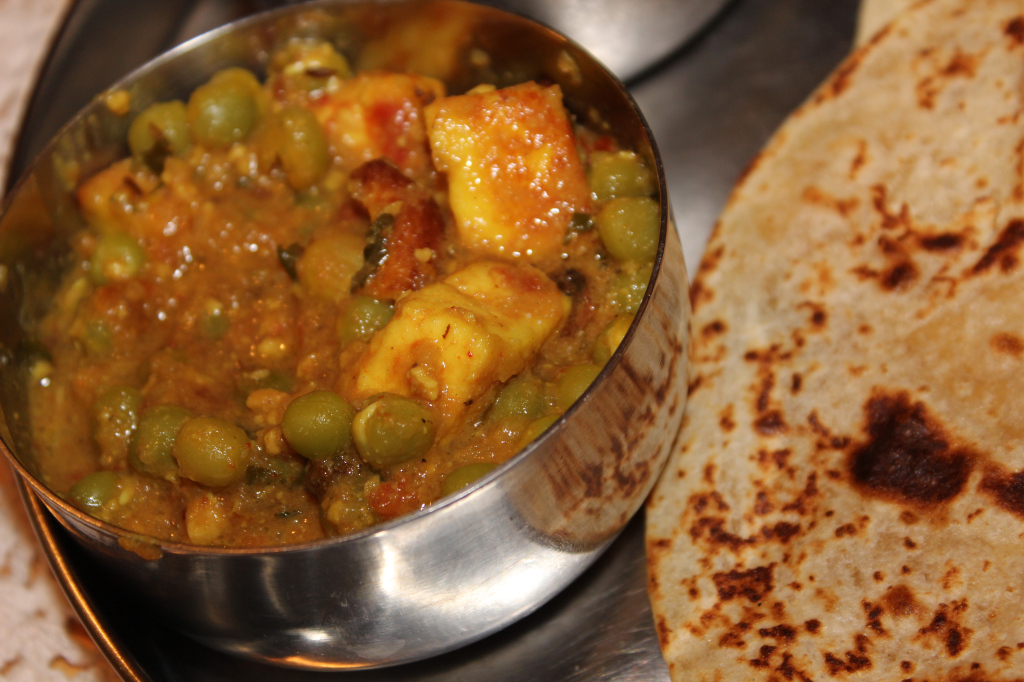
Muttar Paneer

Muttar Paneer served with chappatis

Making fresh Indian cheese, or paneer, used to be a bit of a production in my home. My mother would start with not-so-fresh milk (why “waste” good milk, was her reasoning), bring it to a boil and then add lemon juice. In fascination, I watched the rapid separation of flocculant white curd from transparently greenish whey. That was my first encounter with the biochemistry of protein denaturation, although I would go on to ruin perfectly good batches of enzymes during my graduate career.

Beta lactalbumin is a milk protein designed to carry a lipid in its calyx-shaped pocket.

Beta lactalbumin is a milk protein designed to carry a lipid in its calyx-shaped pocket.

Proteins must be folded properly – into elegant ribbons, twisted helices, graceful loops and tight turns – not only to function properly but also to stay in solution. Too much heat, salt, acid or any number of adverse conditions cause proteins to unfold just enough to get their sticky inside parts to glom together. In a concerted show of protest, they leave the solution as a precipitate. Which brings us back to cheese. The curd is gathered into cheesecloth and suspended over a bowl to drain, before being packed into a brick under some heavy pots and pans. These days, one just reaches into the freezer of the local Patel Brothers for a perfectly rectangular brick of paneer.

So there is absolutely no reason why you should not make this quintessential Punjabi dish of peas and paneer, called Mattar Paneer. Notice that the gravy is vegan, with richness of cashew nuts in place of dairy cream. You can make this dish entirely vegan by replacing the paneer with baby potatoes boiled in their jackets (Alu Mattar..mmm!) or a cheese substitute of your choice.

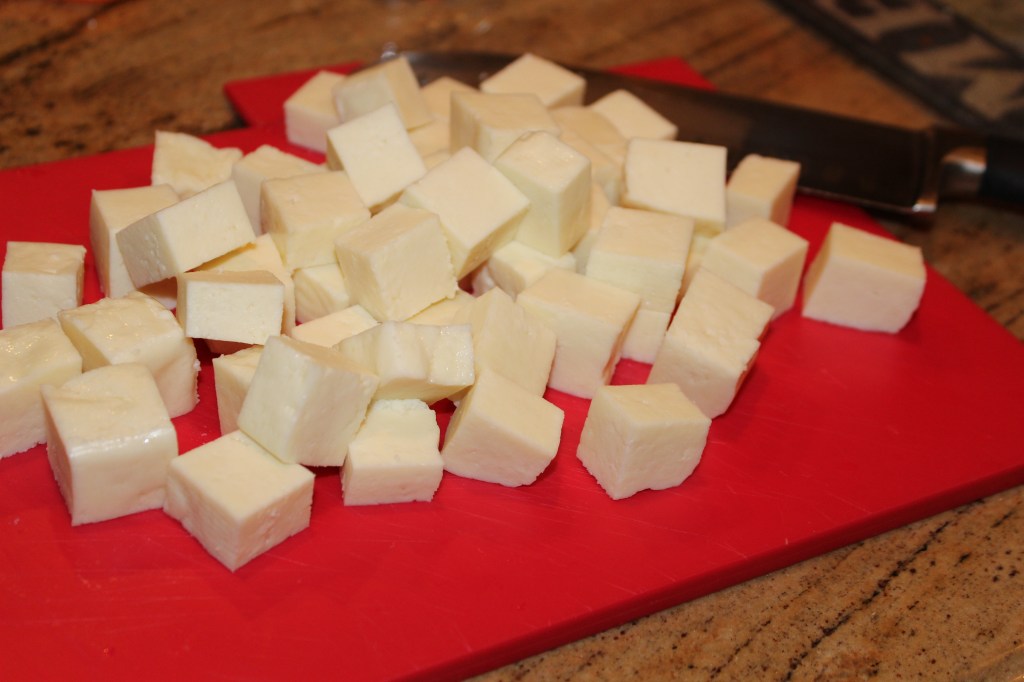
  • Begin by cubing the paneer.

Cube the paneer

Cube the paneer

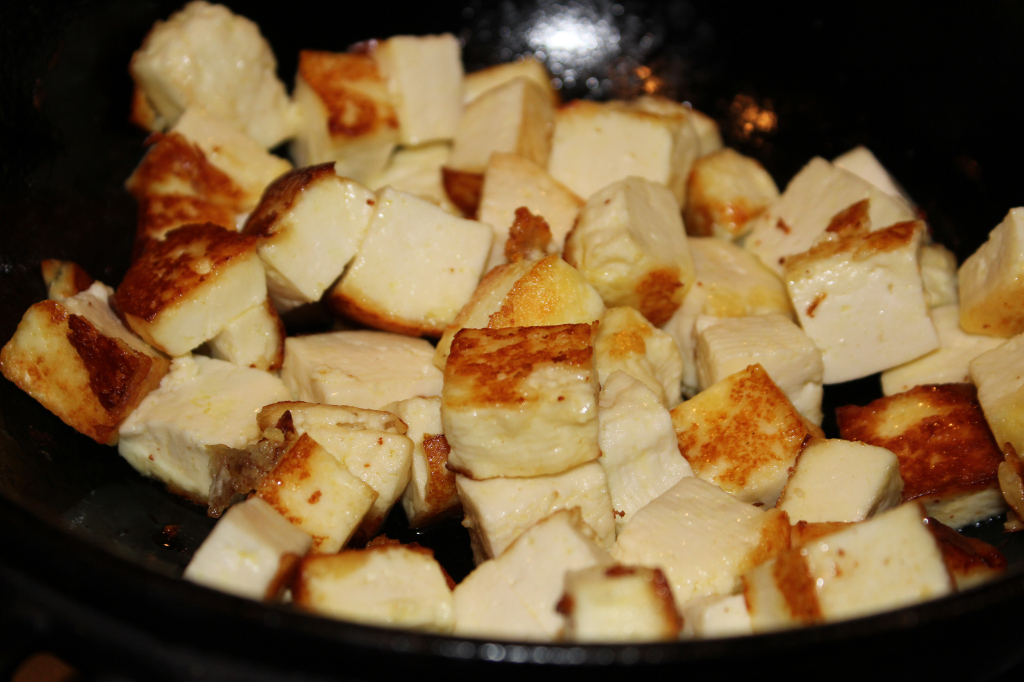
  • Fry the paneer pieces in 1-2 tbs oil in a well conditioned or non-stick pan until it is lightly golden.
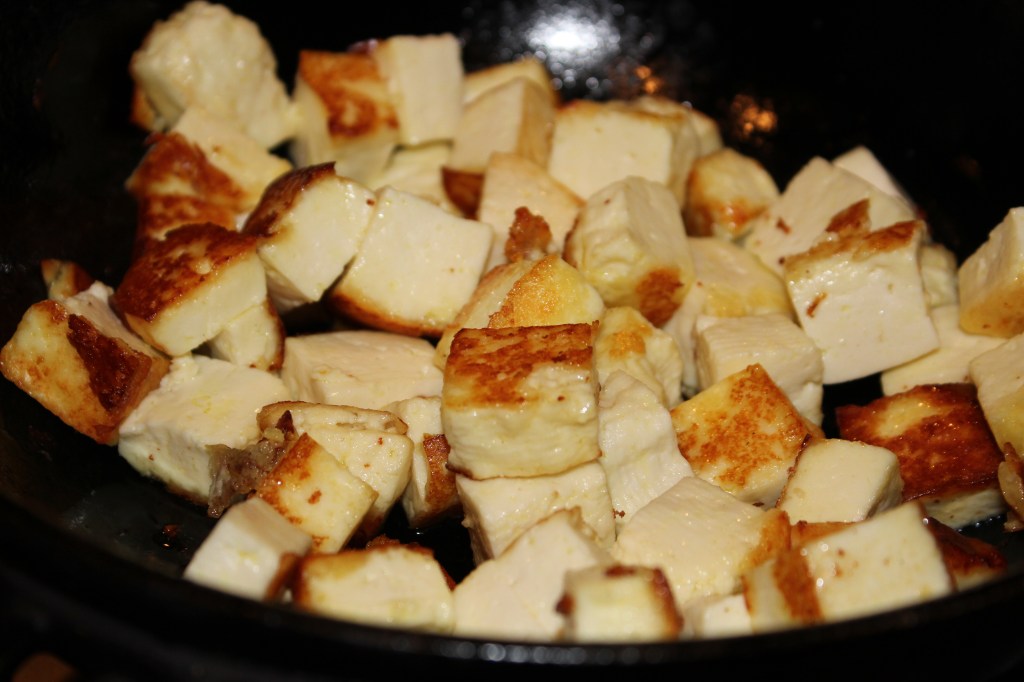
Shallow fry the paneer until golden brown

Shallow fry the paneer until golden brown

  • Transfer to a bowl of water. The excess oil floats away and the paneer stays moist instead of turning rubbery.
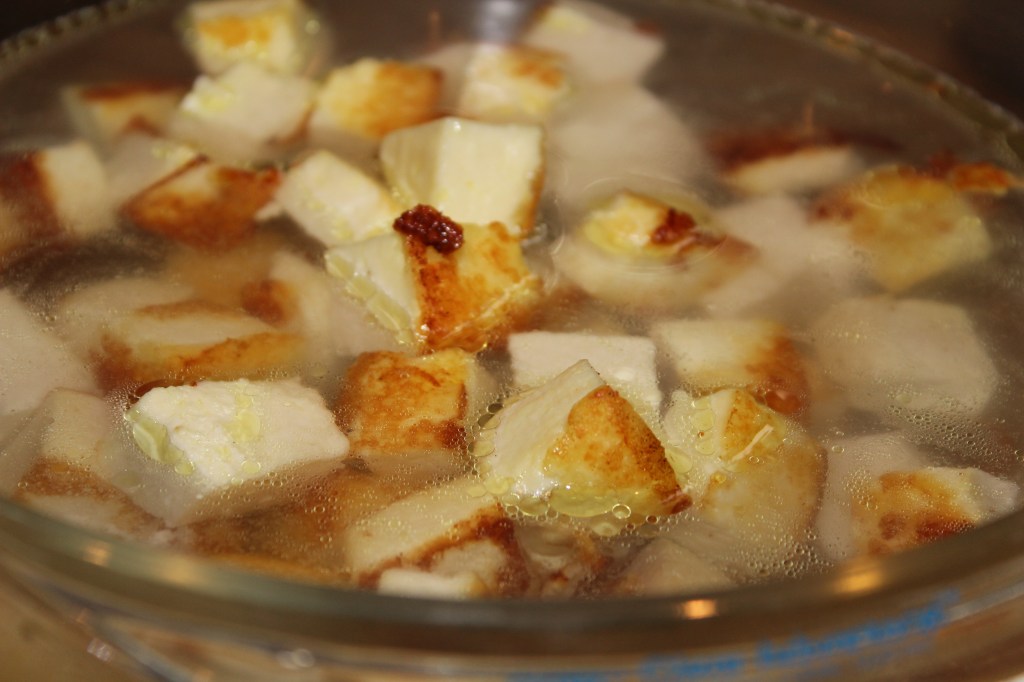
Transfer paneer to a bowl of water

Transfer paneer to a bowl of water

  • Roughly chop an onion, 2 cloves of garlic and an inch of ginger.
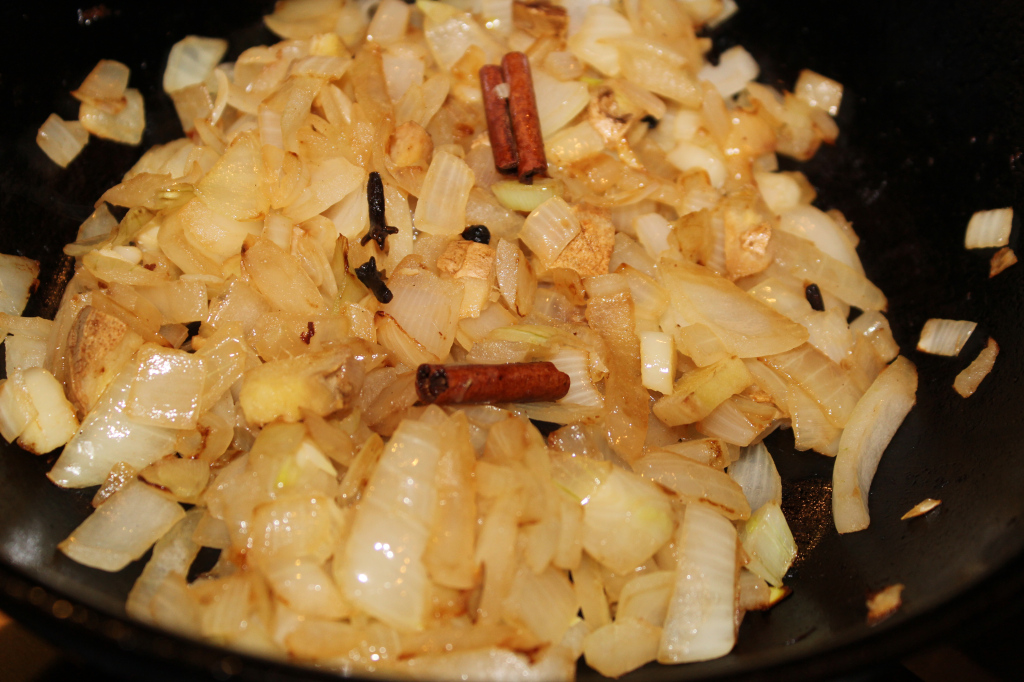
  • Add whole spices to a heated tablespoon of oil: a few cloves, peppercorns and short sticks of cinnamon. When the spices darken and release their fragrance, add the chopped aromatics.
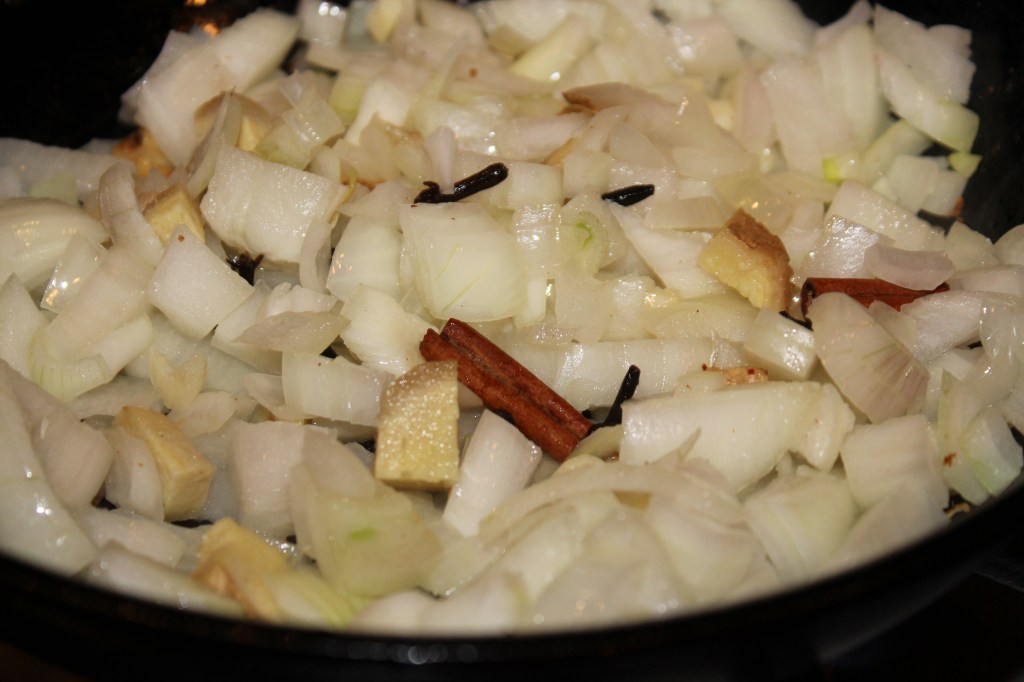
Add aromatics to the whole spices

Add aromatics to the whole spices

  • Saute on medium-high heat until lightly browned.
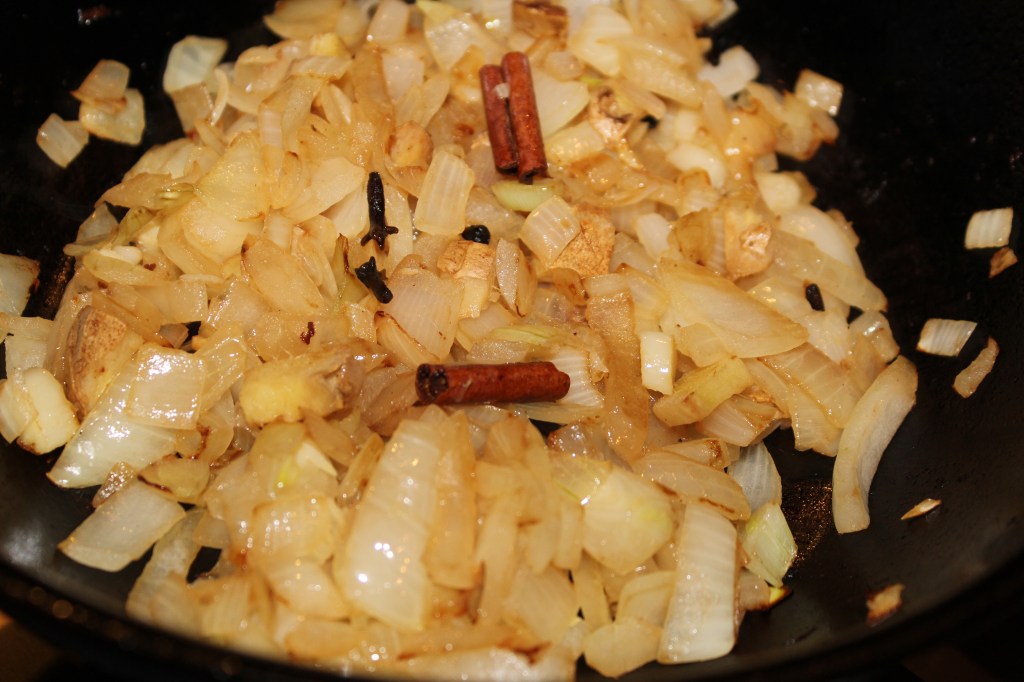
Lightly browned onions and spices

Lightly browned onions and spices

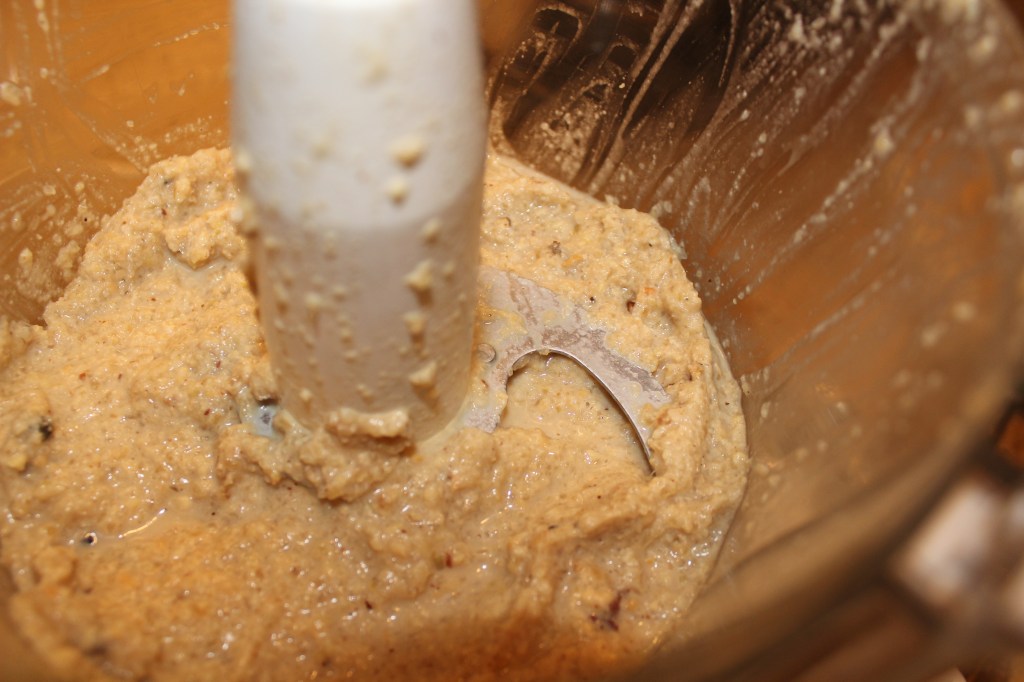
  • Transfer to a food processor and blend with a handful of roasted cashews. This is the basis of the gravy.
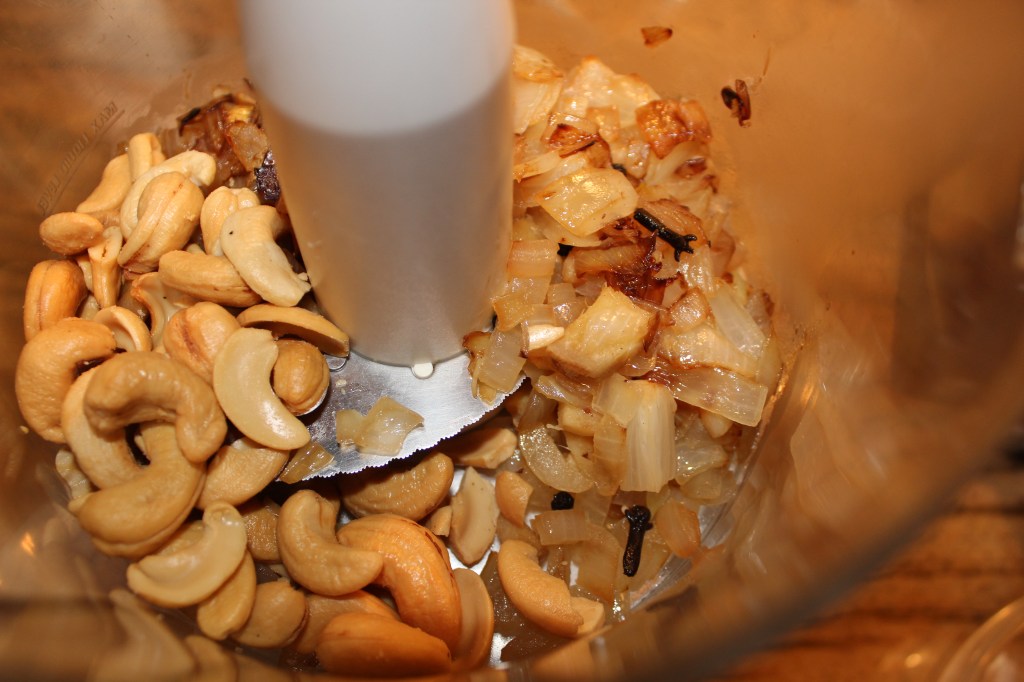
Add roasted cashews to the browned aromatics
Add roasted cashews to the browned aromatics

Gravy base

Gravy base

  • Back to the pan: to another tablespoon of oil, add cumin seeds, bay leaves and a couple of dry red chilies.
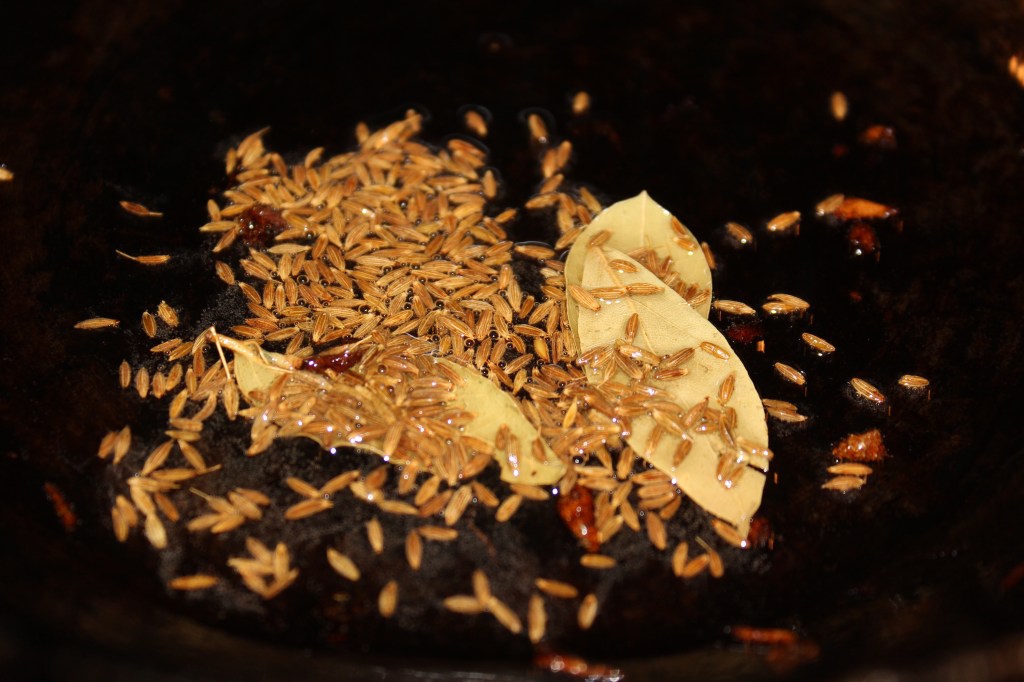
Roast whole spices: bay leaves, cumin and dry red chilies

Roast whole spices: bay leaves, cumin and dry red chilies

  • Next, add the gravy and heat through. It does not look appetizing at this point.
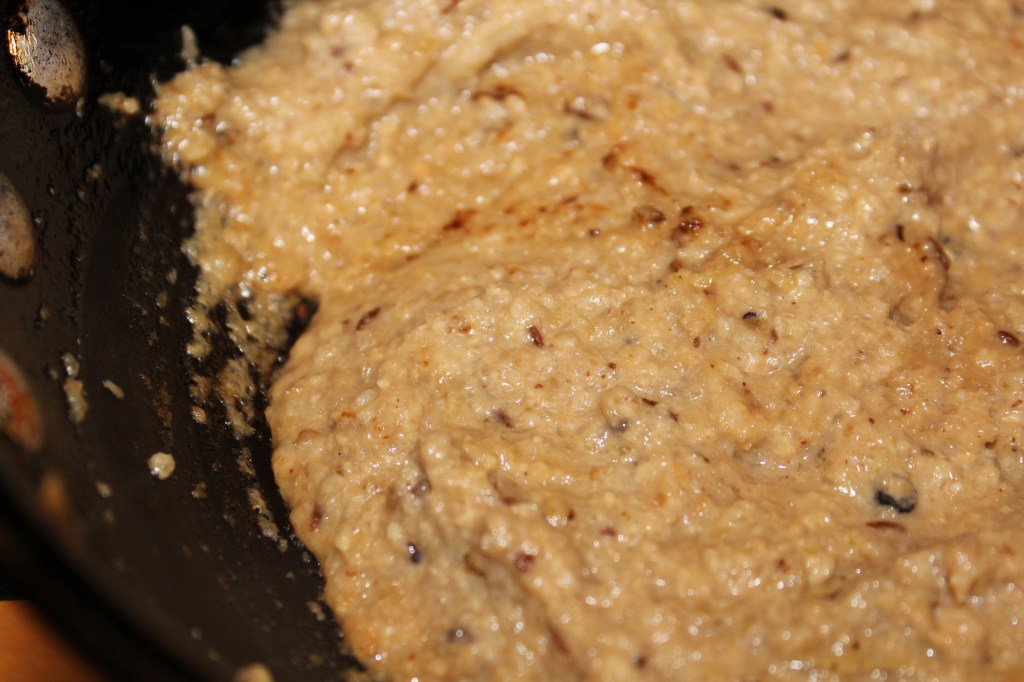
Simmering cashew-onion gravy base

Simmering cashew-onion gravy base

  • So add some turmeric, red chili powder and coriander powder. Season with salt and a pinch of sugar to bring out the sweetness of the peas. Add a cup of crushed tomatoes. Now it looks good, doesn’t it?
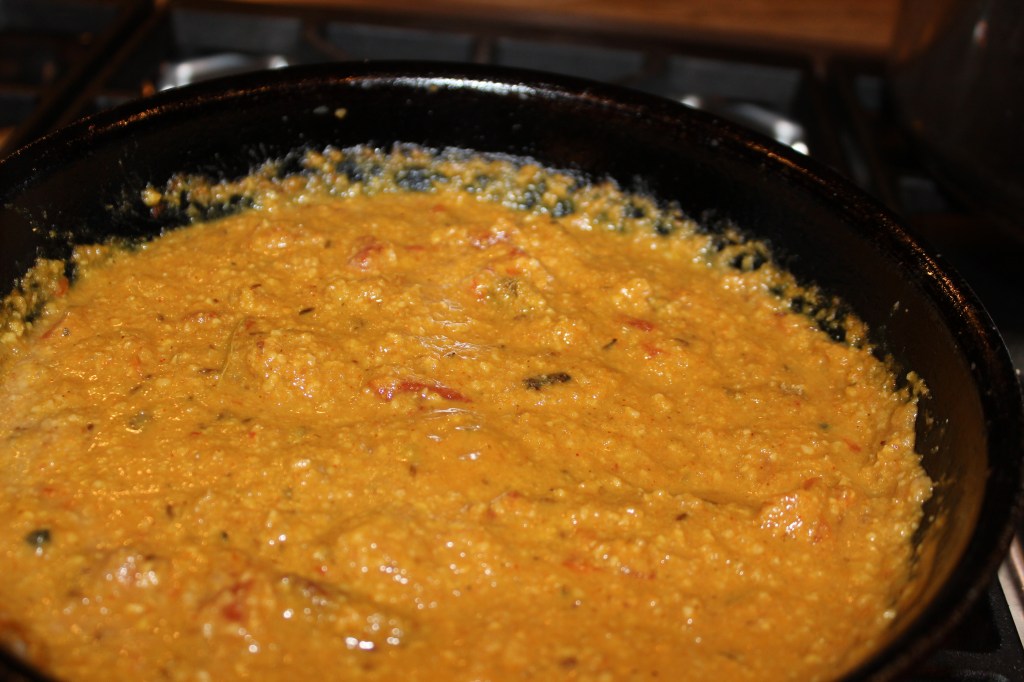
Doctored gravy: add tomatoes, turmeric and spices

Doctored gravy: add tomatoes, turmeric and spices

  • Gently fold in paneer cubes. Add frozen peas at this point, since they have already been blanched during the packing process. I used fresh peas this time, and I boiled them until they were tender but still freshly green. Garnish with chopped cilantro.
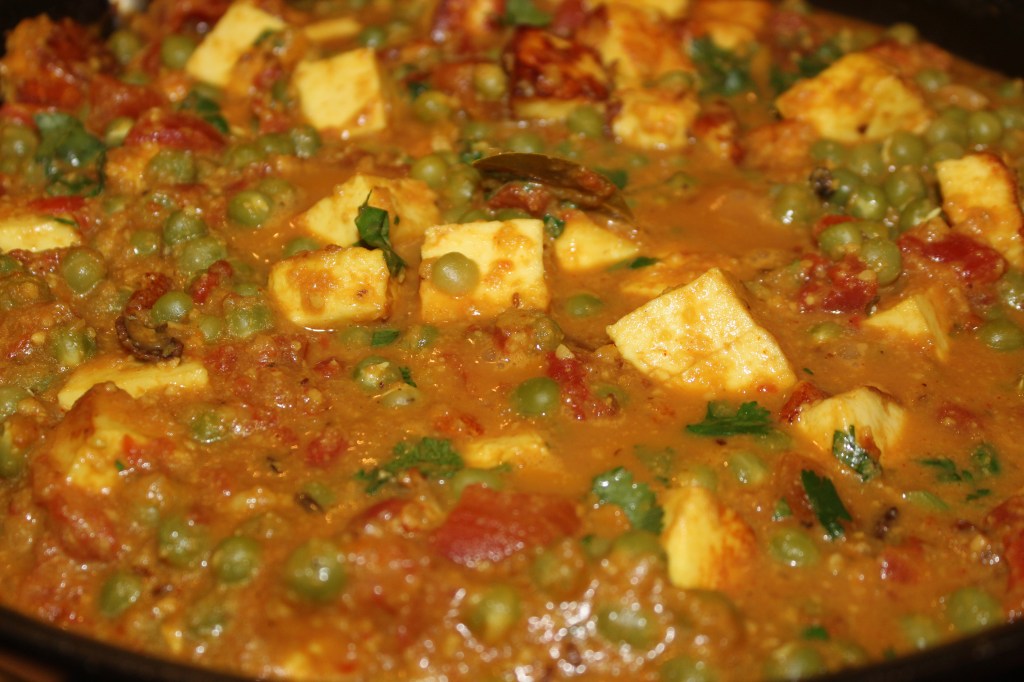
Fold in the peas and paneer

Fold in the peas and paneer

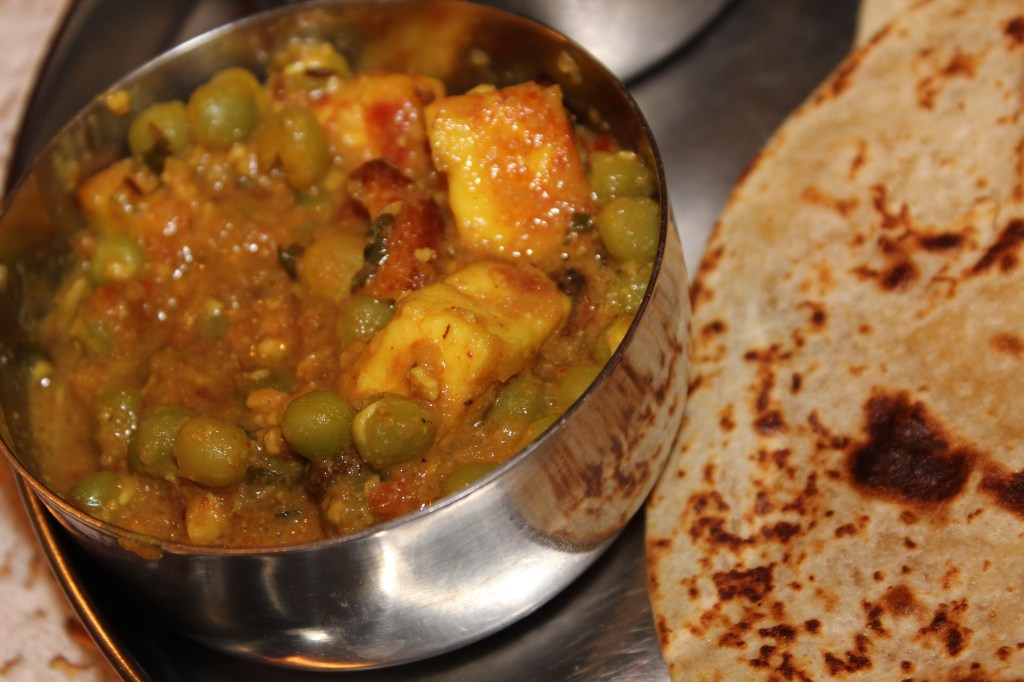
I served the Mattar Paneer with chappatis (Indian flat bread) and home made yogurt.
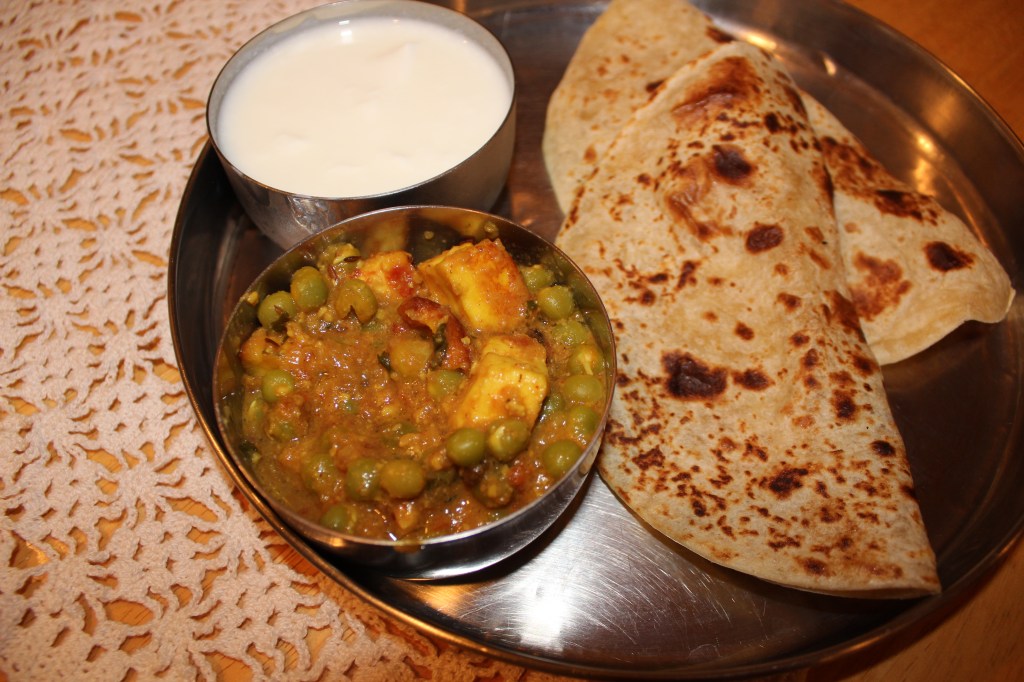
Mattar Paneer served with chappatis and yogurt

Mattar Paneer served with chappatis and yogurt

My most harrowing tale of protein denaturation harkens back to my graduate student days when I was studying the ATP synthase. I had grown 13 liters of E. coli in a fermentor (translation: buckets of bacteria), broken them in a scary high-pressure French Press, spent a couple weeks running between ultracentrifuges and cold room columns until finally, I had my prize- 185 mg of pure ATP synthase in a tube. I handed it, lovingly nestled in an ice bucket, to my collaborator, a senior postdoctoral fellow, who proceeded with the next step of dissociating the complex into its subunit proteins. As I watched in horror, the entire protein precipitated, irreversibly, into a white, insoluble mass! I stared accusingly at the postdoc, who quickly defended himself, “The water must be bad”. Before I could stop myself, I retorted, “The postdoc must be bad”. We’re still friends, 🙂 and I hope some day to dish up some mattar paneer and memories of precipitating proteins with Marwan.

In Memorium: I was deeply saddened to learn that Marc Ponomareff, a dear friend and frequent commentator on these posts, left us on Dec 3 after a long and courageous battle against cancer. Marc’s brilliant writing, humor and wit, and particularly the grace with which he bore his burden of illness will be sorely missed. We shared a love for spices, slapdash cooking and a zest for life. This one is for you, Marc.
Posted in FOOD, Humor, Indian food, Matar Paneer, science, Spices | Tagged , , , , | 11 Comments

Community of Science

Community of Science

Join the Community for #ScienceSunday and #ScienceEveryday .

Brought to you by the curators of ScienceSunday (Allison Sekuler , Robby Bowles , Buddhini Samarasinghe , Chad Haney , and Rajini Rao ).

Posted in Rajini Rao | Tagged , | 49 Comments