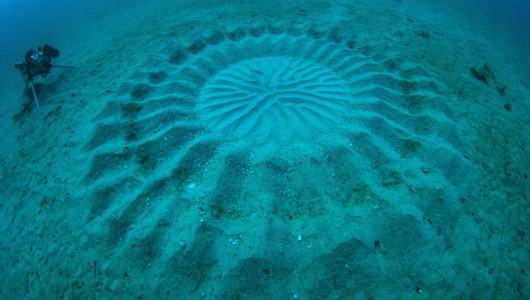
Labor of Love: Are these circles in the sand the work of some underwater aliens? The mystery of these elaborately crafted circles discovered by diver Yoji Ookata off the coast of Japan, has been solved. Spanning ~6.5 feet in diameter, they turned out to be the painstaking work of a tiny species of puffer fish. The male spends days ruffling the sand, decorating it with crushed shells, using only his fin as tool. The groovier the circle, the more females it attracted, to mate with and lay eggs in the center.
• As if puffer fish were not cool enough already! Considered the most poisonous vertebrate, second only to the golden poison frog, puffer fish (Fugu) are considered a culinary (if risky) delicacy.
• Tetrodotoxin is deadly, up to 1,200 times more poisonous than cyanide. There is enough toxin in one puffer fish to kill 30 adult humans, and there is no known antidote. The toxin works by targeting voltage gated sodium channels that are needed to fire neurons and trigger muscle contraction. Death usually occurs because the victim’s diaphragm is paralyzed so breathing stops.
• Highly elastic stomachs allow the puffer fish to quickly swallow huge amounts of water (or air) and transform into a virtually inedible ball several times their normal size.
More: http://goo.gl/Qf9qx
Puffer Fish photo by Chris Laughlin from Nat. Geo.
#scienceeveryday


 madame scientist's not-so-mad musings
wow! how interesting
Absolutely wow. Nature is so incredibly inventive and beautiful.
Michael Durwin , YES, bower birds also labor for love! (I’ve posted on them before, https://plus.google.com/u/0/114601143134471609087/posts/GvmyPKnmtrJ )
Fascinating. Another example of fact being stranger than fiction.
I have never heard of this creature before. Thanks, great share again! 🙂
How does the little fish have the perspective to draw such perfect circles? I’m a lot larger and I doubt if I could draw symmetrical 6 foot circles without a tool of sorts!
Creative
well, my number one males are fireflies (light in the butt is more impressive than the six packs) but I can put these cute guys second rank ; )
Luminescent lovers, alev uneri ? 🙂
The puffer shown is a porcupine puffer, not the same animal as either the fugu, nor is it the species that’s making these designs. Porcupine puffers can get to 2 foot, easily. The puffer family is large, and includes fresh water and brackish water species in addition to the marine ones. The dwarf fresh water puffer maxes out at less than one inch in length.
Rajini Rao re: perspective – indeed! Little critters must have excellent eyesight. What primary advantage could this set of skills have for the fish? Beats me!
The species making the circles are pictured in the link, Sheila Garl . They are indeed tiny. The image on the right was intended to show the stomach inflation (my third bullet point). Is it a porcupine puffer? Thanks! I’ll check back on the Nat. Geo. link to see if they identified it by name.
Fugu, the Japanese delicacy, refers to “Takifugu, Lagocephalus, or Sphoeroides, or porcupinefish of the genus Diodon”. They must all be of the same order, Tetraodontidae, I’m guessing, for the “four teeth”.
Jim Carver , you’ve talked about fish before..do you know more?
Read here: http://www.spoon-tamago.com/2012/09/18/deep-sea-mystery-circle-love-story/
The shown puffer is a porcupine, and one of the most easily recognized, but most puffers lack the spines of the porcupine. There is a pic of the puffer in action at the link.
Hey Sheila Garl , I have the same link in my post 😉
And yes–the order name comes from the teeth. They have impressive dentition, used to crack open snails, crabs, and shrimp. In the home aquarium, they are often fed soft foods and the teeth overgrow. Much like rats, their teeth are always being worn down and growing, so they require a diet of hard, crunchy foods.
Very cool that the teeth regenerate constantly!
It’s the only species able to eat Cap’n Crunch without lacerations! :-0
Yes Rajini Rao – I’m jealous of that. Want that as a feature in my Genome Makeover.
Hopefully, we don’t bloat up after eating cereal David Archer . What is the sea creature in your avatar?
Sea creature, Rajini Rao? Why, what sea creature? That’s me!
http://en.wikipedia.org/wiki/Enteroctopus_dofleini
I just posted it, Feisal Kamil . The little Google creatures who dash off notifications have it queued up, ready to go.
I would recognize you anywhere, David Archer , as the handsomest Enteroctopus in the sea.
Aw, Rajini Rao – you’re making my chromatophores flutter!
I love the design they make, art and nature, beautiful. 🙂
Fantastic story!
Powerpuff fish, go !
Thanks Rajni.You are providing very good information over the site.Good Luck and Happy days.
Thanks, Rajini Rao – you’re like a concentrated version of Wikipedia, all you need to know about the subject in a few brief but precise sentences 🙂
Haha, thanks Oleg Mihailik 🙂
Very appropriate musical choice, Peter Lindelauf . Exactly what the little fella in the circle would be singing.
Amazing !!!
Voltage gated sodium channels. I love neuroscience. 🙂
Jerry Nguyen , Ttx is a great tool for neuroscientists. The lab around the corner from mine has quite a stash of tetrodotoxin. I make sure to stay on the guy’s good side, just in case 😉
Ha! Very important. The number of neurotoxins that neuroscientists use is, literally, mind-boggling. 😉 The bonus is that you might be able to score some cheap Botox. (Not that you need it. I’m just talking personally here. 😀 )
Never say never is my motto Jerry Nguyen 🙂
We have an upcoming seminar by a scientist whose life’s work is extracting and purifying venom from spiders and snakes. Maybe I can get some botox at wholesale prices.
you don’t need it.
But worth the hard work in the end, AKILAN GANESAN 🙂
Wow it’s so nice.
informative
Amazing architect!
Unbelievable.
Awesome…
so god;;;;;;;;;;;;;;;;;;;;;;;;;;;
nice
Wish the female deserved that hard work and this not done only to keep the species .i really enjoyed that . Thnx Rajini Rao
Marvellous post, Rajini Rao!
“How does the little fish have the perspective to draw such perfect circles?” I think they don’t have that perspective at all, neither do they need it.
Perspective is needed for a complex spatial (or temporal) design when there is intelligence involved in its production. Not when it is an emergent phenomenon or a by-product of a simple mechanical process. Think beam robotics or fractals or snowflakes–or the humble kaleidoscope.
Oh, it’s very likely I’m mistaken about all this. Would be happy to learn more about the question you asked–from you or your informed G+ followers.
Wow..
Nature always fascinated one way or other, beauty at one side toxicity on other.
Nature keeps the balance.
Sunil Bajpai , I think you are on to something and I agree..it’s not that this fish has the “intelligence” to plan the geometrical beauty of the circles. I wonder how it tracks its movements along the sand bed so that it ends up making a perfect circle. Perhaps it moves at a constant speed and angle and that would be enough to make a circle?
At the risk of inflating your ego, Rashid Moore , I’m sure your lady fish admires your morning shadow 🙂
Rajini Rao, come to think of it, the lady fish must indeed have the perspective to see the geometrical beauty of the shadow, err…the circles. How else would evolution fine tune the speed and angle of the male dance to produces those patterns?
Fascinating. This warrants further investigation into the mating habits of male
humanserr, fish. 😉Rajini rao, u really have an amazing collection of scientific knowledge! I’m so glad I found this blog =D
Thanks a lot for sharing these amazing facts with us 🙂
Thank you, I’m so happy to hear this Uma Unni !
Goden ball fish.hello
I was right it is a puffer fish
That’s seems very interesting 😮
http://viutube.lk/mobile-video-editing-සිංහලෙන්kinemaster-sinhala-review_v13619
viutube.lk – Mobile video editing සිංහලෙන්.Kinemaster sinhala review.
https://www.fivestuniversal.com/p/top-5-living.html
fivestuniversal.com – LIVING